
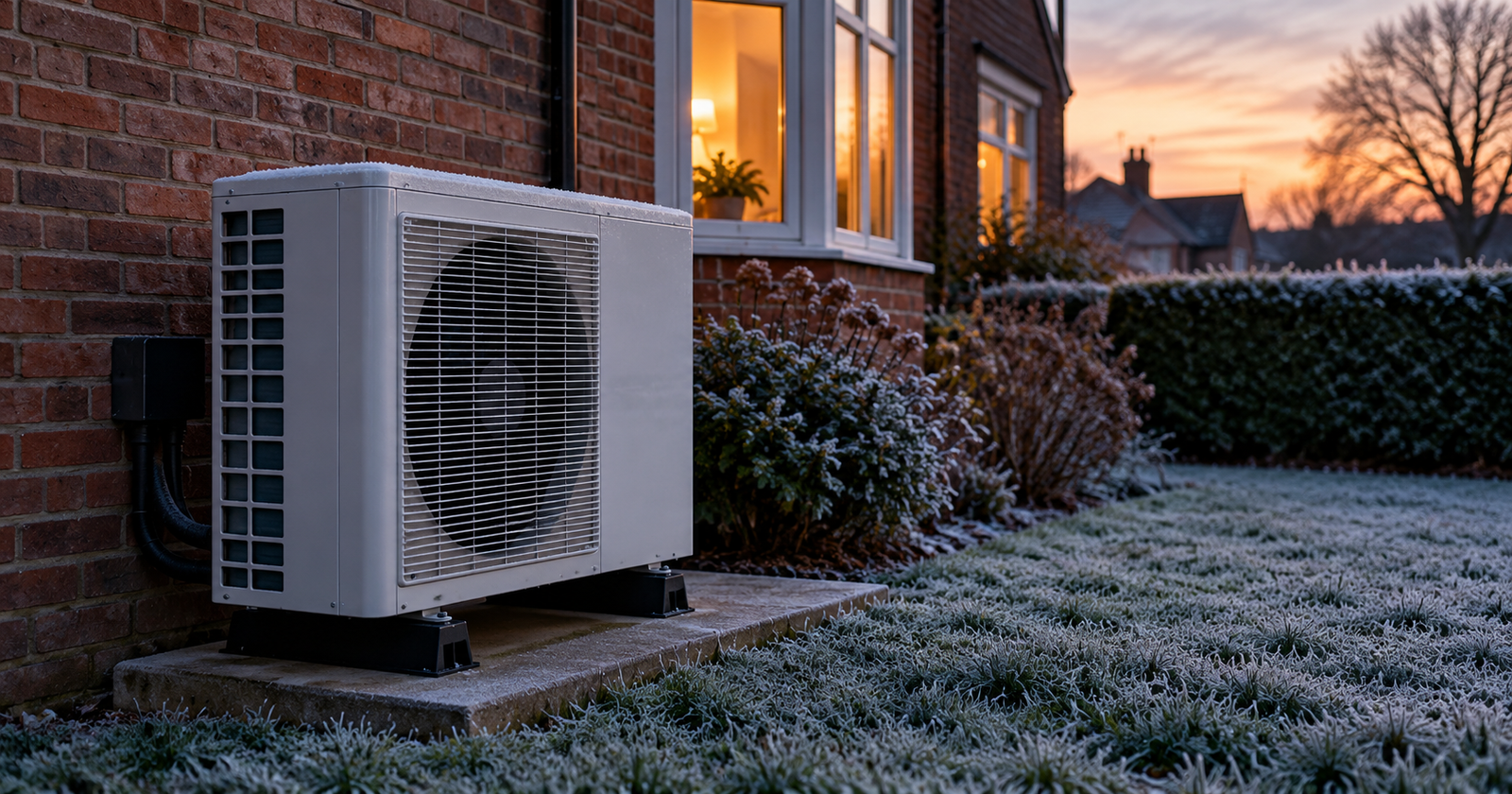
Before the First Cold Snap: A Winter Checklist for Heat Pump Owners
Seasonal Advice · Winter 2026

The short answer: before the first proper frost, spend half an hour on ten checks. Clear around the outdoor unit, learn what a normal defrost looks like, confirm your frost protection, leave the system switched on, check that weather compensation is working, check the pressure, bleed any cold radiators, review your hot water timing, check your tariff and book the annual service.
None of these checks involves opening the outdoor unit or touching refrigerant. They are the owner-level jobs that help a heat pump do what it was designed to do through a UK winter, and they help you spot the problems that do need an engineer before the coldest weeks arrive.
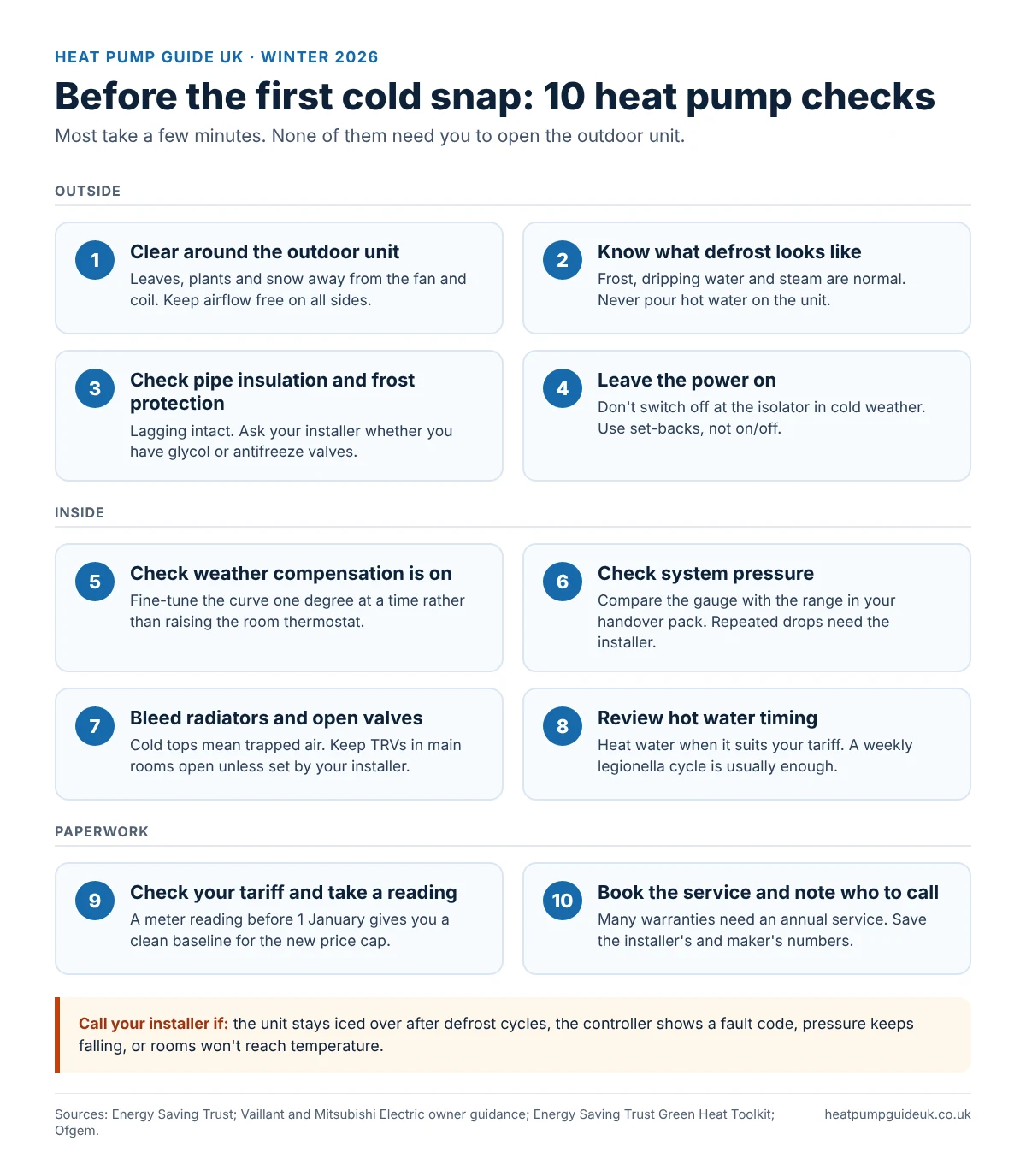
Checks 1–4: outside
1. Clear around the outdoor unit
An air source heat pump needs a free flow of air across its coil. Remove leaves, garden waste and plants growing close to the unit, and keep the area in front of the fan clear. After snowfall, gently brush snow away from the unit and its base so meltwater can drain. Mitsubishi Electric and Vaillant both list clearing leaves, snow and debris as basic winter care for their outdoor units.
Avoid wrapping or boxing the unit in for winter. If you want a canopy or cover, Vaillant’s advice is to make sure it has good ventilation and airflow. Anything that restricts airflow can reduce efficiency.
2. Know what a normal defrost looks like
In cold, damp weather, frost builds up on the outdoor coil. The heat pump clears it by running a short defrost cycle. While this happens you may see water dripping, a cloud of steam from the unit and the fan stopping for a few minutes. That is normal, and it is the system working as designed.
Vaillant, for example, says its de-icing cycle activates when the outside air drops below 2.5°C. Other manufacturers use their own settings. Whatever the make, do not pour hot water over the unit to clear ice. If the coil stays iced over after repeated defrost cycles, call your installer.
3. Check pipe insulation and frost protection
Look at the pipes running between the outdoor unit and the house. The insulation should be intact, with no split or missing sections. Damaged lagging lets heat escape and increases the risk of freezing.
Ask your installer, or check your handover pack, how your system is protected against freezing if the power goes off. The Energy Saving Trust’s installer guidance describes two common methods: adding glycol (antifreeze) to the water circuit, or fitting antifreeze valves that drain a small amount of water when it nears freezing. It describes frost protection as essential to avoid serious damage in a power cut or fault during freezing weather. If your system has antifreeze valves, make sure nothing is blocking where they discharge.
4. Leave the power on
The Energy Saving Trust advises that it is best to keep your heat pump on all the time, using a lower “set-back” temperature when you are out or asleep rather than switching it off. Heat pumps are designed to run steadily at a low temperature, not to blast heat in short bursts.
There is a safety reason too. Many outdoor units use their own controls to protect against frost, and that only works while they have power. Don’t switch off at the outdoor isolator during cold weather unless an engineer has told you to, and check your manual for your model’s frost protection arrangements.
Checks 5–8: inside
5. Check that weather compensation is on and sensibly set
Weather compensation adjusts the temperature of the water going to your radiators (the flow temperature) according to the outside temperature. It runs warmer on cold days and cooler on mild ones. Most well-set-up heat pumps rely on it.
The Energy Saving Trust says installers often set the heating curve higher than needed, and that some households can lower it without the home feeling too cold. Its suggested approach is to turn it down one degree at a time through the winter and nudge it back up by a degree if the house feels cold. If you are not sure how your controller works, ask your installer rather than guessing. Our heat pump temperature settings guide explains the main settings.
6. Check the system pressure
If your system has a pressure gauge on the indoor equipment or cylinder cupboard, compare the reading with the range in your handover pack or manual. Safe pressure ranges differ between systems, so use your own documents rather than a figure from the internet.
A one-off small drop after bleeding radiators can be normal. Pressure that keeps falling suggests a leak or a component problem and needs your installer.
7. Bleed radiators and check the valves
Turn the heating on and feel each radiator. One that is cold at the top and warm at the bottom usually has trapped air and needs bleeding. Check the pressure again afterwards.
Heat pump systems are often designed with radiator valves in the main rooms left fully open, so the heat pump can run steadily. If rooms that were warm last winter are now struggling, check that nobody has turned a valve down over the summer. Our guide to a heat pump not heating properly covers the next steps if a room still won’t warm up.
8. Review your hot water timing
Heating a cylinder takes more energy when the outside air is colder. The Energy Saving Trust suggests avoiding overnight hot water heating unless you are on a cheaper overnight time-of-use tariff, and says that for most households a weekly legionella (high-temperature) cycle is enough. If your system runs a daily cycle, ask your installer whether that is necessary for your household.
Checks 9–10: tariff and servicing
9. Check your tariff and take a meter reading
Under Ofgem’s price cap for 1 October to 31 December 2026, the average electricity unit rate for a Direct Debit customer is 26.32p per kWh, with a standing charge of 54.83p per day. Ofgem notes these figures exclude VAT, which the government has removed from electricity bills from 1 October 2026 to 31 March 2027. Your own rates depend on your region and tariff.
Ofgem will announce the cap for 1 January to 31 March 2027 on 25 November 2026. Take a meter reading (or check that your smart meter is sending readings) before 1 January, so your bill reflects the change accurately. It is also a good time to check whether a heat pump or time-of-use tariff suits your usage. See our heat pump tariffs guide and running costs guide.
If you have an energy monitor or your heat pump’s app reports energy use, note this month’s figures. A simple record of electricity used against outdoor temperature makes it much easier to tell later whether a high bill reflects the weather or a fault.
10. Book the annual service and note who to call
Manufacturers including Vaillant and Mitsubishi Electric recommend an annual service, and many warranties depend on one. If yours is due, book it now. Autumn and early winter are busy times for installers. Our servicing and maintenance guide explains what a service covers and typical costs.
Save your installer’s number, your manufacturer’s helpline and your warranty details somewhere you can find them on a cold Sunday evening.
When to call your installer
- the outdoor unit stays iced over after several defrost cycles;
- the controller shows a fault or error code (the Energy Saving Trust advises checking the fault log for recurring messages and not ignoring warnings);
- system pressure keeps dropping;
- rooms that used to reach temperature no longer do;
- the backup heater or “boost” seems to run often in ordinary winter weather. The Energy Saving Trust says frequent use can point to undersized radiators or an incorrect heating curve;
- you hear new grinding, rattling or banging noises.
Never remove the outdoor unit’s casing or touch the refrigerant circuit. Those jobs are for qualified engineers.
Will your heat pump cope with a cold snap?
A heat pump that has been properly designed for your home should keep it warm through normal UK cold spells. The government-funded Electrification of Heat demonstration project monitored 742 heat pumps. Its interim findings, published by Energy Systems Catapult in March 2023, found the median air source heat pump system efficiency on the coldest days, when mean daily temperatures fell as low as −6°C, was 244%. That was only a marginal drop from the overall median.
The same study found wide differences between individual installations, so a typical result is not a promise for any particular home. Efficiency does fall as it gets colder, and your heat pump will run for longer and use more electricity in January than in November. That is expected. Whether it signals a problem depends on the weather, your settings and your home’s heat loss. Our guide to whether heat pumps work in winter explains how cold-weather performance works, and heat pump not saving money covers what to check if your bills look wrong.
Winter heat pump FAQs
Is steam coming from my heat pump normal?
Usually, yes. Steam or vapour during a defrost cycle is normal in cold, damp weather. Contact your installer if the unit stays iced over or shows a fault code.
Should I cover my heat pump in winter?
Generally not. The outdoor unit is built to be outside, and anything that blocks airflow can reduce efficiency. If you want a canopy or cover, Vaillant’s advice is to make sure it has good ventilation and airflow. Check your manufacturer’s guidance before fitting one.
Should I turn my heat pump off when I go away in winter?
Check your manual first. Many controllers have a holiday or frost protection mode that keeps the system ticking over at a low temperature. Switching off the power entirely in freezing weather can leave the system relying on its backup frost protection.
Can I pour hot water on the outdoor unit to defrost it?
No. Let the unit’s own defrost cycle do the job. Pouring hot water on the unit is specifically warned against by manufacturers such as Vaillant. If ice is not clearing, call your installer.
About the author
David Tooth
Founder & Editor | Heat Pump Guide UK
Independent UK heat pump researcher
Heat Pump Guide UK provides independent homeowner research, not installation services or property-specific heating design. For problems with your own system, contact your installer or the manufacturer.
Sources
- Energy Saving Trust: The most efficient way to run a heat pump
- Energy Saving Trust Green Heat Toolkit: System volume and frost protection
- Ofgem: Changes to energy price cap between 1 October and 31 December 2026
- Energy Systems Catapult: Electrification of Heat interim findings (March 2023)
- Vaillant: How to look after your heat pump in winter
- Mitsubishi Electric: Ecodan homeowner FAQs
Sources checked 28 October 2026. Price cap figures change quarterly. Always follow your own manufacturer’s manual and installer’s advice for your system.