
UPDATED SEPTEMBER 2026
Air Source Heat Pump Running Costs UK: 2026 Guide
Understand what a heat pump could cost to run, when it can compete with gas and why system efficiency matters more than the electricity price alone.
broad annual range
gas break-even point
2026 energy prices

QUICK ANSWER
How Much Does a Heat Pump Cost to Run?
For many UK homes, an air source heat pump may cost roughly £600 to £1,500 per year to run. This is a broad planning range rather than a prediction of your own bill.
Government research also provides useful real-world context. Among Boiler Upgrade Scheme participants who replaced a gas boiler with a heat pump, lower total energy bills were reported substantially more often than higher bills. We look at those findings further down this guide.
Your Home’s Heat Demand
A property that loses twice as much heat needs roughly twice as much useful heating energy, regardless of the heat-pump brand.
Heat Pump Efficiency
The better the seasonal efficiency, the less electricity is needed to produce the same amount of useful heat.
Your Electricity Tariff
Every penny you reduce from the electricity unit rate reduces the cost of every kWh your heat pump consumes.
The number that matters most: cost per unit of useful heat
From 1 October 2026, Ofgem’s average Direct Debit electricity rate under the price cap is 26.32p/kWh, compared with 7.97p/kWh for gas.
Electricity therefore costs considerably more per unit, but an efficient heat pump can turn one unit of electricity into around three or more units of useful heat.
Compare Up to 3 Heat Pump Installers Near You
Tell us a little about your property to see installer options available in your area.
Free to use with no obligation
Electricity and Gas Prices From October 2026
Ofgem’s price cap for 1 October to 31 December 2026 gives the following average rates for households paying by Direct Debit in England, Scotland and Wales.
| Energy | Average Unit Rate | Average Standing Charge |
|---|---|---|
| Electricity | 26.32p/kWh | 54.83p/day |
| Gas | 7.97p/kWh | 29.68p/day |
Electricity VAT has temporarily been removed from domestic electricity bills from 1 October 2026 to 31 March 2027. The Ofgem electricity figure above therefore excludes VAT, while the gas rate includes 5% VAT.
Are Heat Pumps Cheaper to Run Than Gas Boilers?
They can be, but efficiency determines the answer. Comparing electricity and gas prices directly ignores the fact that a heat pump produces several units of useful heat from each unit of electricity.
| Heating System | Example Efficiency | Energy Needed | Approx. Energy Cost |
|---|---|---|---|
| Heat pump | SCOP 2.5 | 4,000kWh electricity | £1,053 |
| Heat pump | SCOP 3.0 | 3,333kWh electricity | £877 |
| Heat pump | SCOP 3.5 | 2,857kWh electricity | £752 |
| Gas boiler | 90% | 11,111kWh gas | £886 |
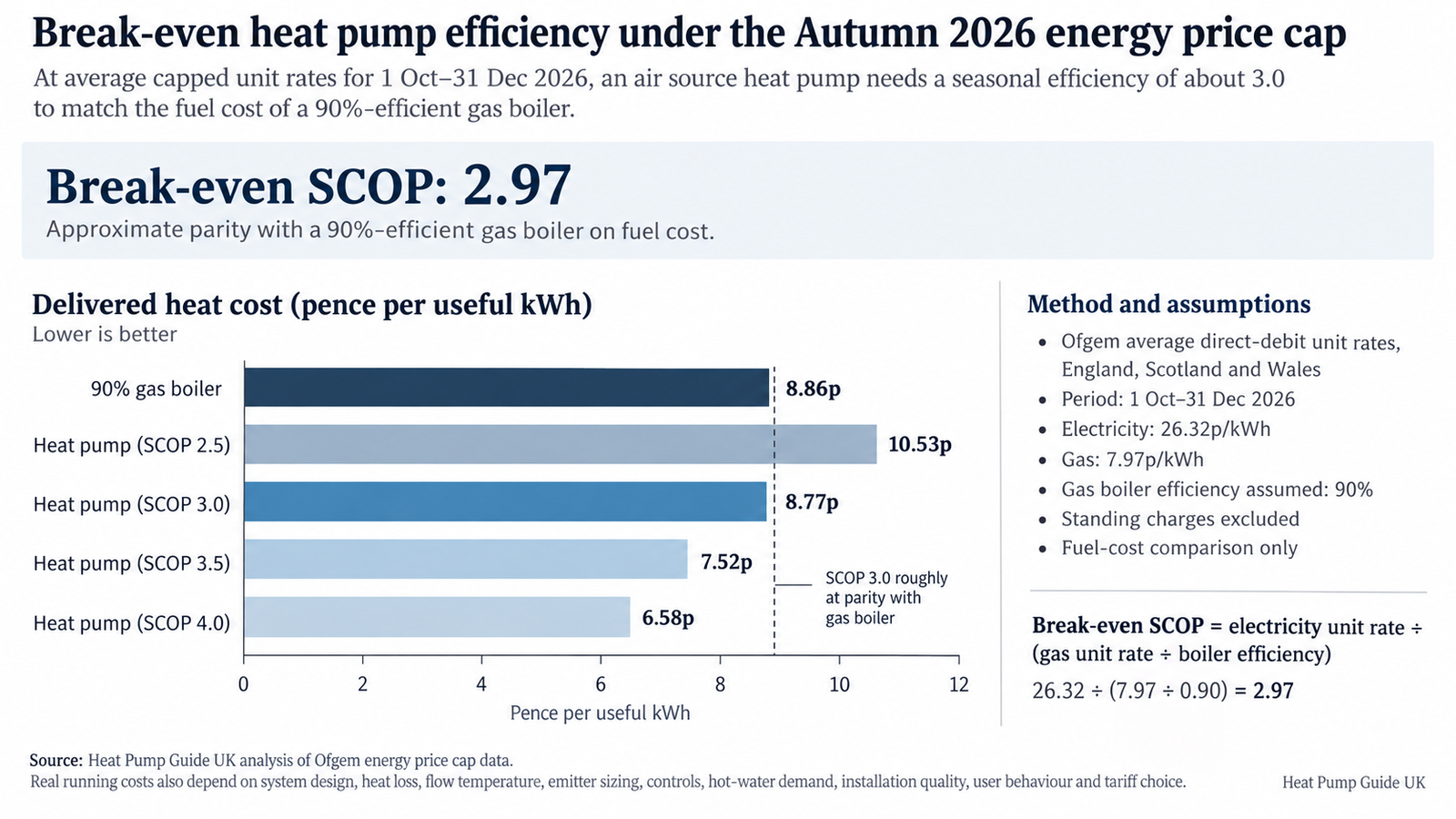
Current break-even point: approximately SCOP 3.0
Using the October 2026 average price-cap rates and an illustrative 90%-efficient gas boiler, a heat pump operating at a seasonal efficiency of roughly 3.0 produces useful heat at approximately the same energy cost.
Above that efficiency, the heat pump becomes cheaper in this simplified comparison. Below it, gas becomes cheaper.
What Do Heat Pump Owners Report About Their Energy Bills?
Modelled running-cost comparisons are useful, but they cannot tell us what every household experiences after switching. The government’s evaluation of the Boiler Upgrade Scheme provides useful real-world evidence from property owners who installed low-carbon heating.
Lower bills were reported more often than higher bills
Among Boiler Upgrade Scheme recipients who replaced a gas boiler with a heat pump, 50% reported that their total energy bills had decreased, compared with 15% who reported an increase.
This does not mean a heat pump will cut every household’s bills. It does, however, provide useful real-world evidence that lower overall energy bills are achievable for a meaningful proportion of households switching from gas.
Tariffs Can Change the Result
The BUS evaluation also examined changes in household energy tariffs after installation. Specialist heat-pump and time-of-use tariffs can alter running costs significantly compared with standard electricity tariffs.
Use the Evidence Alongside the Maths
Survey evidence should complement, rather than replace, the cost-per-unit-of-heat calculation above. A heat pump still needs sufficient seasonal efficiency for the electricity-to-gas price relationship to work in its favour.
WHY DESIGN MATTERS
The Same Heat Pump Can Cost More to Run in One Home Than Another
The efficiency printed on a manufacturer’s specification sheet does not determine your annual bill by itself.
The heating system surrounding the heat pump has a major influence on how hard the unit needs to work throughout the year.

UK Heat Pump Running Cost Index
Energy prices change every quarter, which means the efficiency a heat pump needs to compete with gas also changes.
Our Heat Pump Running Cost Index tracks the relationship between electricity prices, gas prices and heat-pump efficiency so homeowners can see how the economics move over time.
Autumn 2026: the gas break-even point
At October–December 2026 average Direct Debit price-cap rates, our simplified comparison puts energy-cost parity with a 90%-efficient gas boiler at approximately SCOP 3.0.
This matters because quoting an annual heat-pump bill without stating the assumed efficiency and energy price can be misleading. When assessing an installation proposal, use our heat-pump quote comparison checklist to ask about predicted performance and electricity use.
Typical Heat Pump Running Costs by Property Size
Bedroom count can provide a rough starting point, but it should never be treated as a prediction of your own energy bill.
| Property | Broad Annual Planning Range | What Matters Most |
|---|---|---|
| 2-bed house | £600–£900 | Heat loss, insulation and hot-water use |
| 3-bed house | £700–£1,200 | Heat demand and system efficiency |
| 4-bed house | £900–£1,500+ | Larger heated area and hot-water demand |
| Large or older property | £1,500+ | Higher heat loss can materially increase electricity use |
Why Can Two Heat Pumps Have Very Different Running Costs?
Property Heat Loss
Insulation, glazing, draughts, exposed walls, floor area and indoor temperature all affect how much heat the property needs.
Flow Temperature
The hotter the heating water needs to be, the harder an air source heat pump generally has to work.
Heat Pump Temperature Guide →Radiator Size
Larger emitters can provide the required room heat using lower water temperatures, helping the heat pump operate efficiently.
Do You Need New Radiators? →Controls
Weather compensation, sensible schedules and properly configured controls can avoid unnecessarily high operating temperatures.
Compare Heat Pump Controls →Hot Water
Cylinder temperature, household usage and immersion-heater operation can all add to annual electricity consumption.
Electricity Tariff
Standard, fixed, time-of-use and specialist heat-pump tariffs can produce very different running costs from identical electricity use. Compare the current options in our heat pump tariffs guide. If you have solar panels or a home battery, see our heat pump with solar and battery guide for how much they can realistically reduce running costs.
Compare Up to 3 Heat Pump Installers Near You
Tell us a little about your property to see installer options available in your area.
Free to use with no obligation
How Do Heat Pump Running Costs Compare With Other Heating?
Gas Boiler
A sufficiently efficient heat pump can compete with gas, but the result is sensitive to the electricity-to-gas price ratio.
Gas Boiler to Heat Pump →Heating Oil
Oil prices move independently of domestic electricity and gas prices, so the comparison varies over time and by the price you pay for oil.
Oil Boiler to Heat Pump →LPG
LPG-heated off-grid homes are worth assessing individually because fuel costs and existing system efficiency can vary considerably.
LPG Boiler to Heat Pump →Direct Electric Heating
Direct electric heaters convert electricity into heat at roughly one-for-one, whereas a heat pump can provide several units of heat from each unit of electricity.
Do Heat Pumps Cost More to Run in Winter?
Usually, yes. Your home loses heat faster when the temperature outside falls, so every heating system has more work to do during colder weather.
Air source heat pumps can also become less efficient as the outdoor temperature falls because there is a greater temperature difference between the outside air and the heating water.
That does not mean a heat pump has stopped working properly. What matters more is its performance across the whole heating season rather than its efficiency on one particularly cold day.
How to Reduce Heat Pump Running Costs
A properly commissioned heat pump should not need constant adjustment, but several factors are worth checking if you want to keep electricity consumption under control.
When Is a High Heat Pump Bill a Sign of a Problem?
A higher winter electricity bill does not automatically mean something is wrong. Cold weather naturally increases heating demand.
High consumption becomes more concerning when comfort is poor too.
If electricity use appears unusually high while rooms are still difficult to heat, it is worth investigating the setup rather than simply assuming heat pumps are expensive to run.
Backup Heating
Frequent immersion or electric backup-heater use can materially increase consumption.
High Flow Temperatures
A system constantly operating much hotter than expected may use substantially more electricity.
Frequent Cycling
Repeated starting and stopping can point towards control, sizing or system-volume issues worth investigating.
Uneven Comfort
Rooms that remain cold while others overheat can indicate balancing, emitter or control problems.
Compare Up to 3 Heat Pump Installers Near You
Tell us a little about your property to see installer options available in your area.
Free to use with no obligation
RUNNING COST QUESTIONS
Frequently Asked Questions
How much does a heat pump cost to run in the UK?
A broad planning range for many UK homes is around £600 to £1,500 per year. Actual costs can be lower or higher depending on property heat demand, heat-pump efficiency, electricity price and hot-water use.
What is the electricity price from October 2026?
Ofgem’s average Direct Debit electricity rate under the price cap from 1 October to 31 December 2026 is 26.32p/kWh. Actual rates vary by region, tariff and payment method.
Are heat pumps cheaper to run than gas boilers?
They can be. Using October 2026 average price-cap rates, a sufficiently efficient heat pump can have similar or lower energy costs than an efficient gas boiler.
Do real heat pump owners report lower energy bills?
Some do. Government Boiler Upgrade Scheme evaluation data shows that among grant recipients replacing a gas boiler with a heat pump, 50% reported lower total energy bills and 15% reported higher bills. These are self-reported outcomes rather than guaranteed or metered savings.
What SCOP does a heat pump need to beat gas?
At October 2026 average price-cap rates, our simplified example using a 90%-efficient gas boiler gives energy-cost parity at approximately SCOP 3.0. This is not a household savings forecast.
Why is my heat pump expensive to run?
Possible causes include high property heat loss, high flow temperatures, undersized radiators, poor controls, excessive backup-heater use, hot-water settings, electricity tariff or system design and commissioning issues.
Can a heat-pump tariff reduce running costs?
Potentially. Specialist and time-of-use tariffs can provide cheaper electricity during particular periods, but the benefit depends on when and how your household uses electricity.
INDEPENDENT GUIDANCE
About the Author
Practical independent guidance for UK homeowners comparing heat-pump costs, efficiency, equipment and installers.
Sources & Further Reading
Energy-price figures on this page were checked against Ofgem’s published price-cap rates for 1 October to 31 December 2026. Real-world homeowner evidence was checked against the Department for Energy Security and Net Zero’s final 2026 evaluation of the Boiler Upgrade Scheme.
Related Heat Pump Guides
Installation Costs
See what an air source heat pump costs to install before and after current grants.
Air Source Heat Pump Costs →Running Cost Index
Track how changing electricity and gas prices affect heat-pump break-even efficiency.
UK Running Cost Index →Are Heat Pumps Worth It?
Compare installation cost, running costs, grants and practical suitability together.
Are Heat Pumps Worth It? →Best Heat Pumps
Compare seven current UK air source heat-pump ranges and the applications where each stands out.
Best Air Source Heat Pumps →Work Out Your Own Heat Pump Running Costs
National averages are useful for understanding the market, but your home’s heat demand, system efficiency and electricity tariff matter much more.