
Air-to-Air Heat Pump Cost UK: Installation & Running Costs
See what air-to-air heat pumps can cost in the UK, how the £2,500 Boiler Upgrade Scheme grant changes the numbers, what affects multi-room quotes and how to compare potential running costs.
- Updated for 2026
- £2,500 grant explained
- Installation & running costs

How Much Does an Air-to-Air Heat Pump Cost?
Energy Saving Trust currently gives indicative costs of around £1,900 to heat one room and around £3,700 for a three-bedroom semi-detached home.
Those figures are useful benchmarks rather than guaranteed quotes. The actual price depends heavily on how many rooms need heating, the number and type of indoor units, outdoor equipment, pipe routes, electrical work and whether the installation is intended to become the home’s main heating system.
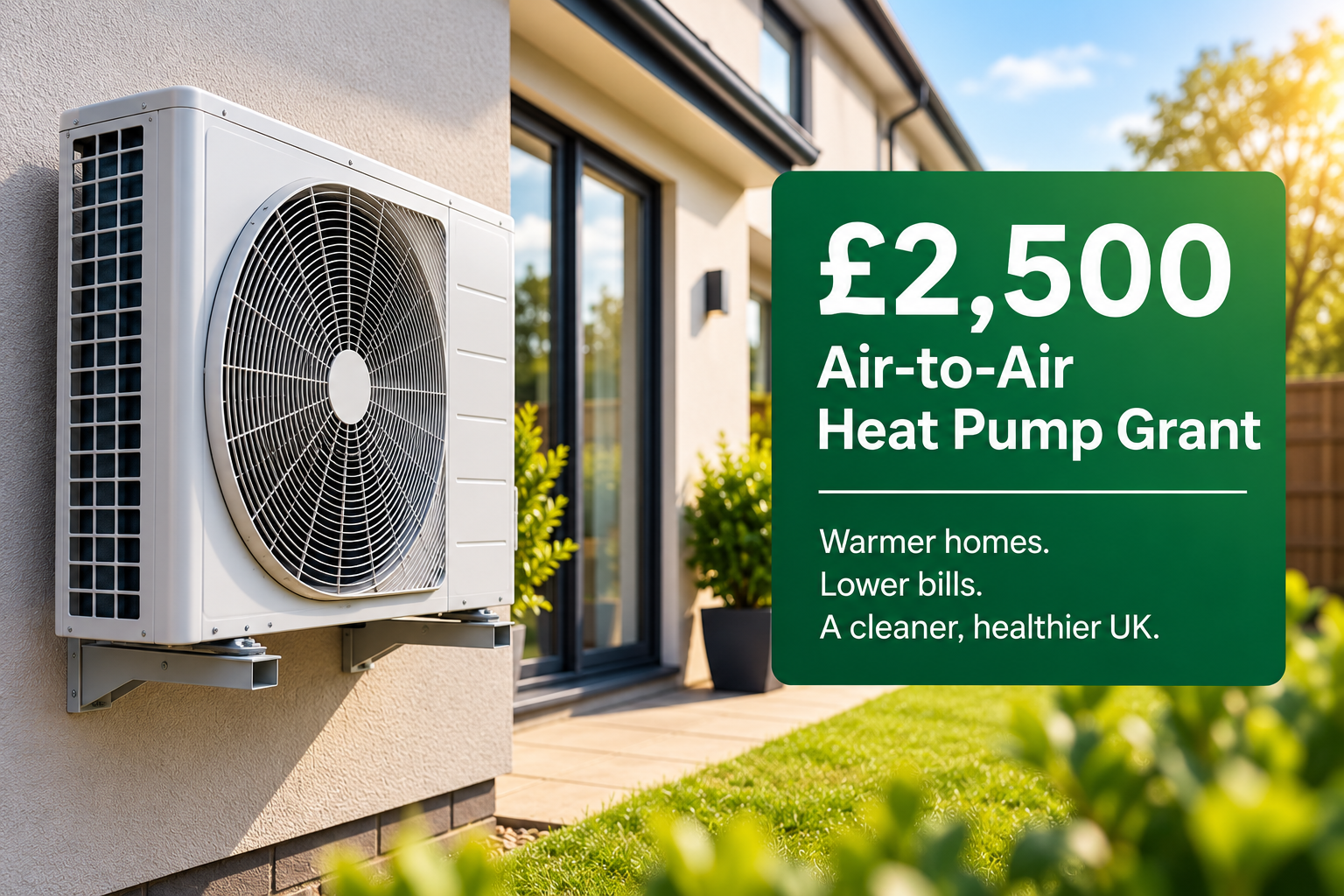
Eligible residential air-to-air heat pump installations in England and Wales can currently receive a £2,500 Boiler Upgrade Scheme grant.
Typical Air-to-Air Heat Pump Costs
| Example | Current EST indicative cost | What it represents |
|---|---|---|
| Single room | Around £1,900 | Heating one room with an air-to-air system |
| Three-bedroom semi-detached home | Around £3,700 | A broader multi-room domestic installation |
Energy Saving Trust also notes that additional work such as redecoration can add to the total cost.
Why we do not give a £6,000, £8,000 or £10,000 “typical” whole-home price
There is not yet a sufficiently reliable standard UK market benchmark for every larger multi-room configuration. Complex installations can certainly cost more than the Energy Saving Trust examples, but the price should come from the actual design rather than an invented bedroom-to-price formula.
What Could Air-to-Air Cost for Your Home?
A headline average cannot account for your number of bedrooms, current heating system, property type or the grant support that may apply.
Use our calculator to enter information about your own home and explore the costs and available support that are most relevant to your situation.
Calculate Your Heat Pump Costs & Grant →What Are You Actually Paying For?
An air-to-air installation is more than an outdoor unit and a wall-mounted fan.
Indoor units
Each room or zone that needs direct heating and cooling may need its own appropriately sized indoor unit.
Outdoor equipment
The design may use one single-split outdoor unit, a multi-split system or more than one outdoor unit.
Refrigerant pipework
Insulated refrigerant lines need to connect indoor and outdoor equipment, sometimes across several floors.
Condensate drainage
Indoor units need suitable drainage for condensation produced during cooling and some operating modes.
Electrical work
Electrical supplies, isolators and associated work need to suit the equipment being installed.
Design and commissioning
A system intended as primary heating needs proper sizing, commissioning, controls and testing rather than simply choosing units by room size.
Why Can Air-to-Air Installation Costs Vary So Much?
Number of rooms
A single open-plan room is very different from a traditional house with several bedrooms and closed doors.
Single-split or multi-split
Connecting several indoor units to one outdoor system can reduce outdoor-unit numbers but can make pipework and system design more complex.
Pipe routes
A short run through one external wall is much easier than routing several refrigerant lines between floors and around a finished home.
Indoor-unit type
Wall-mounted units are only one option. Floor units, ceiling cassettes and concealed ducted systems can change both the design and price.
Electrical requirements
The existing electrical installation and the proposed equipment determine whether additional work is needed.
Whole-home heating design
If the system is replacing the existing heating system, it needs to meet the property’s actual space-heating requirement rather than simply provide comfort in selected rooms.
If your main priority is cooling rather than replacing your heating, our Air Conditioning Cost UK guide is the better starting point.
Single-Split vs Multi-Split Costs
Single-split
One outdoor unit connects to one indoor unit.
This is commonly considered for:
- A bedroom
- Living room
- Home office
- Garden room
- Loft conversion
It is generally the simplest form of fixed air-to-air installation.
Multi-split
Several indoor units connect to an outdoor system, subject to the equipment’s design and capacity.
This can suit:
- Several bedrooms
- Multi-room heating and cooling
- Whole-home projects
- Homes where fewer outdoor units are preferred
Costs generally rise as the number of indoor units, pipe routes and installation complexity increase.
Multi-split is not automatically cheaper than several smaller systems. The right arrangement depends on equipment, pipe lengths, property layout and how independently different rooms need to operate.
See our Air-to-Air Heat Pumps UK guide for more on system layouts.
What Does a Whole-House Air-to-Air System Cost?
Whole-home installations are where simple online price ranges become least reliable.
An air-to-air system has to distribute warm air to the rooms being heated. In a traditional property with several enclosed rooms, this can require multiple indoor units and potentially more than one outdoor system.
A whole-home design might use:
- Several single-split systems
- One or more multi-split systems
- Concealed ducted equipment
- A combination of different indoor-unit types
Compare the heating design, not just the number of units
A cheaper proposal is not necessarily better value if parts of the home cannot be heated adequately. If air-to-air will become your primary heating system, ask how the proposed installation meets the calculated heat demand of the property.
Can You Get the £2,500 Air-to-Air Heat Pump Grant?
Yes. Eligible residential air-to-air heat pump installations in England and Wales can currently receive £2,500 through the Boiler Upgrade Scheme.
Ofgem administers the scheme and the grant is applied through the installer rather than being paid directly to you.
It is not simply a £2,500 air-conditioning voucher
Installing a reversible split air conditioner does not automatically make the project eligible for BUS support.
The property, equipment and installation need to satisfy the scheme’s current eligibility and technical requirements.
The standard BUS support levels are currently:
| Technology | Current standard grant |
|---|---|
| Air-to-air heat pump | £2,500 |
| Air-to-water heat pump | £7,500 |
| Ground source heat pump | £7,500 |
For the full eligibility rules, see our Heat Pump Grants UK guide.
What Could an Eligible Installation Cost After the £2,500 Grant?
The easiest way to understand the grant is to subtract £2,500 from the eligible installation price.
| Example eligible quote | BUS grant | Simple amount remaining |
|---|---|---|
| £5,000 | £2,500 | £2,500 |
| £7,500 | £2,500 | £5,000 |
| £10,000 | £2,500 | £7,500 |
These are arithmetic examples only. They are not typical installation prices and do not mean an installation at those values will automatically qualify.
Does the £9,000 off-grid grant apply?
No. Eligible air-to-air installations remain at £2,500, including qualifying off-gas-grid properties.
The temporary £9,000 grant applies to eligible air-to-water and ground source heat pumps in off-gas-grid homes replacing oil or LPG.
Which Heat Pump Grant and Cost Could Apply to You?
Your current heating system, property and chosen heat-pump technology can materially change the available grant and overall cost comparison.
Use our calculator to enter your own circumstances before comparing installer quotes.
Check Your Costs & Grant →Compare Up to 3 Air-to-Air Heat Pump Installers Near You
Tell us a little about your property to see installer options available in your area.
Free to use with no obligation
How Much Does an Air-to-Air Heat Pump Cost to Run?
There is no reliable single annual running-cost figure for every home.
Air-to-air systems use electricity to move heat rather than producing all of their heat through direct electric resistance.
Basic running-cost relationship
Useful heat required ÷ seasonal heat-pump efficiency × electricity unit price = approximate space-heating electricity cost.
The result depends on:
- Property heat loss
- Rooms being heated
- Outdoor temperatures
- Indoor temperature settings
- Actual seasonal system efficiency
- Equipment sizing
- Indoor-unit positioning
- Controls and usage
- Installation quality
- Your electricity tariff
- Summer cooling use
- How domestic hot water is produced
For the Ofgem price-cap period from 1 October to 31 December 2026, the average Direct Debit electricity unit rate is 26.32p/kWh.
Your own tariff can be different, and households on fixed tariffs are not necessarily paying the price-cap unit rate.
Air-to-Air Heat Pump vs Gas Boiler Running Costs
Comparing the electricity and gas unit rates alone does not tell you which heating system will cost less.
For 1 October to 31 December 2026, Ofgem’s average Direct Debit price-cap rates are:
| Fuel | Average unit rate |
|---|---|
| Electricity | 26.32p/kWh |
| Gas | 7.97p/kWh |
Electricity therefore costs substantially more per purchased kWh, but a heat pump can deliver several units of useful heat for each unit of electricity it consumes.
A gas boiler, meanwhile, cannot convert every purchased kWh of gas into useful room heat.
Why there is no universal winner
The result depends on your home’s heating requirement, the heat pump’s actual seasonal efficiency, the efficiency of the boiler being replaced, electricity and gas tariffs, hot-water production and how the systems are used.
We therefore do not assume that switching from mains gas to air-to-air will automatically reduce your bills.
How Could Air-to-Air Compare With Your Current Heating?
The most useful comparison is based on the heating system you already have rather than a generic UK average.
Use our calculator to compare your current heating with a heat pump using information about your own home and current fuel.
Compare Your Heating Costs →For the wider methodology, see our Heat Pump Running Costs UK guide.
Air-to-Air vs Direct Electric Heating
This can be one of the most relevant comparisons for air-to-air.
Panel heaters, electric radiators and similar resistance heaters use purchased electricity to produce heat directly.
An air-to-air heat pump uses electricity to transfer additional heat from outdoor air into the property. When operating efficiently, it can therefore require less electricity to provide the same quantity of useful space heat.
That does not guarantee a particular saving. The result still depends on the home, system design, usage and tariff.
What About Oil and LPG Heating?
Air-to-air can also be considered in off-gas-grid homes currently heated by oil or LPG.
However, the current grant difference becomes particularly important.
Eligible air-to-air
Current BUS support remains £2,500.
Eligible air-to-water or ground source
Qualifying off-gas-grid properties replacing oil or LPG can currently receive £9,000 until 31 March 2027.
An off-grid homeowner therefore needs to compare the post-grant total system cost, not simply which technology has the cheaper headline installation price.
See our Heat Pump Grants UK guide for the current scheme details.
Does Air-to-Air Need New Radiators?
No. Air-to-air heat pumps distribute heat through indoor fan units or ductwork rather than a wet radiator circuit.
This can avoid radiator-upgrade costs associated with some air-to-water conversions.
Instead, you need to consider:
- Number and position of indoor units
- Heating coverage with doors closed
- Refrigerant pipe routes
- Condensate drainage
- Indoor airflow
- Fan noise
- Visual appearance
If radiator replacement is a significant part of an air-to-water quote you are comparing, see Do You Need New Radiators for a Heat Pump?.
Air-to-Air vs Air-to-Water Heat Pump Costs
| Cost factor | Air-to-Air | Air-to-Water |
|---|---|---|
| Heat distribution | Indoor fan units or ducts | Radiators or underfloor heating |
| Radiator upgrades | Not required | May be required |
| Domestic hot water | Usually separate | Normally integrated through a cylinder |
| Cooling | Normally available | Not normally part of a standard UK system |
| Standard BUS support | £2,500 if eligible | £7,500 if eligible |
| Oil/LPG off-grid uplift | Not available | £9,000 if eligible until 31 March 2027 |
Air-to-air can be attractive where cooling has real value, there is no suitable existing wet central-heating system or significant radiator work would otherwise be required.
Air-to-water may make more sense where the homeowner wants familiar wet central heating, integrated domestic hot water or can benefit from substantially higher BUS support.
Read our Heat Pump vs Air Conditioning UK comparison before deciding between the two.
Is an Air-to-Air Heat Pump Worth the Cost?
Air-to-air can be particularly interesting because one installation can potentially address winter heating and summer overheating.
Worth investigating when…
- You want both heating and cooling
- You currently rely on direct-electric heating
- Your home does not have wet central heating
- You value room-by-room temperature control
- You want to avoid radiator upgrades
- You have suitable locations for indoor and outdoor units
Compare carefully when…
- You currently have mains-gas heating
- Your home has many enclosed rooms
- You dislike visible fan units
- You also need a completely new hot-water system
- You could receive substantially higher support for air-to-water
- Summer cooling has little value to you
The right comparison is the total installation cost, available grant, domestic-hot-water solution, expected running costs and value of cooling for your particular home.
Compare Up to 3 Air-to-Air Heat Pump Installers Near You
Tell us a little about your property to see installer options available in your area.
Free to use with no obligation
What Should You Ask for in an Air-to-Air Quote?
Heating design
- What is the calculated heat requirement?
- How was each indoor unit sized?
- Can it meet demand in cold weather?
- Which rooms receive their own indoor unit?
- How are rooms without one heated?
- What seasonal-efficiency assumption is being used?
Installation and cost
- What exact equipment is included?
- Where will refrigerant pipework run?
- How will condensate be drained?
- What electrical work is included?
- How will domestic hot water be provided?
- Does the quote include making good?
- Is the installation eligible for the £2,500 grant?
For larger projects, comparing multiple designs is often more useful than comparing headline prices alone.
Air-to-air heat pump cost FAQs
How much does an air-to-air heat pump cost in the UK?
Energy Saving Trust currently gives indicative costs of around £1,900 to heat one room and around £3,700 for a three-bedroom semi-detached house. Actual quotations vary according to the equipment, number of units, property layout and installation work required.
Can I get £2,500 towards an air-to-air heat pump?
Eligible residential installations in England and Wales can currently receive £2,500 through the Boiler Upgrade Scheme. The installation must satisfy the current scheme conditions.
Can I get the £2,500 grant for ordinary air conditioning?
Do not assume so. Reversible air-conditioning equipment can use air-to-air heat-pump technology, but BUS eligibility depends on the complete installation meeting the scheme requirements.
Does the £9,000 off-grid grant apply to air-to-air?
No. Eligible air-to-air installations remain at £2,500. The temporary £9,000 rate applies to qualifying off-gas-grid air-to-water and ground source systems replacing oil or LPG.
Is an air-to-air heat pump cheaper to run than gas?
Not automatically. The outcome depends on seasonal heat-pump efficiency, boiler efficiency, tariffs, property heat demand, usage and hot-water provision.
Is air-to-air cheaper than direct electric heating?
It can use substantially less electricity to provide a given amount of useful space heat than direct resistance heating when operating efficiently, but actual savings depend on the property, system and usage.
Does an air-to-air heat pump provide hot water?
Most conventional systems do not, so domestic hot-water provision should be included when comparing the total cost of replacing an existing heating system.
Related guides
 Air-to-Air Heat Pumps UKUnderstand whole-home design, indoor units, hot water, winter performance and suitability.
Heat Pump vs Air ConditioningCompare air-to-air heating and cooling with conventional air-to-water heat pumps.
Air-to-Air Heat Pumps UKUnderstand whole-home design, indoor units, hot water, winter performance and suitability.
Heat Pump vs Air ConditioningCompare air-to-air heating and cooling with conventional air-to-water heat pumps.
 Heat Pump Grants UKSee current Boiler Upgrade Scheme support and how grant amounts differ by technology.
 Home Air Conditioning UKCompare fixed, portable, split, multi-split and ducted cooling options.
 Air Conditioning Cost UKSee installation costs when your main objective is home cooling rather than heating replacement.
 Heat Pump Running Costs UKUnderstand tariffs, efficiency and the assumptions behind heat-pump running-cost calculations.
Sources and verification
Costs, grants and energy prices can change. This guide uses current UK government, Ofgem and Energy Saving Trust information available at the time of updating.