
Best Home Air Conditioning Systems UK
Single-split, multi-split, ducted or floor-standing? Compare the main fixed air-conditioning options for UK homes and find out which type makes the most sense for your rooms, property and budget.
- Fixed home AC compared
- Heating & cooling options
- Independent UK guide

Quick answer: which type of home air conditioning is best?
See each system in detailFor most UK homes, the best system depends primarily on how many rooms you want to condition and how visible you want the equipment to be.
Best for one room
Single-split system
A straightforward choice for cooling a bedroom, lounge, loft room or home office with one indoor unit connected to one outdoor unit.
Read moreBest for several rooms
Multi-split system
Several indoor units can connect to one outdoor unit, making this attractive where you want room-by-room control without multiple condensers outside.
Read moreBest for a discreet finish
Ducted / concealed system
Most of the equipment is hidden within ceilings or other concealed spaces, leaving discreet grilles rather than visible wall units.
Read moreBest where wall space is limited
Floor-standing system
A lower-mounted indoor unit can suit rooms where a conventional high wall unit is difficult to position or undesirable.
Read moreThere isn’t one “best” air conditioner for every home
A bedroom requiring occasional summer cooling has very different requirements from a four-bedroom house where several rooms need independent heating and cooling.
Rather than naming one universal winner, this guide compares the main system configurations by the factors listed here. The final equipment capacity and design should be based on the property and rooms rather than simply copying a generic recommendation online.
- Room coverage
- Installation complexity
- Appearance
- Control
- Suitability for different homes
Home air conditioning systems compared
Start with the number of rooms you want to cool, then consider appearance, outside space and how much installation work you are prepared to accommodate.
| System | Best suited to | Indoor units | Main advantage | Watch for |
|---|---|---|---|---|
| Single-split | One room | One | Simple, targeted installation | Each additional separate system normally requires another outdoor unit |
| Multi-split | Several rooms | Multiple | Several rooms can share one outdoor unit | Design and pipework become more involved |
| Ducted / concealed | Larger homes, renovations and discreet interiors | Concealed | Minimal visible equipment | Requires suitable ceiling, loft or service space |
| Floor-standing | Rooms with awkward wall layouts | One or more depending on system | Alternative to a high wall-mounted unit | Uses some low-level wall or floor space |
Each system in detail
How each configuration works, where it fits best and what to watch for.

Single-split air conditioning
A single-split system connects one indoor unit to one outdoor condenser. It is one of the simplest ways to add permanently installed cooling to a specific room.
Typical applications include bedrooms, lounges, loft conversions, garden rooms and home offices.
- Good for targeted cooling. You can condition the room where overheating causes the biggest problem.
- Relatively straightforward installation. There is one indoor-to-outdoor refrigerant circuit to accommodate.
- Can usually heat as well as cool. Most modern residential split systems are reversible air-to-air heat pumps.

Multi-split air conditioning
A multi-split system connects several indoor units to one outdoor condenser, allowing different rooms to be conditioned independently while reducing the number of external units required.
Strengths
- Fewer outdoor units: one condenser can serve several compatible indoor units rather than installing a separate external unit for every room.
- Room-by-room control: indoor units can generally be controlled independently, allowing different rooms to operate at different times or temperatures.
Watch for
- More design work: pipe routes, total system capacity and the combination of indoor units all need to be considered carefully during design.
Manufacturers offer different multi-split configurations. For example, Daikin’s current UK residential Multi range can connect up to five indoor units to one outdoor unit, while Panasonic’s UK residential Free Multi range also supports multiple compatible indoor-unit types. Exact combinations vary by product and capacity.

Ducted and concealed air conditioning
Ducted systems hide the main indoor equipment within a ceiling, loft or other suitable service space. Conditioned air is delivered through discreet grilles or vents rather than a conventional wall-mounted unit.
The main advantage is appearance. A carefully designed ducted installation can be much less visually intrusive than installing wall-mounted units throughout the house.
The trade-off is installation complexity. The property needs suitable space for equipment and ductwork, so ducted systems can be particularly attractive during renovations, extensions or new-build work where those routes can be planned from the beginning.
Consider ducted AC when:
- You want the indoor equipment to be as unobtrusive as possible.
- You are renovating and can accommodate ductwork.
- Several connected rooms need conditioning.
- You have suitable loft, ceiling or service space.
- A clean interior finish matters more than minimising installation complexity.
Floor-standing air conditioning
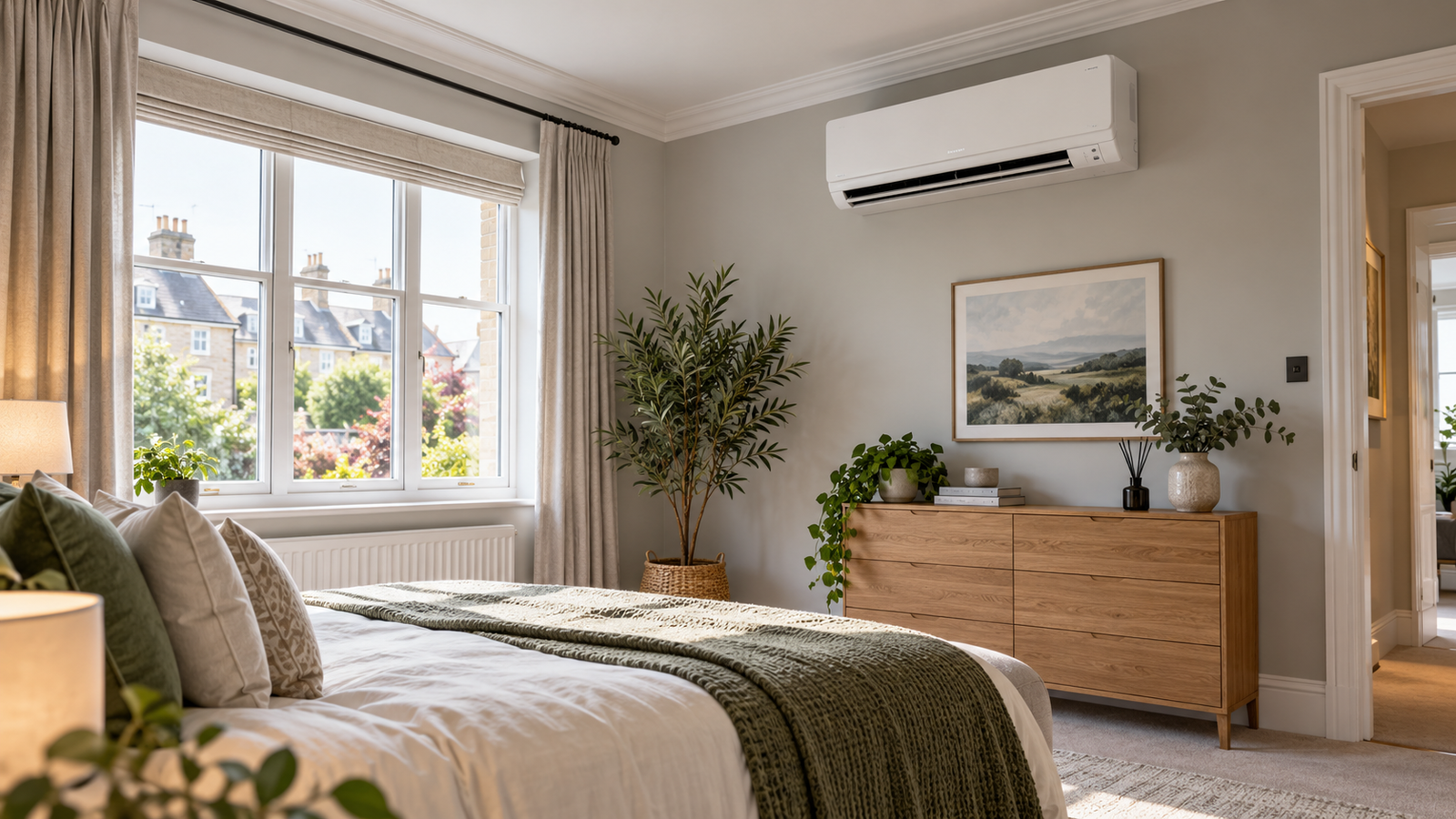
A floor-standing indoor unit sits lower on the wall and can be useful where there is not a suitable high-level location for a conventional wall-mounted unit.
Strengths
- Low-level position: can work beneath windows or in rooms where high wall space is limited.
- Heating & cooling: residential floor-standing units can form part of reversible air-to-air systems providing both functions.
Watch for
- Different visual trade-off: you avoid a high wall unit, but the indoor equipment remains visible at low level.
Five questions to answer before requesting quotes
How many rooms?
One hot bedroom may need a very different solution from three bedrooms and a living room.
Cooling only or heating too?
If winter heating matters, tell the installer so the system can be designed with that requirement in mind.
How visible can it be?
Wall-mounted systems are straightforward; concealed solutions prioritise appearance but require more installation work.
Where can the outdoor unit go?
Available exterior space can influence whether several separate systems or a multi-split design makes more sense.
What does the survey show?
Room size alone does not determine cooling demand. Glazing, orientation, insulation, occupancy and internal heat gains matter too.
Not sure yet?
A good installer should explain why a particular system and capacity have been proposed rather than simply quoting for a generic unit.
Compare Up to 3 Air Conditioning Installers Near You
Tell us a little about your property to see installer options available in your area.
Free to use with no obligation
Does the air conditioning brand matter?
Yes, but the manufacturer name should not be considered in isolation. The exact model, correct capacity, installation quality, controls, warranty arrangements and local aftercare can all matter to the finished result.
Compare exact models
Two systems from the same manufacturer can differ significantly in efficiency ratings, features, controls and noise specifications.
Consider installer support
A technically impressive unit is less attractive if you struggle to obtain servicing, parts or warranty support locally.
Don’t buy on specification alone
Published manufacturer specifications describe equipment under stated conditions; they do not guarantee how a poorly designed installation will perform in your home.
We compare manufacturers separately in our Best Air Conditioning Brands UK guide rather than turning this system-selection page into a manufacturer ranking.
How much does home air conditioning cost?
Installation price depends heavily on the number of rooms, system configuration, equipment selected and how complicated the refrigerant pipework, electrical work and condensate drainage are.
Rather than duplicating price figures here and allowing them to become inconsistent, we maintain current examples in the dedicated Air Conditioning Cost UK guide.
Running costs also depend on the system’s electrical demand, efficiency, set temperature, usage and electricity tariff. Our air conditioning running costs guide covers that separately.
Don’t compare quotes on price alone
Before deciding, check whether each quotation includes the same:
- Indoor and outdoor equipment
- Number of rooms
- System capacity
- Pipework and trunking
- Electrical work
- Condensate drainage
- Controls and commissioning
- Warranty and aftercare
Frequently asked questions
What is the best type of air conditioning for a house?
For one room, a single-split system is often the simplest fixed option. Multi-split systems can suit several rooms, while ducted systems can be attractive where concealed equipment and a clean interior finish are priorities.
Is multi-split air conditioning better than separate split systems?
Neither is universally better. Multi-split systems reduce the number of outdoor units, while separate single-split systems can offer a different balance of installation simplicity, independence and equipment choice. The property layout and number of rooms matter.
Can home air conditioning heat as well as cool?
Most modern fixed split air-conditioning systems are reversible air-to-air heat pumps and can provide heating as well as cooling. If heating is an important part of your project, tell the installer during system design.
Should I choose the air conditioner before contacting an installer?
It is useful to understand the system types and features you prefer, but final equipment selection should follow an assessment of the rooms and installation requirements rather than relying only on an online shortlist.
Home air conditioning guides
 Home Air Conditioning UKOur complete guide to cooling a UK home
 Air Conditioning Installers Near MeCompare installer options in your area
 Air Conditioning Installation UKSurvey, installation and commissioning
 Air Conditioner Size GuideWhat affects the capacity your rooms need
Single-Split vs Multi-SplitOne-room and multi-room configurations
Whole House Air ConditioningLarger multi-room cooling systems
 Air-to-Air Heat Pumps UKUsing reversible AC for heating
 Air Conditioning Cost UKInstallation and running-cost guidance
 Best Air Conditioning Brands UKLeading manufacturers compared
Sources and further information
- Daikin UK: Residential air conditioning systems
- Daikin UK: Multi-split residential systems
- Panasonic Heating & Cooling UK: Residential systems
- Panasonic: Free Multi residential systems
Manufacturer ranges and specifications checked September 2026. Product ranges can change; confirm the exact model and specification included in any installer quotation.