Warm Homes Loan Scheme 2026: Heat Pump Finance, Grants and How to Apply
Updated 27 October 2026. The UK government has launched the Warm Homes Loan Scheme, with participating lenders offering government-supported low- or no-interest finance for eligible home energy upgrades, including heat pumps. Unlike a grant, the loan must be repaid.
The homeowner question: Can I finance a heat pump, combine a loan with the Boiler Upgrade Scheme grant, and avoid paying the full installation cost upfront?
What is the Warm Homes Loan Scheme?
The Warm Homes Loan Scheme is a government-backed financing programme delivered through participating lenders, not a grant paid directly to homeowners. It is intended to make the upfront cost of heat pumps, solar panels, home batteries and other qualifying improvements more manageable. The first participating lenders were named on 27 October 2026.
The scheme is available across England, Scotland, Wales and Northern Ireland, but the loan products, rates, geographic coverage and eligibility checks depend on the lender. Not every participating lender necessarily offers finance for every technology.
How much can you borrow for a heat pump?
The government has published the following maximum supported loan amounts. These are scheme ceilings, not guaranteed borrowing limits or quotes.
| Technology | Maximum supported loan | Important condition |
|---|---|---|
| Air-to-water heat pump | Up to £20,000 | Subject to lender approval and eligible installation |
| Ground source heat pump | Up to £35,000 | Subject to lender approval and eligible installation |
| Air-to-air heat pump | Up to £10,000 | Subject to the required MCS certification route being available |
| Solar panels | Up to £15,000 | Subject to lender terms |
| Home battery storage | Up to £15,000 | Subject to lender terms |
For the installation cost itself, see our air source heat pump cost guide. The amount you should borrow depends on the actual installation quotation, any grants applied and the total finance cost.
Can you combine a Warm Homes Loan with the £7,500 or £9,000 heat pump grant?
Yes, potentially. The government says the new loan can be used alongside the Boiler Upgrade Scheme in England and Wales, or relevant Home Energy Scotland support in Scotland, subject to each scheme’s rules.
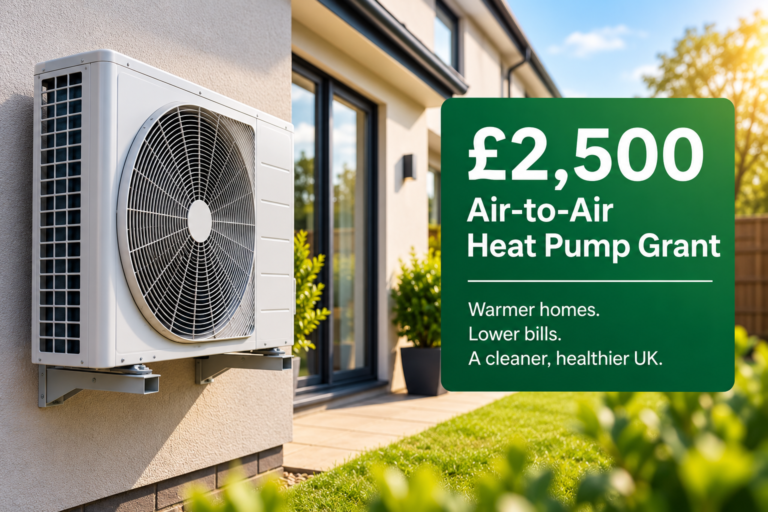
For an eligible air-to-water installation in England or Wales, the standard Boiler Upgrade Scheme grant is currently £7,500. Qualifying off-gas-grid homes replacing oil or LPG can receive £9,000 until 31 March 2027. An eligible air-to-air system has a separate £2,500 grant, although access depends on the required installer certification.
Illustrative calculation only: if an eligible installation is quoted at £13,000 and receives a £7,500 grant, the remaining amount is £5,500. A homeowner could investigate financing that balance through a participating lender. This is arithmetic, not a representative installation price, loan offer or guarantee of approval.
See our complete UK heat pump grants guide for eligibility and the difference between the schemes.
Which lenders are participating?
The government named ten initial participants on 27 October 2026:
- HomeServe (partnering with E.ON)
- Hometree Finance
- Propensio
- Secure Trust Bank
- Selina Finance
- South Manchester Credit Union
- Sunsave
- Tandem Bank
- The Money Co-op
- This Bank
Do not assume that all ten currently finance heat pumps. Some products or partnerships may initially focus on solar panels or batteries, and some lenders may only operate through selected installers or within particular areas. Ask the lender which technologies, properties and installers its current product covers.
What interest rates and repayment terms apply?
There is no single Warm Homes Loan interest rate. The government says some participating lenders are offering interest-free finance, while other loans have reduced interest rates compared with their ordinary products. Some products may allow repayment periods of up to 30 years.
That does not mean every applicant can borrow interest-free for 30 years. The available rate, term, fees, security requirements and loan amount depend on the lender and your circumstances. A longer term can lower monthly payments while increasing the total amount repaid.
What to compare before borrowing
- The annual percentage rate (APR), any fees and the total repayable amount
- Monthly payments over the full loan term, not just the first year
- Whether the rate is fixed or variable, and whether early repayment charges apply
- Whether the loan is secured against your home
- Whether you must use a particular installer and how the quote compares with alternatives
- Whether the grant has already been deducted from the financed amount
A heat pump may be cheaper to run in some homes, but savings are not guaranteed. Results depend on heat loss, design flow temperature, emitter sizing, controls, installation and commissioning, household usage, achieved seasonal efficiency and electricity tariff. Compare heat pump running costs separately from loan repayments.
How do you apply?
- Check your heating options. Establish whether an air-to-water, ground source or air-to-air heat pump is suitable for your property.
- Check grants first. Find out whether the Boiler Upgrade Scheme or devolved-nation support can reduce the amount you need to borrow.
- Get a detailed installation quote. Check heat-loss calculations, radiator or emitter changes, cylinder, controls, electrics and commissioning.
- Ask participating lenders for current offers. Confirm that the lender finances your chosen technology and installer.
- Compare the complete cost of credit. Review APR, fees, security, monthly payments and total repayment before agreeing.
- Apply through the lender or an eligible installer partner. The lender will carry out its usual affordability, credit and eligibility checks.
The government states that installations funded through the scheme normally need an MCS-certified installer, apart from the stated heat-network connection exception. Check the current requirements for the exact technology before signing a contract.
Is the Warm Homes Loan Scheme worth using?
It may be useful if you have already decided that a properly designed heat pump suits your property, can obtain an eligible grant and would prefer to spread the remaining installation cost. It is less attractive if the financing cost is high, you would be stretching your household budget, or you are relying on unverified savings to cover repayments.
If you are also considering solar panels or battery storage, read our guide to combining a heat pump with solar panels and a battery. Financing several technologies together should still be justified by the costs and benefits of each one.
Warm Homes Loan Scheme FAQs
Is the Warm Homes Loan Scheme a grant?
No. It is a loan that must be repaid. Government support is intended to make eligible borrowing cheaper, but interest rates and terms vary by lender.
Can I use the loan and the Boiler Upgrade Scheme together?
Potentially, yes. Government guidance confirms that qualifying heat pump grants and the loan scheme can be combined, subject to the rules and lender approval.
Is the scheme available in Scotland and Northern Ireland?
Yes, the Warm Homes Loan Scheme covers the UK. However, the Boiler Upgrade Scheme itself applies only to England and Wales. Grant arrangements and individual lender availability differ elsewhere.
Can I get an interest-free heat pump loan?
Some participating lenders offer interest-free products, but availability depends on the lender, technology, property and your eligibility. Do not assume a 0% rate applies to every heat pump installation.
Can I finance an air-to-air heat pump?
The government lists a maximum supported loan of £10,000 for air-to-air systems when the necessary MCS certification is available. Confirm practical availability and approved installers before relying on this option.

About the author
David Tooth
Founder & Editor | Heat Pump Guide UK
Independent UK heat pump researcher
Heat Pump Guide UK provides independent homeowner research, not regulated financial advice, installation services or property-specific heating design. Always review lending documents and seek suitable professional advice where needed.
Official sources
- Department for Energy Security and Net Zero: Warm Homes Loan Scheme factsheet (27 October 2026)
- DESNZ: Warm Homes Loan Scheme rules and lender participation
- GOV.UK: Boiler Upgrade Scheme grant values
Sources checked 27 October 2026. Finance products and lender participation may change. This article does not recommend a particular loan or lender.