
Home Air Conditioning UK: Complete Guide 2026
Home air conditioning is becoming a more practical option for UK households, whether you want occasional bedroom cooling from a portable unit or a permanent split system that can heat as well as cool your home.
This guide compares portable, single-split, multi-split and other fixed air conditioning options, including typical costs, running costs, noise, outdoor units, planning rules and the new £2,500 support available for qualifying air-to-air heat pumps.
- Updated for 2026
- Portable & fixed AC compared
- Independent UK homeowner advice

Quick Answer: What Is the Best Air Conditioning for a UK Home?
The best option depends mainly on how many rooms you want to cool and how often you expect to use it.
Occasional cooling in one room
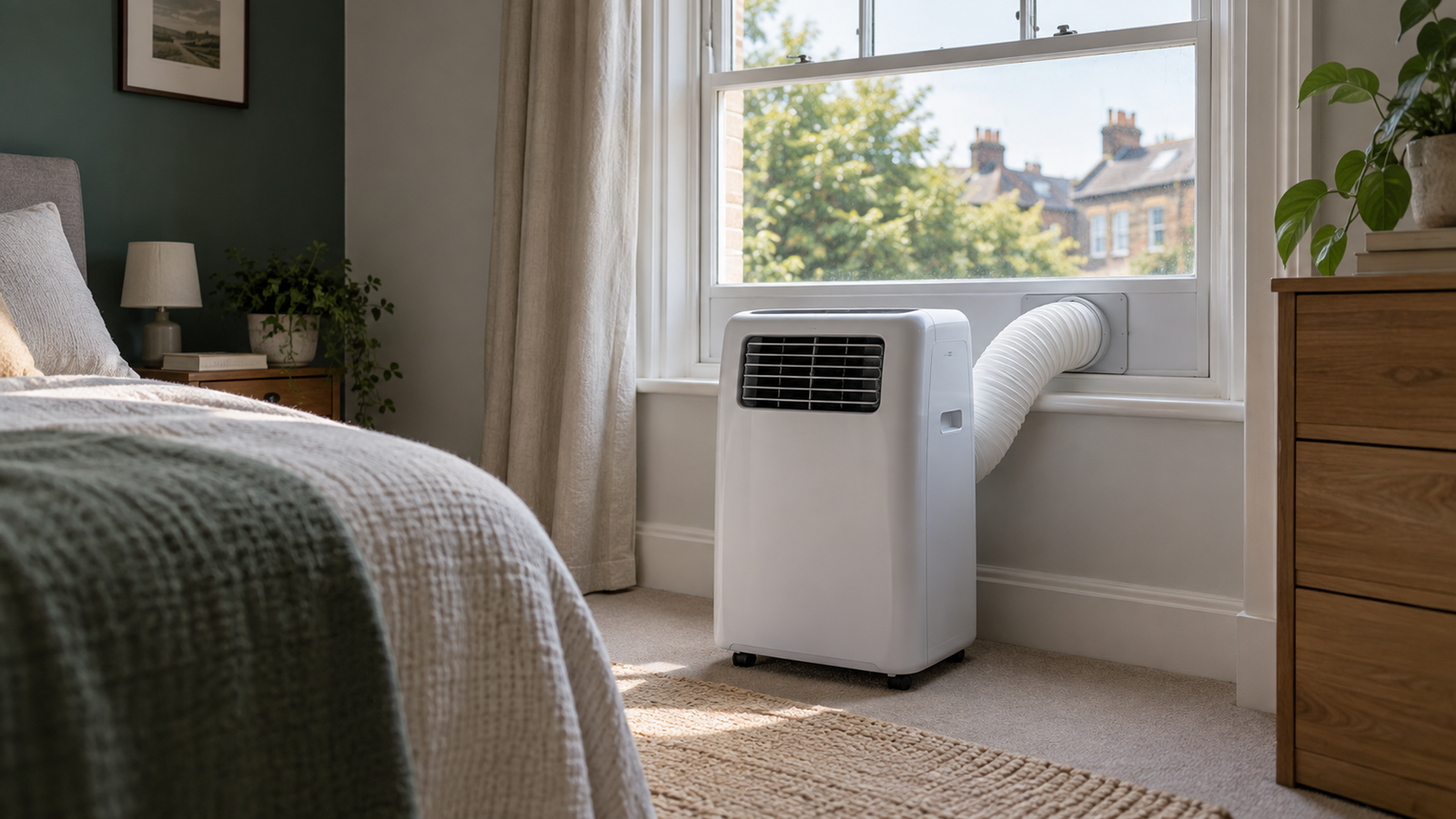
A portable air conditioner can be the simplest and cheapest starting point. It requires no permanent refrigerant installation, although you do need to vent hot air outside through a window or wall opening.
Compare Portable Air Conditioners →Regular cooling and heating
A fixed split air conditioner or air-to-air heat pump is usually quieter, more efficient and better suited to regular use. Most modern systems can provide heating as well as cooling.
Air-to-Air Heat Pump Guide →Simple rule
If you only need to make one bedroom or home office more comfortable during occasional hot weather, start by considering portable AC. If you want dependable summer cooling across several rooms — particularly if you also want efficient electric heating — fixed air conditioning deserves serious consideration.
Types of Home Air Conditioning in the UK
Products advertised as “air conditioning” can work in very different ways. Before comparing brands or prices, it helps to understand the main system types.
| Type | Best For | Permanent Installation? | Can Heat? | Relative Cost |
|---|---|---|---|---|
| Portable AC | Occasional single-room cooling | No | Selected models | £ |
| Single-split AC | Regular heating and cooling in one room | Yes | Usually | ££ |
| Multi-split AC | Several rooms | Yes | Usually | £££ |
| Ducted AC | Discreet whole-home cooling | Yes | Usually | ££££ |
| Monobloc wall system | Properties where an outdoor unit is difficult | Yes | Depends on model | ££–£££ |
The biggest decision for most homeowners is therefore not which brand to buy. It is whether you need a portable appliance or a permanently installed system.
Portable Air Conditioners
A genuine portable air conditioner contains a refrigeration circuit and compressor. It removes heat from the room and sends that heat outside through an exhaust hose.
That makes it fundamentally different from a fan or inexpensive evaporative “air cooler”.
Advantages of portable AC
- Much lower upfront cost than most fixed systems
- No permanent outdoor unit
- No refrigerant pipework installation
- Can be moved between suitable rooms
- Useful for rented properties or occasional cooling
Disadvantages of portable AC
- The compressor is inside the room, so noise can be noticeable
- Hot air must be exhausted outside
- An open or poorly sealed window reduces performance
- Units can be heavy and bulky
- Single-hose portable units are generally less efficient than good fixed split systems
Which portable AC should you buy?
We compared seven current UK models from Meaco, Dreo, Pro Breeze, De’Longhi and other brands, with separate picks for bedrooms, larger rooms, smart controls, premium buyers and lower budgets.
See the Best Portable Air Conditioners UK →Fixed Split Air Conditioning
A split system separates the main compressor from the unit inside your home.
The outdoor unit contains the compressor and heat exchanger, while an indoor unit distributes cooled or heated air around the room. Refrigerant pipework connects the two.
This arrangement is one reason fixed systems can be considerably quieter indoors than portable air conditioners: the compressor is outside rather than sitting in the bedroom or living room.
Single-split systems
A single-split system normally consists of one outdoor unit connected to one indoor unit.
It can be ideal for:
- Bedrooms that regularly overheat
- Home offices
- Conservatories or garden rooms
- Living rooms
- Loft conversions
Energy Saving Trust currently estimates around £1,900 for an air-to-air heat pump serving a single room. Actual quotes can vary substantially depending on the unit, installation route, electrical work, access and pipework.
Multi-Split Air Conditioning
A multi-split system connects several indoor units to one outdoor unit.
For example, one external unit could potentially serve:
- Two or three bedrooms
- A living room and bedroom
- Several upstairs rooms
- Different zones within a larger home
Each indoor unit can normally be controlled separately, allowing you to cool or heat occupied rooms rather than treating the whole house as one zone.
Important: More indoor units do not automatically mean better comfort. Capacity, pipe lengths, room heat gains, system design and outdoor-unit sizing all need to be considered properly.
Energy Saving Trust gives a current indicative figure of around £3,700 for an air-to-air heat pump in a three-bedroom semi-detached home. This should be treated as a planning figure rather than a guaranteed installation price.
Ducted Air Conditioning
Ducted systems distribute conditioned air through concealed ductwork rather than placing a visible wall-mounted indoor unit in every room.
This can create a cleaner appearance, but installation is considerably more involved.
Ducted systems are easiest to accommodate when there is suitable space in:
- Lofts
- Ceiling voids
- Service spaces
- Major renovation projects
- New-build homes
Retrofitting ductwork into an existing UK house can require substantial building work, which is why conventional wall-mounted split systems are often more practical.
What Is a Monobloc Air Conditioner?
Wall-mounted monobloc systems provide another option for properties where an external condenser is undesirable or difficult to install.
The main equipment remains inside the property, with air passing through ducts in the external wall.
Energy Saving Trust notes that some air-to-air monobloc systems use two wall ducts of roughly 15–20cm rather than a conventional outdoor unit.
This can make them useful in some flats and visually sensitive situations, although planning, leasehold and building-specific restrictions still need to be checked.
Home Air Conditioning Can Usually Heat as Well as Cool
This is one of the most important distinctions between modern fixed air conditioning and a cooling-only appliance.
Most modern reversible split systems are effectively air-to-air heat pumps.
Summer
The system removes heat from inside your home and releases it outdoors.
Winter
The refrigeration cycle reverses, extracting heat from outdoor air and transferring it indoors.
That means the same equipment can potentially provide both summer cooling and winter space heating.
For a deeper look at using this technology as part of your heating system, read our Air-to-Air Heat Pumps UK guide.
You can also read our comparison of heat pumps vs air conditioning if the terminology is causing confusion.
Can Air Conditioning Heat Your Whole Home?
Potentially, but it depends heavily on the layout and heating demand of the property.
A small open-plan flat can be much easier to heat through air than a large traditional house containing several closed rooms and corridors.
Factors that matter include:
- Property heat loss
- Number and position of indoor units
- Door positions and air movement between rooms
- Outdoor winter temperatures
- System sizing
- Insulation and draughts
- Desired room temperatures
Air-to-air systems also normally do not provide domestic hot water. You may therefore need an immersion-heated cylinder, heat-pump water heater, electric shower or another hot-water solution.
Do not assume that adding one wall unit to a downstairs living room will replace an existing whole-house central-heating system.
How Much Does Home Air Conditioning Cost in the UK?
Prices vary enormously because “home air conditioning” can mean anything from a portable appliance to a multi-room fixed heat-pump system. See our guide to home air conditioning installation costs for a closer look at budgeting for a fixed system.
| System | Useful Planning Guide | Notes |
|---|---|---|
| Portable AC | Hundreds rather than thousands | DIY setup; no permanent refrigerant installation |
| Single-room air-to-air system | About £1,900 | Current Energy Saving Trust indicative figure |
| Three-bed semi air-to-air system | About £3,700 | Current Energy Saving Trust indicative figure |
| Complex multi-room / ducted installation | Potentially considerably more | Highly property and design dependent |
Installation price can change according to:
- Number and capacity of indoor units
- Outdoor-unit size
- Length and complexity of refrigerant pipework
- Electrical upgrades
- Condensate drainage
- Scaffolding or difficult access
- Wall construction
- Decorative making-good
- Whether planning permission is required
Do not treat these as quotations: Energy Saving Trust’s £1,900 and £3,700 figures are useful national planning estimates. The correct price for your home depends on the actual system design and installation.
Can You Get a Grant for Home Air Conditioning?
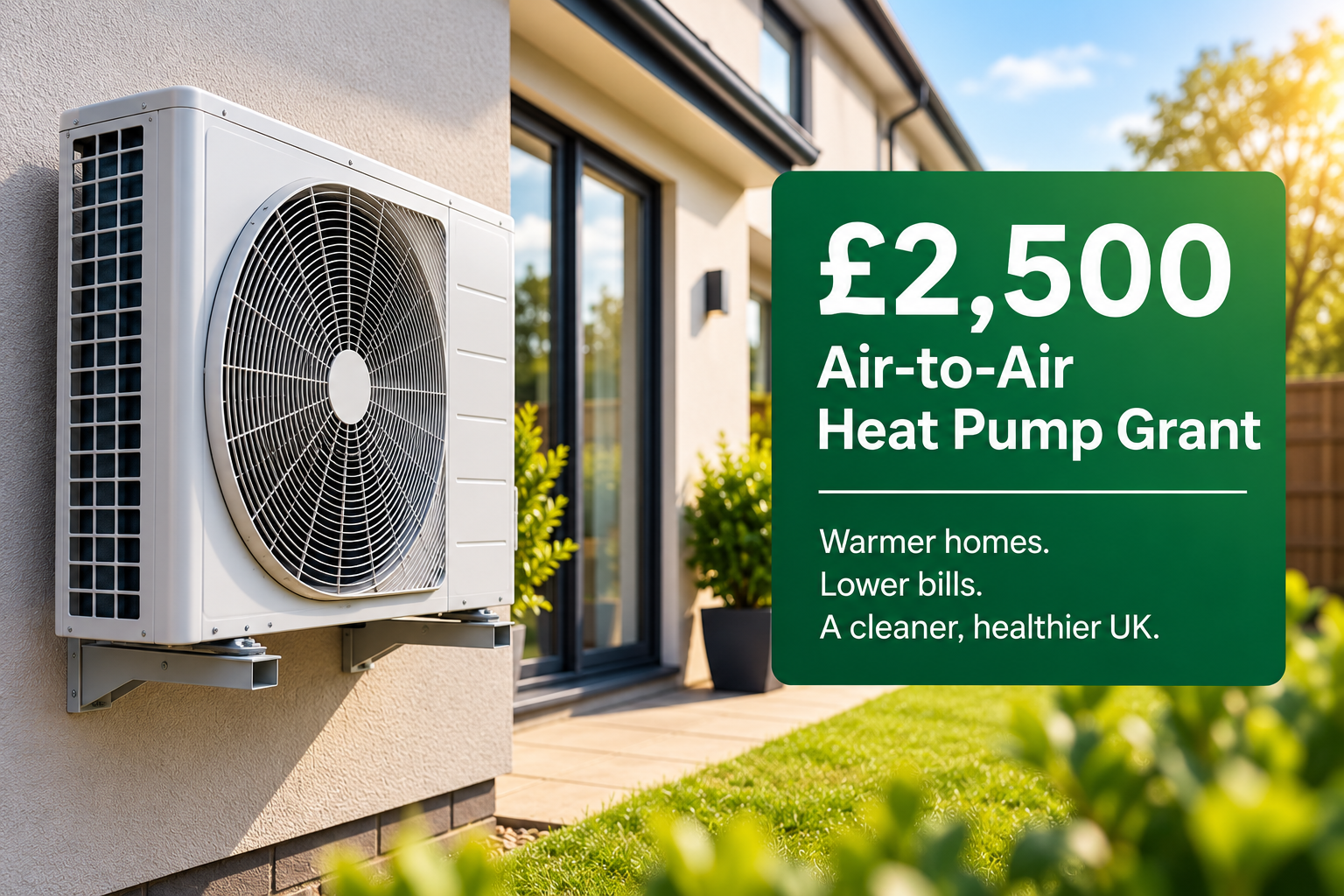
Yes, some qualifying air-to-air heat-pump installations in England and Wales can now receive £2,500 through the Boiler Upgrade Scheme.
This is an important 2026 change.
From 21 July 2026, the approved Boiler Upgrade Scheme grant categories include:
- £2,500 towards an eligible air-to-air heat pump
- £7,500 towards a standard eligible air-to-water heat pump
- £7,500 towards a ground source heat pump
The £2,500 grant does not mean that any domestic air conditioner bought online qualifies.
The property, product and installation need to meet the scheme requirements, and the installation is handled through an eligible installer.
Portable AC is different
A portable plug-in air conditioner is not the same as an eligible professionally installed air-to-air heat pump. Do not buy a portable AC expecting to claim the £2,500 Boiler Upgrade Scheme grant.
See the current GOV.UK Boiler Upgrade Scheme guidance before making a decision.
How Much Does Home Air Conditioning Cost to Run?
There is no useful single figure because electricity consumption varies substantially between systems and operating conditions.
Running costs depend on:
- Electrical input of the system
- How many rooms you condition
- Outdoor temperature
- Indoor target temperature
- Insulation and glazing
- Solar gain
- Efficiency of the equipment
- How long it operates
- Your electricity tariff
For 1 July to 30 September 2026, Ofgem’s average capped electricity unit rate for a standard-variable Direct Debit customer is 26.11p/kWh.
Simple electricity example
An appliance drawing an average of 1kW for one hour uses 1kWh.
At 26.11p/kWh:
1kW × 1 hour × 26.11p = approximately 26.1p.
This calculation shows how electricity pricing works; it is not a prediction that your air conditioner will cost 26p every hour.
Inverter-driven fixed systems can adjust their output as the room approaches the target temperature rather than continually operating at maximum capacity.
Portable AC vs Fixed Air Conditioning
| Feature | Portable AC | Fixed Split AC |
|---|---|---|
| Upfront cost | Lower | Higher |
| Professional installation | Usually no | Yes |
| Indoor noise | Usually higher | Usually lower |
| Efficiency | Generally lower | Generally better |
| Heating | Selected models | Common on reversible systems |
| Appearance | Floor unit and exhaust hose | Wall/ceiling indoor unit plus outdoor unit |
| Mobility | Can be moved | Permanent |
| Best use | Occasional room cooling | Regular heating and cooling |
Is Fixed Air Conditioning More Efficient Than Portable AC?
Generally, yes.
Portable single-hose air conditioners discharge indoor air outside through an exhaust hose. This can create slight negative pressure in the room, encouraging warmer air from elsewhere to enter.
A properly installed split system transfers heat through refrigerant pipework instead, without needing to exhaust large volumes of conditioned room air through a hose.
Modern fixed systems also commonly use inverter compressors that can modulate output according to demand.
Real efficiency still depends on system sizing, controls, operating temperatures, building heat gain, maintenance and installation quality.
How Noisy Is Home Air Conditioning?
Noise is particularly important if you are cooling a bedroom.
Portable air conditioners
Both the fan and compressor sit inside the room, so they are clearly audible. Even products marketed using terms such as “sleep” or “quiet” should not be assumed to be silent.
Fixed split air conditioning
The compressor is outside, leaving the quieter indoor fan and heat exchanger inside.
This is one of the biggest practical advantages of fixed air conditioning for bedrooms.
Check how noise is measured: manufacturers may publish sound pressure, sound power or measurements taken at different fan speeds. Two headline dB figures are not necessarily directly comparable.
Where Should Indoor Air Conditioning Units Go?
Indoor-unit positioning affects comfort and performance.
A good position should allow conditioned air to circulate through the room without blowing continuously at occupants.
Installers also need to consider:
- External-wall access
- Refrigerant pipe routes
- Condensate drainage
- Electrical supply
- Furniture placement
- Ceiling height
- Future maintenance access
Placing an indoor unit wherever it looks least noticeable is not always the best technical solution.
Where Can the Outdoor AC Unit Go?
The outdoor unit needs sufficient airflow and should be positioned with noise, access and visual impact in mind.
Common locations include:
- External walls
- Ground-mounted positions beside the property
- Rear gardens
- Flat roofs where applicable
Avoid enclosing the outdoor unit tightly or placing it where discharge air is immediately recirculated back into the intake.
Neighbouring windows, bedrooms and boundaries should also be considered before the installation position is finalised.
Do You Need Planning Permission for Home Air Conditioning?
Not always.
In England, qualifying domestic air-source heat-pump installations can be permitted development if all relevant conditions are met.
The rules were relaxed in 2025 so that systems capable of both heating and cooling can qualify. This is important because modern reversible air conditioning is technically an air-to-air heat pump.
Current Planning Portal guidance includes conditions covering:
- Compliance with MCS 020a planning standards
- Outdoor-unit volume
- Number of heat pumps at the property
- Roof positioning
- Listed buildings
- Scheduled monuments
- Conservation Areas and World Heritage Sites
- Noise
For houses in England, the outdoor compressor unit can currently be up to 1.5m³ under the permitted-development criteria. Detached houses can also potentially have two qualifying air-source heat pumps.
Check your own property: permitted-development rules differ across the UK and can be restricted by listed status, conservation controls, leasehold conditions or local circumstances. Do not assume an installation is exempt from planning permission simply because another property nearby has AC.
See the current Planning Portal air-source heat-pump guidance for England.
Air Conditioning in Flats and Apartments
Flats can benefit particularly from air conditioning because upper-floor properties can experience significant summer overheating.
However, installing fixed equipment can be more complicated.
Check:
- Your lease or freeholder rules
- Planning requirements
- External-wall ownership
- Where the condenser could be mounted
- Noise impact on neighbouring flats
- Access for installation and maintenance
If a conventional outdoor unit is impossible, a portable or wall-mounted monobloc system may be worth investigating.
Best Air Conditioning for Bedrooms
For bedrooms, noise is often as important as maximum cooling capacity.
You essentially have two routes:
Portable bedroom AC
Cheaper and simpler to install, but the compressor remains inside the room. Choose the capacity carefully and expect some operating noise.
See Our Bedroom Portable AC Pick →Fixed bedroom AC
Higher upfront cost, but generally significantly quieter indoors and better suited to regular overnight use.
Learn About Fixed Air-to-Air Systems →Can You Air Condition a Whole House?
Yes, but cooling every room does not necessarily mean installing an indoor unit in every room.
The correct approach depends on:
- Which rooms actually overheat
- Occupancy patterns
- Floor plan
- Heat gain through glazing
- Whether cooling and heating are both required
- Available outdoor-unit capacity
- Budget
A multi-split system might serve several priority rooms, while larger renovations may suit ducted air conditioning.
Cooling only the spaces that genuinely need it is usually more sensible than assuming the entire property needs mechanical cooling.
Can Air Conditioning Help With Humidity?
Yes. Refrigerant air conditioning naturally removes some moisture from the air while cooling.
Many portable and fixed units also provide a dedicated dehumidification or “dry” mode.
However, air conditioning should not be used to disguise a persistent damp, leak or ventilation problem. If excess moisture has an underlying building cause, that should still be addressed.
Air Conditioning vs a Fan
A fan and an air conditioner solve different problems.
Fan
- Uses relatively little electricity
- Cheap to buy
- Makes occupants feel cooler through increased air movement
- Does not substantially reduce room temperature
Air conditioner
- Uses more electricity
- Costs more to buy
- Actively removes heat from the room
- Can reduce both temperature and humidity
During moderate UK weather, shading, ventilation and a good fan may be enough. Mechanical cooling becomes more useful when the building continues to overheat despite these measures.
Reduce Overheating Before Increasing AC Use
Air conditioning should not be the only response to overheating.
Energy Saving Trust recommends considering passive cooling measures first where practical.
Useful measures can include:
- External shading
- Closing blinds or curtains before direct sun reaches the room
- Night-time ventilation when outdoor air is cooler
- Reducing unnecessary internal heat sources
- Improving ventilation
- Managing solar gain through large windows
Reducing the cooling load can make a smaller air-conditioning system more effective and reduce electricity consumption.
Is Home Air Conditioning Worth It in the UK?
For some homes, yes. For others, probably not.
It is most compelling where:
- Bedrooms regularly become uncomfortably hot
- Loft conversions overheat
- Large areas of glazing create high solar gain
- People work from home during hot weather
- Passive cooling has not solved the problem
- You also want an efficient electric heating option
If you only experience a few uncomfortable evenings each year, a fan or portable AC may be easier to justify than permanent whole-home air conditioning.
If you need regular heating and cooling, a reversible fixed air-to-air system becomes much more interesting because the same installation can serve both purposes.
The key question
Do not ask simply, “Should I install air conditioning?”
Ask which rooms overheat, how often they need cooling, whether you also need heating, and whether a portable or permanent system solves that problem most efficiently.
Compare Up to 3 Air Conditioning Installers Near You
Tell us a little about your property to see installer options available in your area.
Free to use with no obligation
Home air conditioning FAQs
What is the best home air conditioning system in the UK?
For occasional cooling in one room, a portable air conditioner can be the most practical choice. For regular heating and cooling, a fixed split air-to-air heat pump is generally quieter and more efficient. Multi-split systems can serve several rooms from one outdoor unit.
How much does home air conditioning cost?
Portable units generally cost hundreds of pounds. Energy Saving Trust currently estimates around £1,900 for an air-to-air heat pump serving one room and around £3,700 for a three-bedroom semi-detached home. Actual fixed-system quotes depend on equipment, system design and installation complexity.
Can I get a grant for air conditioning?
Some qualifying professionally installed air-to-air heat pumps in England and Wales can now receive £2,500 through the Boiler Upgrade Scheme. A plug-in portable air conditioner does not qualify simply because it can provide cooling.
Does home air conditioning also provide heating?
Most modern reversible split air conditioners can provide both heating and cooling because they operate as air-to-air heat pumps. Portable models vary, so check the exact specification.
Do I need planning permission for home air conditioning?
Not necessarily. Qualifying domestic air-source heat-pump installations in England can fall under permitted-development rights if all conditions are met. Different rules may apply elsewhere in the UK, and listed buildings, conservation areas, flats and leasehold properties need additional checks.
Is portable air conditioning good for a bedroom?
It can cool a bedroom effectively if correctly sized and properly vented, but the compressor remains inside the room and can be noisy. A fixed split system is normally quieter indoors.
Does a portable air conditioner need a window?
It needs a route for hot exhaust air to leave the room. In most homes this means a window and a suitable sealing kit, although a correctly designed wall vent can also be used.
Is air conditioning expensive to run?
It uses more electricity than a fan, but actual running costs vary significantly with system efficiency, electrical input, outdoor temperature, room heat gain, thermostat setting, usage and your electricity tariff.
Sources and further reading
Costs, grants, energy pricing and planning information in this guide were checked against current UK government, regulator and independent energy-advice sources.