
CONCEALED HOME AIR CONDITIONING
Ducted Air Conditioning UK: Is It Right for Your Home?
Ducted air conditioning hides most of the indoor equipment from view, delivering heating and cooling through discreet grilles. It can create an excellent finish, but the property needs suitable space and the installation is more involved than conventional wall-mounted AC.
QUICK ANSWER
What Is Ducted Air Conditioning?
Ducted air conditioning uses a concealed indoor unit rather than a visible wall-mounted air conditioner.
The indoor equipment normally sits in a ceiling void, loft or other suitable concealed space. Short ducts then distribute conditioned air to one or more grilles in the rooms.
The biggest advantage is appearance. Instead of an AC unit being visible high on the wall, you mainly see discreet supply and return grilles.
The trade-off is installation. The home needs enough space for the equipment, ductwork, drainage and future servicing access.
HOW IT WORKS
What Does a Ducted AC System Look Like?
Most of the equipment is hidden, so the finished room can look very different from a conventional split-system installation.
Concealed Indoor Unit
The main indoor AC unit sits above a ceiling, in a loft or within another suitable service space.
Ductwork
Insulated ductwork carries conditioned air between the concealed unit and the required rooms or zones.
Discreet Grilles
Supply and return grilles are visible in the finished room rather than a large wall-mounted indoor unit.
WHY CHOOSE DUCTED AC?
The Main Attraction Is a Cleaner Interior
If you want air conditioning without prominent wall-mounted indoor units in each room, concealed AC is one of the strongest options to consider.
Daikin’s current UK residential concealed-ceiling range is designed so that the indoor equipment is hidden and only the suction and discharge grilles remain visible. :chatgpt-content-reference{index=”0″}
That makes ducted systems particularly attractive in high-specification renovations, extensions and homes where interior design is a priority.
They can also provide heating as well as cooling when used as reversible air-to-air heat-pump systems.
DUCTED VS WALL-MOUNTED
Which Type of Air Conditioning Is Better?
Neither is universally better. They prioritise different things.
| Factor | Ducted / concealed AC | Wall-mounted split AC |
|---|---|---|
| Appearance | Main equipment hidden; mostly grilles visible | Indoor unit visible on the wall |
| Installation | More building integration normally required | Generally simpler |
| Ceiling / service space | Usually required | Not normally required |
| Multiple rooms | Can distribute air to several areas depending on design | Normally one indoor unit per room or zone |
| Zoning | Available with suitable system design and controls | Each indoor unit naturally acts as a separate zone |
| Retrofit suitability | Depends heavily on available void space | Usually easier to retrofit |
| Future access | Access panels need to be planned | Indoor unit remains directly accessible |
THE BIG QUESTION
Do You Have Enough Space for Ducted Air Conditioning?
This is usually the first practical question an installer needs to answer.
Ceiling Voids
A suspended or lowered ceiling can provide space for the concealed indoor unit and duct routes.
Loft Space
Upper-floor rooms may sometimes be served from equipment and ducts positioned within a suitable loft.
Service Access
The equipment cannot simply be boxed in permanently. Filters, drainage and components need appropriate maintenance access.
How Much Ceiling Space Does the Equipment Need?
It depends on the exact product.
As one current example, Daikin’s residential concealed-ceiling unit is designed for false-ceiling spaces of around 240mm height or more. Other concealed units and duct arrangements have different dimensional requirements. :chatgpt-content-reference{index=”1″}
Do not design a ceiling void around that number alone. The installer also needs space for ducts, drainage, insulation, connections and future access.
WHERE DUCTED AC WORKS WELL
Which Homes Are Best Suited to Concealed Air Conditioning?
Major Renovations
Ceilings and services can be designed around the AC installation before finishes are completed.
Extensions
New ceiling voids and service routes make it easier to integrate concealed equipment from the start.
Homes With Accessible Lofts
Upper-floor bedrooms can sometimes be served from concealed equipment positioned above them.
Design-Led Interiors
Where avoiding visible AC units is a priority, grilles can be significantly less intrusive.
Several Nearby Rooms
A concealed unit with suitable zoning can potentially distribute conditioned air to several adjacent areas.
Whole-House Projects
Ducted systems can form part of a larger multi-room design rather than treating every room as an isolated wall-mounted installation.
See our Whole House Air Conditioning UK guide for the wider multi-room options.
MULTI-ZONE CONTROL
Can Different Rooms Have Different Temperatures?
Potentially, yes — but it depends on the system and zoning design.
A basic ducted installation may serve an area as one zone, while more sophisticated systems can use dampers, separate outlets and controls to divide the property into several temperature zones.
Daikin currently offers concealed systems that can use a multi-zoning kit to serve individually controlled climate zones from one indoor unit. :chatgpt-content-reference{index=”2″}
Panasonic’s current PACi Multi Zone Duct system goes further, offering independent control for up to five zones using dedicated fans and motors at each outlet. :chatgpt-content-reference{index=”3″}
Those are product examples rather than universal capabilities, so the exact zoning arrangement needs to be designed around the proposed equipment.
Why Zoning Matters
- Bedrooms and living spaces can have different comfort requirements.
- Unused rooms do not necessarily need the same conditioning.
- Different floors can behave differently during hot weather.
- Room schedules vary through the day.
- Heating requirements can also vary between zones.
DUCT DESIGN
Good Ductwork Matters as Much as the Air Conditioner
Hiding the indoor unit does not make system design less important. In some respects it makes it more important.
Duct Length & Resistance
The indoor fan needs to overcome the resistance created by ducts, bends, filters and grilles while still delivering the intended airflow.
Supply Air Position
Grilles should distribute conditioned air effectively without creating uncomfortable draughts in regularly occupied areas.
Return Air
The system also needs an appropriate route for room air to return to the concealed unit.
This is why ducted AC should be designed as an airflow system rather than simply selecting a concealed unit and attaching whatever ductwork fits.
NOISE
Is Ducted Air Conditioning Quieter?
It can create a very quiet-feeling room because the main indoor fan and refrigeration equipment are concealed away from the occupied space.
However, noise depends on more than the published sound level of the indoor unit.
Air velocity through grilles, duct dimensions, bends, fan pressure, vibration isolation and where the concealed unit is positioned can all affect what occupants hear.
For bedrooms in particular, ask the installer about the expected room sound level at the operating condition you are likely to use overnight.
Good Acoustic Design Considers:
- Indoor-unit sound level
- Fan speed
- Duct velocity
- Grille sizing
- Vibration isolation
- Equipment position relative to bedrooms
- Outdoor-unit position
Compare Up to 3 Air Conditioning Installers Near You
Tell us a little about your property to see installer options available in your area.
Free to use with no obligation
INSTALLATION
Why Ducted AC Is Easier During a Renovation
Concealed systems require space not only for the indoor unit but also for ducts, grilles, drainage, electrical connections and maintenance access.
Ceilings Can Be Planned
Bulkheads, dropped ceilings and service voids can be designed around the equipment rather than added afterwards.
Duct Routes Can Be Coordinated
The installer can work around lighting, joists, plumbing, ventilation and other services before ceilings are closed.
Access Can Be Built In
Maintenance hatches can be positioned deliberately rather than becoming an awkward retrofit compromise.
This does not mean ducted AC cannot be retrofitted. It means an installer needs to confirm that the finished property has enough usable space to do it properly.
COST
Is Ducted Air Conditioning More Expensive?
It commonly involves more installation work than fitting a straightforward wall-mounted split system, but there is no useful single premium that applies to every property.
More Installation Materials
Ductwork, grilles, plenums, dampers, insulation and access arrangements can all form part of the system.
More Building Integration
Ceiling alterations or joinery may sometimes be needed depending on the property and desired finish.
More Design Time
Airflow, duct pressure, zoning and equipment access all need consideration before installation begins.
Daikin’s current UK guidance likewise describes concealed systems as particularly suited to new builds and major renovations and notes that installation costs are generally higher than for wall-mounted or floor-standing systems. :chatgpt-content-reference{index=”4″}
YEAR-ROUND USE
Can Ducted Air Conditioning Heat as Well?
Yes, where the concealed system is a reversible air-to-air heat pump.
The same refrigeration cycle can operate in reverse to deliver warm air through the duct system in winter.
If the installation is expected to provide significant winter heating, the design should account for the home’s room-by-room heat losses and outdoor operating conditions rather than being selected purely around summer cooling.
If Heating Is Important, Check:
- Winter room heat losses
- Available heating capacity
- Airflow to each zone
- Expected outdoor design conditions
- Control strategy
- Whether another form of heating will remain
OUTDOOR EQUIPMENT
Ducted Indoors Does Not Mean No Outdoor Unit
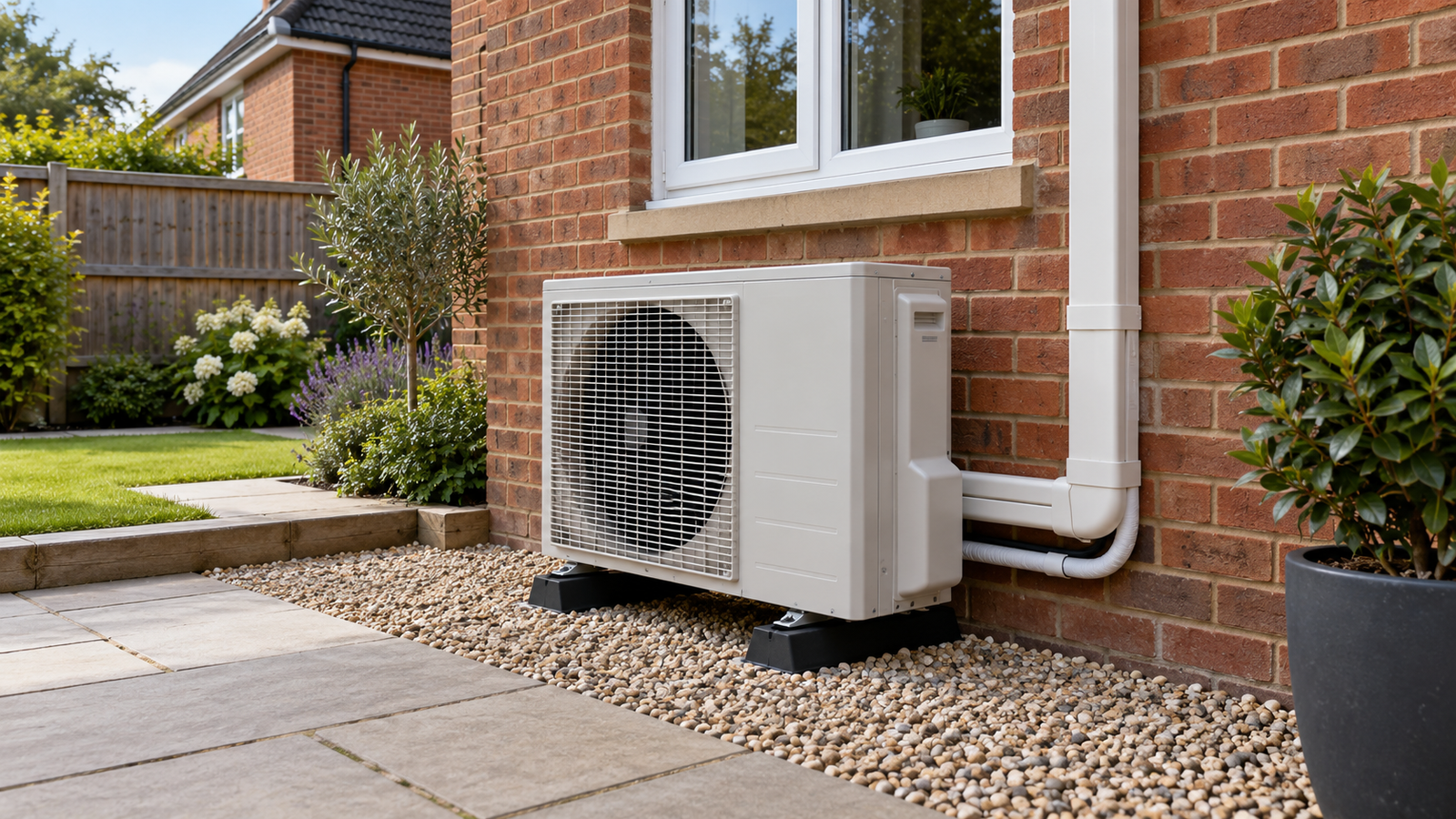
A concealed indoor system still normally connects to external refrigeration equipment.
The outdoor condenser therefore needs a suitable position with consideration given to airflow, access, appearance, noise and the applicable planning rules.
See our Air Conditioning Planning Permission UK guide before the final position is agreed.
IS IT RIGHT FOR YOU?
Ducted or Wall-Mounted AC?
Ducted AC May Suit You If:
- You want the equipment largely hidden.
- You are renovating or extending the property.
- You have suitable ceiling, loft or service space.
- Several rooms need conditioning.
- Interior appearance is a high priority.
- You are prepared for a more involved installation.
Wall-Mounted AC May Suit You If:
- You only need one or two rooms conditioned.
- You want a simpler retrofit.
- You do not have suitable ceiling voids.
- Lower installation complexity matters more than hiding the indoor unit.
- You want each indoor unit to remain directly accessible.
Compare Up to 3 Air Conditioning Installers Near You
Tell us a little about your property to see installer options available in your area.
Free to use with no obligation
THE BOTTOM LINE
Is Ducted Air Conditioning Worth It?
Ducted AC is most compelling when you want permanent multi-room heating and cooling without wall-mounted units dominating the interior.
The price for that discreet finish is a more involved installation and a greater need to plan equipment space, ducts, airflow, zoning and maintenance access properly.
For an existing home with little usable ceiling or loft space, wall-mounted split systems may be considerably easier to accommodate.
For a major renovation or carefully designed whole-house project, concealed AC can be one of the cleanest-looking solutions available.
CONTINUE YOUR RESEARCH
Ducted & Whole-House AC Guides
Whole House Air Conditioning
Compare ducted, multi-split and multiple-system approaches.
Best Home Air Conditioning Systems
Compare the main fixed AC options for UK properties.
Single-Split vs Multi-Split
Compare conventional wall-mounted multi-room layouts.
Air Conditioning Installation UK
See what happens from survey through to commissioning.
AC Planning Permission UK
Check rules affecting the outdoor equipment.
Air Conditioner Size Guide
Understand why capacity should be assessed room by room.
Compare Air Conditioning Quotes
Compare specifications and installation scope properly.
Air Conditioning Installers Near Me
Compare installer options serving your area.
COMMON QUESTIONS
Frequently Asked Questions
What is ducted air conditioning?
Ducted air conditioning uses a concealed indoor unit connected to supply and return grilles by ductwork. Most of the indoor equipment is hidden above ceilings or within another suitable service space.
Can one ducted AC unit cool several rooms?
Potentially, yes. Suitable concealed systems can distribute conditioned air to several rooms or zones, but the number of rooms, airflow, zoning and capacity must be designed for the particular system and property.
Is ducted air conditioning more expensive than wall-mounted AC?
It generally requires more installation work because ductwork, grilles, zoning, access and ceiling integration may be needed. The actual difference depends on the property and system design.
Can ducted air conditioning heat as well as cool?
Yes, where the system is a reversible air-to-air heat pump. If it is intended to provide substantial winter heating, the design should account for room heat losses as well as summer cooling loads.
INDEPENDENT GUIDANCE
About the Author

David Tooth
Independent UK heat pump researcher
Heat Pump Guide UK provides independent information to help homeowners understand air conditioning, heat pumps, system design, costs and installation decisions.
Ducted system suitability depends on the property layout, available void space, cooling and heating loads, airflow design, controls, installation quality and intended use.
Sources and Further Information
- Daikin UK — Residential concealed-ceiling air conditioning
- Daikin UK — ADEA concealed ceiling unit and multi-zoning
- Panasonic UK — Residential air-to-air systems and multi-zone duct
Manufacturer system information checked September 2026. Ceiling-space requirements, duct pressure, zoning capability and permitted system combinations vary by exact equipment and must be confirmed during system design.