
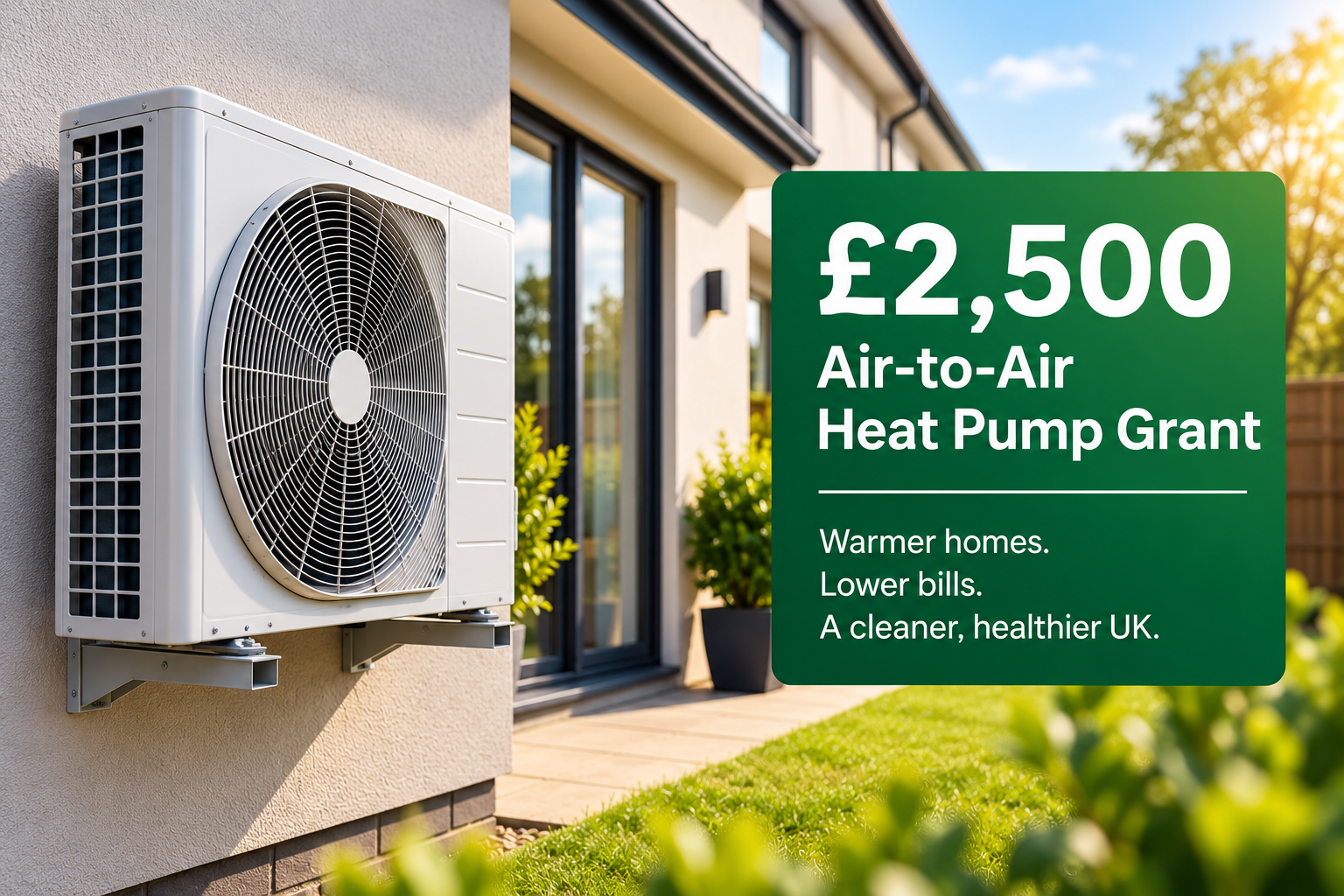
New £2,500 Air-to-Air Heat Pump Grant: Who Qualifies in 2026?
New £2,500 Air-to-Air Heat Pump Grant: Who Qualifies in 2026?
Last updated: September 2026
Air-to-air heat pumps are now formally included in the Boiler Upgrade Scheme, with eligible residential installations in England and Wales able to receive a £2,500 grant once the required MCS installer-certification route is fully operational.
September 2026 update: UKAS has now approved the changes needed to bring air-to-air heat pumps into the redeveloped MCS Installer Scheme. This is a major step towards homeowners being able to use the £2,500 grant, but installer certification is still being implemented and is not yet widely available.
The grant can apply to systems that provide both heating and cooling, but it is not a general £2,500 discount for adding air conditioning to your home.

• Independent UK heat pump researcher
• Reviewed for accuracy
Quick Answer: Can You Claim the £2,500 Air-to-Air Heat Pump Grant Yet?
The £2,500 air-to-air heat pump grant is formally part of the Boiler Upgrade Scheme, but the installer-certification infrastructure is still being completed.
Air-to-air heat pumps became an approved Boiler Upgrade Scheme technology from 28 April 2026. However, installations also need to meet MCS requirements.
In September 2026, UKAS approved updates to the MCS Installer Scheme that bring air-to-air heat pumps into scope. MCS can now move to the next stage: accrediting certification bodies so they can begin certifying air-to-air installers.
What does this mean for homeowners?
The £2,500 grant exists, and qualifying products are already beginning to appear on the MCS Product Directory, but homeowners should not assume they can immediately book any air-conditioning installer and claim £2,500.
The practical rollout depends on appropriately qualified installers obtaining the required MCS certification once certification bodies are accredited to offer it.
MCS says Certsure (NICEIC) and NAPIT are among the first certification bodies intending to apply for the necessary UKAS accreditation.
We will update this guide again when installer certification becomes fully operational.
What Changed in 2026?
Air-to-air heat pumps were added to the Boiler Upgrade Scheme as part of a wider expansion of the technologies eligible for support.
The current headline grant values are:
| Technology | Current BUS Grant | Key Point |
|---|---|---|
| Air-to-air heat pump | £2,500 | Residential properties only |
| Air-to-water heat pump | £7,500 | Standard BUS support |
| Ground source heat pump | £7,500 | Includes qualifying water-source systems |
| Eligible off-grid air-to-water / ground source | Up to £9,000 | Temporary uplift for qualifying oil/LPG homes |
| Biomass boiler | £5,000 | Additional eligibility restrictions apply |
The £9,000 off-grid uplift does not apply to air-to-air systems. Eligible air-to-air installations remain at £2,500.
For the wider grant picture, see our Heat Pump Grants UK guide.
Who Qualifies for the £2,500 Air-to-Air Heat Pump Grant?
There are several important conditions.
At a high level, the proposed installation must:
- be at an eligible residential property in England or Wales;
- replace an eligible fossil-fuel or electric heating system;
- use an eligible air-to-air heat pump;
- be installed and commissioned through an appropriately MCS-certified installer;
- meet the Boiler Upgrade Scheme technical requirements; and
- be sized to meet the property’s full space-heating requirement.
Does the Air-to-Air System Have to Replace Your Existing Heating?
For a normal retrofit property, yes.
The BUS-funded installation needs to replace an existing fossil-fuel or electric heating system.
That can include systems using:
- mains gas;
- oil;
- LPG;
- direct electric heating; or
- another eligible existing heating system.
This is why the grant should be thought of as support for a heating replacement, rather than cashback for adding summer cooling.
Heating replacement, not air-conditioning cashback
A reversible wall-mounted system may look very similar to conventional air conditioning. For BUS purposes, what matters is the role it plays in the property and whether the complete installation satisfies the scheme rules.
Can I Get £2,500 Towards Air Conditioning?
Not simply because the equipment can cool your home.
Many modern fixed split air-conditioning systems are actually reversible air-to-air heat pumps. They can provide warm air in winter and cooling in summer.
That cooling capability does not prevent BUS eligibility. However, a system installed mainly as supplementary summer cooling while the existing heating remains in place would not automatically qualify.
The BUS-funded heat pump needs to meet the property’s full space-heating requirement and satisfy the other eligibility conditions.
If cooling is your main objective rather than replacing the home’s heating, start with our Home Air Conditioning UK guide.
Does an Air-to-Air Heat Pump Have to Heat the Whole House?
The heat pump needs sufficient thermal capacity to meet 100% of the property’s space-heating requirement.
This is important because a typical UK air-conditioning installation may only serve one bedroom, conservatory or living room.
A BUS-funded whole-home system may instead require:
- several indoor units;
- a multi-split or multiple-system arrangement;
- a proper room-by-room heat-loss calculation;
- careful indoor-unit positioning;
- sufficient output at winter design conditions; and
- an appropriate control strategy.
Read our Air-to-Air Heat Pumps UK guide for a fuller explanation of whole-home heating with these systems.
September 2026: Air-to-Air Heat Pumps Enter the MCS Installer Scheme
The biggest practical development for the £2,500 grant arrived in September 2026.
The United Kingdom Accreditation Service (UKAS) approved updates to the redeveloped MCS Installer Scheme that formally bring air-to-air heat pumps into scope.
This removes an important regulatory bottleneck that had prevented the new Boiler Upgrade Scheme support from becoming fully usable in practice.
What happens next?
The next stage is for installer certification bodies to gain UKAS accreditation so that they can assess and certify installers for air-to-air heat pump work.
MCS has confirmed that Certsure (NICEIC) and NAPIT are among the first certification bodies intending to apply.
As part of the certification process, installers will need to demonstrate the appropriate competency for air-to-air systems, including refrigeration, air-conditioning and heat-pump skills.
The approval allows installer certification to move forward. Homeowners should still check the current MCS status of the installer and proposed equipment before relying on the £2,500 grant.
This development follows the arrival of MCS-listed air-to-air products, including the first 65 Daikin Multi-split and Multi+ combinations added to the Product Directory earlier in September.
September 2026 Update: Multi-Split Systems Are Now Appearing on the MCS Product Directory
A significant practical development arrived on 2 September 2026.
Daikin UK and Eurovent Certification announced that 65 residential Daikin Multi-split and Multi+ air-to-air heat pump combinations had been listed on the MCS Product Directory.
Eurovent described this as a UK industry first for multi-split air-to-air products being listed through its certification route.
45 Multi-split combinations
These systems connect one outdoor unit to between two and five wall-mounted indoor units, allowing multiple rooms or zones to be heated and cooled.
20 Multi+ combinations
These combinations can connect multiple indoor air units and, on suitable configurations, a domestic hot-water tank to one outdoor system.
This matters because whole-home air-to-air installations often need several indoor units. Until manufacturers began listing suitable multi-split combinations through MCS, homeowners had less clarity about the products likely to form part of grant-funded installations.
A product appearing on the MCS Product Directory does not, by itself, mean a particular installation will qualify for the Boiler Upgrade Scheme. Ofgem makes clear that the complete system still needs to satisfy all relevant BUS requirements.
That means the installer still needs to confirm matters such as:
- property eligibility;
- the heating system being replaced;
- the heat-loss calculation;
- the capacity of the complete system;
- technical and efficiency requirements;
- the MCS certification of the installation; and
- the wider BUS rules applying to the project.
Other manufacturers may add further eligible products, so check the current MCS Product Directory and ask the installer to confirm the exact equipment proposed for your property.
Do Multi-Split Air-to-Air Systems Qualify?
They can potentially qualify where the complete installation meets the Boiler Upgrade Scheme requirements.
The important issue is not simply whether the equipment is described as a single-split or multi-split system. The complete arrangement must still be designed to meet the property’s full space-heating requirement and comply with the relevant MCS and BUS standards.
The September 2026 Daikin listings are useful because they demonstrate that multi-split equipment can now appear on the MCS Product Directory in configurations suitable for multi-room residential use.
That still does not mean every Daikin multi-split, or every multi-split from another manufacturer, automatically qualifies.
What About Hot Water?
This is one of the biggest differences between air-to-air and conventional air-to-water heat pumps.
A standard air-to-air heat pump heats the air inside the home. It normally does not produce domestic hot water for baths, showers and taps.
Under the current BUS rules, eligible non-fossil-fuel supplementary heating appliances can be used alongside a heat pump.
Depending on the system design, hot water could therefore involve:
- an immersion heater;
- a dedicated hot-water heat pump;
- an electric hot-water system;
- a compatible integrated solution; or
- another arrangement permitted by the applicable BUS rules.
The newly listed Daikin Multi+ range is particularly interesting because some configurations can combine air-to-air space heating and cooling with domestic hot-water production.
Can You Keep a Gas or Oil Boiler as Backup?
Not as a fossil-fuel hybrid system funded through the Boiler Upgrade Scheme.
Hybrid systems that combine a heat pump with fossil-fuel heating are not eligible.
Eligible heat pumps can operate alongside certain supplementary heating appliances, but the supplementary system must meet the relevant rules and the heat pump itself still needs sufficient capacity to meet the property’s full space-heating requirement.
You should therefore not assume that you can keep an existing gas or oil boiler as permanent backup and still claim the £2,500 grant.
Can Landlords Get the £2,500 Grant?
Potentially, yes.
The Boiler Upgrade Scheme is available to property owners, and qualifying residential properties can include rented homes as well as owner-occupied properties.
The usual property, heating-system and technical requirements still apply.
Can New-Build Homes Get the Air-to-Air Grant?
Most ordinary developer-built new homes are not eligible for the Boiler Upgrade Scheme.
Certain eligible self-build properties can qualify where they meet the scheme’s specific self-build conditions.
If you are purchasing a new-build property from a developer, do not assume that the £2,500 grant will be available.
Is the Grant Available in Scotland or Northern Ireland?
No. The Boiler Upgrade Scheme applies to eligible properties in England and Wales.
Scotland and Northern Ireland operate separate funding arrangements, so homeowners there need to check the current support available in their own nation.
How Will You Apply for the £2,500 Air-to-Air Grant?
The Boiler Upgrade Scheme is installer-led, but the air-to-air installer-certification route is still being rolled out.
Once appropriately certified air-to-air installers are available, the process is expected to follow the normal BUS structure:
- Find an installer holding the appropriate MCS certification for air-to-air heat pumps.
- Have the property assessed and its heating requirement calculated.
- Confirm that the proposed equipment and complete installation meet the relevant BUS and MCS requirements.
- Review the full quotation, including the cost before and after the £2,500 grant.
- The installer submits the Boiler Upgrade Scheme application.
- Ofgem contacts the property owner to confirm consent and eligibility information.
- The installer completes and commissions the system.
- The installer redeems the voucher after satisfying the scheme requirements.
How Long Is an Air-to-Air BUS Voucher Valid?
Air-to-air heat pump vouchers currently have a three-month validity period.
Ofgem says installers normally have three months from voucher issue to complete the installation. Ground source heat pumps have a longer six-month period.
This is worth considering for a complex whole-home air-to-air system where surveys, design work, electrical work and several indoor units may be involved.
Is £2,500 Enough to Make Air-to-Air Worth Considering?
For some households, £2,500 can make a meaningful difference to the upfront cost.
Air-to-air systems can sometimes avoid some of the work associated with converting a home to an air-to-water heat pump, such as:
- replacing or enlarging radiators;
- installing new wet heating pipework;
- redesigning radiator circuits for lower flow temperatures; or
- installing the same type of hot-water cylinder arrangement used with many air-to-water systems.
But a whole-home air-to-air system may require several indoor units, external pipework routes and a separate or integrated hot-water solution.
Final cost depends on the property’s layout, heat loss, number of zones, system capacity, indoor-unit positioning, electrical requirements and installation complexity.
£2,500 Air-to-Air Grant vs £7,500 Air-to-Water Grant
The lower grant amount does not automatically make air-to-air worse value. The two systems solve heating in different ways.
| Feature | Air-to-Air | Air-to-Water |
|---|---|---|
| Standard BUS grant | £2,500 | £7,500 |
| Heat delivery | Warm air through indoor units | Radiators / underfloor heating |
| Cooling | Usually available on reversible systems | Not normally through standard radiators |
| Domestic hot water | Usually requires separate or integrated solution | Normally designed into the system |
| Radiators required? | No | Usually yes |
| Off-grid £9,000 uplift? | No | Potentially, where eligibility conditions are met |
Your decision should be based on the complete system cost and suitability rather than simply choosing the technology with the larger grant.
What Should You Ask an Installer Before Relying on the Grant?
Before signing an agreement, ask the installer to confirm:
- whether your property meets the current BUS eligibility rules;
- whether the installer holds the appropriate MCS certification;
- whether the exact air-to-air equipment is MCS certified;
- whether the proposed configuration meets the relevant BUS requirements;
- which heating system is being replaced;
- the calculated whole-property heat loss;
- how the air-to-air system has been sized to meet that demand;
- how domestic hot water will be provided;
- whether any supplementary heating is included;
- the complete price before the grant;
- where the £2,500 discount appears on the quote; and
- whether the finished installation will receive the required MCS certification.
An MCS-listed product is only one part of the eligibility picture. The complete property, design and installation must comply with the Boiler Upgrade Scheme requirements.
£2,500 Air-to-Air Heat Pump Grant FAQ
How much is the air-to-air heat pump grant?
The approved Boiler Upgrade Scheme grant is £2,500 for an eligible residential air-to-air heat pump in England and Wales. However, the MCS installer-certification framework required for practical delivery of the grant is still being implemented in September 2026.
Can I claim the £2,500 air-to-air grant today?
The grant is formally available under the Boiler Upgrade Scheme, but the MCS installer-certification route is still being implemented. UKAS approved the necessary Installer Scheme changes in September 2026, and certification bodies are now progressing towards accreditation. Check that your installer can currently deliver an MCS-certified air-to-air installation through BUS before relying on the grant.
When did air-to-air heat pumps become eligible?
Air-to-air heat pumps became eligible for Boiler Upgrade Scheme applications properly made from 28 April 2026.
Can I get £2,500 towards ordinary air conditioning?
Not automatically. The installation needs to qualify as an eligible air-to-air heat pump system, replace an eligible existing heating system and meet the property’s full space-heating requirement.
Does a single-room air-conditioning system qualify?
A normal single-room system would be unlikely to meet the requirement to provide the property’s full space-heating demand unless the property itself is very small and the complete installation meets all other BUS requirements.
Can multi-split systems qualify?
Potentially. Multi-split systems can form part of an eligible whole-home installation where the products, installer, property and complete system meet the Boiler Upgrade Scheme requirements.
Are Daikin multi-split systems now MCS listed?
Yes. In September 2026, Daikin and Eurovent Certification announced that 65 residential Multi-split and Multi+ combinations had been added to the MCS Product Directory. This does not mean every Daikin installation automatically qualifies for BUS.
Can an air-to-air heat pump provide cooling?
Yes. Many reversible systems provide heating and cooling. Cooling capability does not itself prevent grant eligibility, provided the complete installation meets the heating and other BUS requirements.
Can landlords claim the air-to-air grant?
Eligible residential rental properties can potentially qualify where the property owner and installation meet the normal scheme conditions.
Is the £2,500 grant available to businesses?
No. Under the current Boiler Upgrade Scheme rules, air-to-air grants are limited to residential properties.
Sources & Further Reading
This article was checked against current Boiler Upgrade Scheme rules, Ofgem guidance and the September 2026 multi-split MCS announcement.
- GOV.UK – What you can get through the Boiler Upgrade Scheme
- GOV.UK – Approved Boiler Upgrade Scheme grant categories and values
- Ofgem – Boiler Upgrade Scheme for property owners
- Ofgem – Boiler Upgrade Scheme installer requirements
- Ofgem – Boiler Upgrade Scheme product eligibility
- Eurovent Certification – Daikin multi-split air-to-air heat pumps added to the MCS Product Directory
- MCS Installer Scheme – Air-to-air heat pump implementation enters next phase, September 2026
Related Guides
Thinking About Air-to-Air?
The £2,500 grant can reduce the upfront cost, but the bigger decision is whether an air-to-air system can meet your home’s heating demand, how many indoor units you need and how domestic hot water will be provided.