
Adding a Heat Pump to a Home with Solar Panels and a Battery: What to Check
If you already have solar panels and a home battery, a heat pump is the natural next step, but it adds a large new electrical load to a system that was designed without it. These are the checks to make before you get quotes.
- Sources checked 21 October 2026
- MCS and network operator rules
- Independent research

Quick answer: what changes when you add a heat pump?
Jump to the installer questionsThe heat pump itself works the same as in any other home. What needs checking is the electrical side. That means whether your supply can take the extra load, whether your network operator needs to be told, what your battery and inverter can power, and whether the controls of three separate systems will work together.
Supply and fuse
A heat pump adds a significant load. The installer should check your main fuse and consumer unit before quoting.
Network operator
Heat pumps, solar and batteries all have to be notified to your local network operator. Some need approval before connection.
Controls and tariff
Solar, battery and heat pump usually have separate apps. Decide early which system decides when the heat pump runs.
1. Check your electrical supply and consumer unit
Your home’s supply has a maximum current, set by the main fuse. A heat pump, an electric car charger, an electric shower and a battery charging from the grid can all draw power at the same time.
What the installer should assess
- The rating of your main fuse and the new maximum demand of the home with the heat pump added.
- Whether your consumer unit has space and suitable protection for a new heat pump circuit.
- Whether load management is needed, for example if you also charge an electric car.
Why it matters more in solar homes
Solar and battery installations add their own connections to the consumer unit. A board that was tidy before the heat pump may now need upgrading, which is better known before you accept a quote than discovered on installation day.
2. Notify the network operator
Your distribution network operator (DNO) runs the local electricity network. MCS requires installers to notify the DNO when they install heat pumps, solar panels or batteries.
| Situation | Route | When |
|---|---|---|
| Heat pump, new maximum demand 60A or less (and other criteria met) | Connect and notify | Notify within 28 days of installation |
| Heat pump, new maximum demand 60A to 100A | Apply to connect | Before installation; MCS says the DNO assesses capacity within 10 working days |
| Solar or battery up to 16A per phase | G98 notification | Within 28 days of commissioning |
| Solar or battery above 16A per phase, including most solar-plus-battery systems | G99 application (MCS says G99 is likely for solar with a battery) | Approval needed before connection |
Your heat pump installer handles the heat pump notification. Ask them to check whether your existing solar and battery approval affects anything, and to tell you which form they will submit. If you plan to add or enlarge a battery later, the whole system’s export arrangements may need to be looked at again, not just the new part.
Keep your paperwork together. Your MCS certificates for the solar, battery and heat pump, and any network operator approvals, are needed for export tariffs, grant claims and warranty claims, and are useful if you sell the house.
3. Check what your battery and inverter can power
A battery’s capacity (kWh) is how much it stores. Its inverter’s power rating (kW) is how much it can supply at once. Both matter once a heat pump is running.
Questions to ask about your battery
- What is its usable capacity and maximum continuous output?
- Can it cover the heat pump plus normal household use during your tariff’s peak hours, or will the grid top it up?
- Can it be charged from the grid on a cheap rate, and does your current setup allow that?
- Does it have a backup or emergency power function, and is the heat pump on a circuit it covers?
Do not assume backup heating
Many battery systems only power selected circuits during a power cut, and a heat pump also depends on its circulating pumps and controls. If keeping the heating on during an outage matters to you, ask the battery and heat pump installers to confirm in writing what will and will not run.
For the bigger picture on battery sizing and how batteries are used with heat pumps in winter, see our heat pump, solar and battery guide.
Compare Up to 3 Heat Pump Installers Near You
Tell us a little about your property to see installer options available in your area.
Free to use with no obligation
4. Decide how the controls will work together
Solar inverters, batteries and heat pumps usually come from different manufacturers, each with its own app. They do not automatically coordinate.
Simple schedules
The most common setup. The heat pump runs on its own heating and hot water timetable, set to match your tariff’s cheap hours, while the battery follows its own schedule.
Tariff-led control
Some tariffs can control a compatible battery for you. Check whether yours can, and whether the heat pump schedule then needs adjusting to match.
Integrated systems
Some companies sell solar, battery and heat pump as one controlled package. Ask which brands it supports, as existing equipment may not be compatible.
Whichever route you choose, weather compensation and a sensible flow temperature still matter more to running costs than clever scheduling. Our heat pump temperature settings guide covers the basics, and our smart heating controls guide explains what is compatible with heat pumps.
5. Plan the hot water cylinder and any solar diverter
If you have a combi boiler, you will usually need a hot water cylinder for the heat pump. If you already have a cylinder with a solar diverter, check how the two will work together.
- Cylinder suitability. Heat pumps need a cylinder with a large enough heating coil. An existing cylinder may need replacing even if it already has an immersion heater.
- Diverter priority. A diverter heats water at one unit of heat per unit of electricity, while a heat pump typically produces two to three. Decide which heats the water first, and make sure both are not heating it at the same time.
- Hot water timing. Scheduling the heat pump to heat water around midday on sunny days, or in a cheap tariff window in winter, is usually the simplest saving available.
Moving from a combi? Our combi boiler to heat pump guide covers the cylinder and space it needs.
Questions to ask heat pump installers
Use these alongside the usual questions about heat loss, radiators and price. Tell each installer about your solar and battery at the start.
Solar and battery checklist
- Have you checked my main fuse and calculated the new maximum demand?
- Does my consumer unit need work, and is that included in the quote?
- Which network operator route applies, and will you handle it?
- Will the heat pump be on a circuit my battery can supply, including during a power cut?
- How will the heat pump’s schedule work with my battery and tariff?
- What happens to my existing cylinder and solar diverter?
- Will you provide the MCS certificate and commissioning records I need for grants and tariffs?
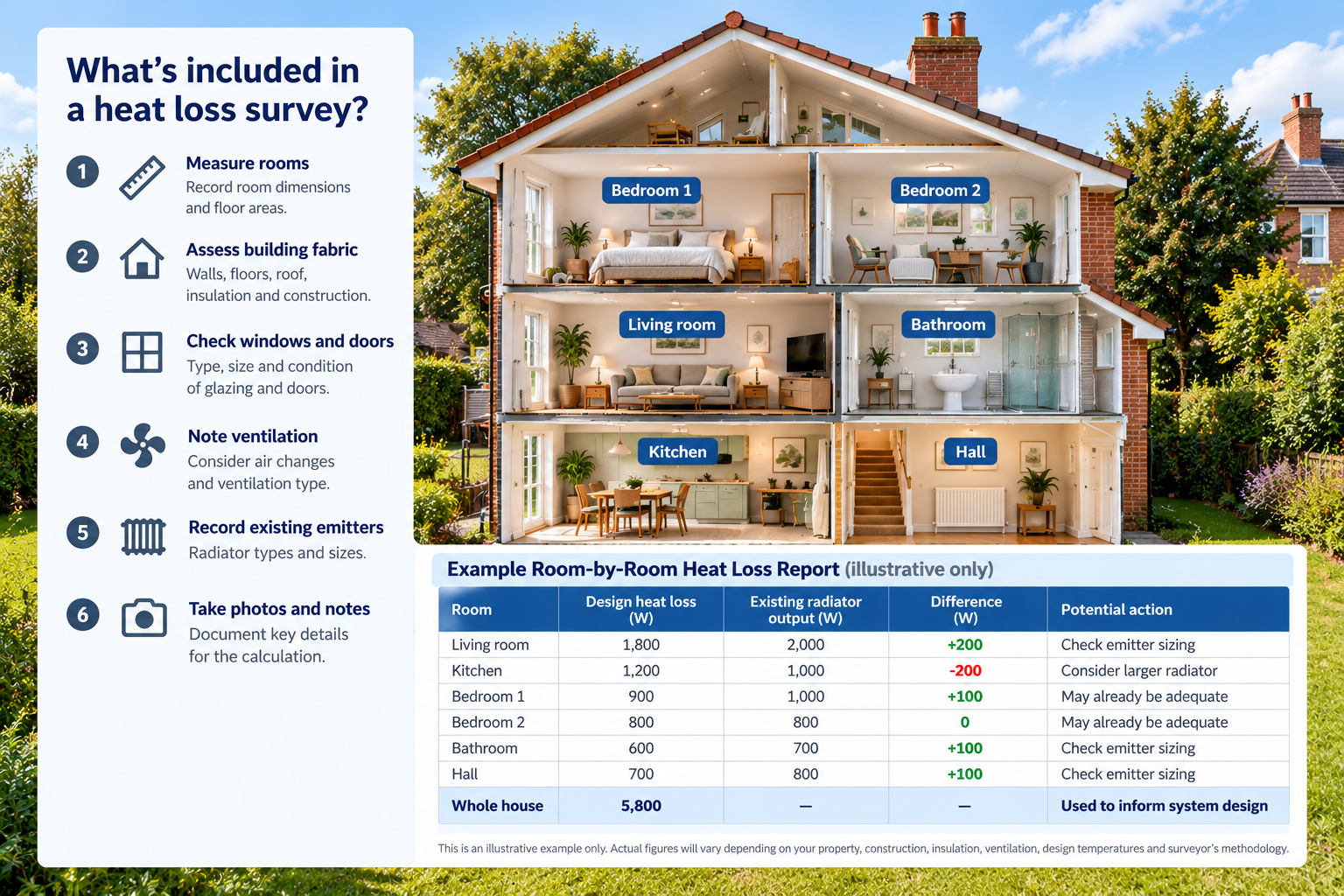
Our heat loss survey guide explains the assessment every quote should be based on, and our installation process guide walks through what happens on the day.
Adding a heat pump to a solar home: FAQs
Does my solar installer need to be involved?
Not necessarily, but it helps. The heat pump installer needs to know what is already connected. If the battery or inverter settings need changing, for example to charge from the grid on a cheap rate, your solar or battery installer may be better placed to do it.
Will adding a heat pump affect my export payments?
It can reduce them, because the heat pump will use some solar electricity you previously exported. That is usually a good trade, because the electricity you use is normally worth more than what you are paid to export, but check your export tariff’s terms.
Do I still get the heat pump grant if I have solar?
Yes, if you meet the normal rules. The Boiler Upgrade Scheme is based on owning the property and replacing a fossil fuel heating system, not on whether you have solar or a battery.
Can I add a battery later if I get a heat pump now?
Yes. Ask for the heat pump and electrical work to leave room for it, and expect the battery to need its own network operator notification or approval. Installing at the same time as solar panels used to be needed for zero-rate VAT on batteries, but batteries retrofitted to existing systems have qualified since February 2024.

Sources and further reading
All sources checked on 21 October 2026.