
Heat Pump with Solar Panels and Battery Storage: Is It Worth It?
Solar panels and a home battery can lower what a heat pump costs to run, but not in the way most adverts suggest. Here is what solar covers, what the battery really does in winter, which tariffs fit and how to judge whether the combination suits your home.
- Sources checked 21 October 2026
- Worked examples with stated assumptions
- Independent research

Quick answer: are solar, a battery and a heat pump worth combining?
See the worked exampleOften yes, but the solar panels do most of their work outside the heating season. In spring, summer and early autumn, solar can cover much of your heat pump’s hot water and light heating. From November to February, when your heat pump uses the most electricity, UK solar output is low, so most of your heating will still run on grid electricity.
That is why the battery matters more than many homeowners expect. In winter its main job is usually storing cheap off-peak grid electricity and using it at peak times, rather than storing solar power. A time-of-use tariff is what turns that into a saving.
Where solar helps most
Hot water all year round, and space heating in spring and autumn. In our worked example below, even with perfect timing, a typical roof could cover at most around half of a heat pump’s annual electricity, and far less in midwinter.
Where the battery helps most
Shifting winter heating onto cheaper overnight or afternoon electricity, and keeping evening heating and hot water off the expensive 4pm–7pm peak on tariffs that have one.
Be wary of headline savings claims. Some companies selling bundled systems advertise bill reductions of up to 80% or 90%. Results like that depend on roof size, battery size, tariff, export payments and how much heat your home loses. Nobody can promise them for your home without looking at your home.
Why solar and heating demand peak at opposite times of year
UK solar panels produce most of their electricity from April to August. Heating demand is concentrated from November to March. The two barely overlap.
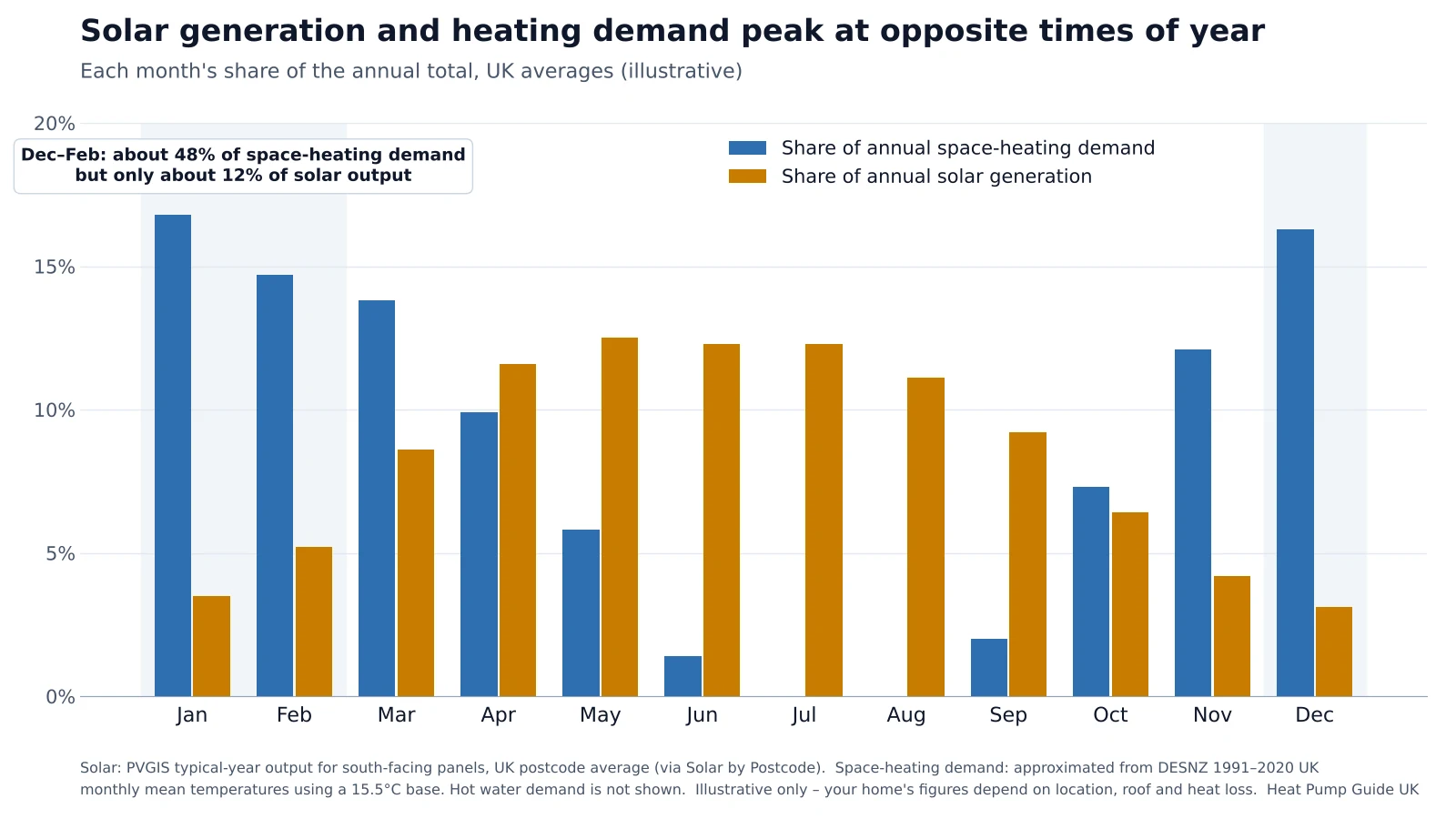
December to February
Roughly 48% of annual space-heating demand, but only about 12% of annual solar output.
November to March
Roughly 74% of space-heating demand, against about 25% of solar output.
A south-facing kilowatt of panels
About 29kWh in December and about 119kWh in May on the UK-average PVGIS figures, so roughly four times as much in late spring.
Hot water is the exception. Your heat pump heats water all year, so solar can make a real difference to that part of the bill in the sunnier months. Our guide to heat pumps in winter explains why winter efficiency also matters.
How many solar panels do you need to run a heat pump?
About ten panels could generate as much electricity over a year as our example heat pump uses, but it would take over 40 to cover January from solar alone. The annual figure is the one installers usually quote, but it hides the seasonal mismatch.
Assumptions used in this example
- 10,000kWh of useful space heating a year, delivered at a seasonal efficiency (SCOP) of 3.0. That is the same illustrative home used in our Heat Pump Running Cost Index.
- 2,000kWh of hot water a year at an efficiency of 2.5, spread evenly across the year.
- Total heat pump electricity: about 4,130kWh a year, ranging from about 625kWh in January to about 70kWh in July.
- Solar: UK-average PVGIS output for south-facing panels, about 950kWh per kilowatt of panels a year. Panels are assumed to be 430W each.
| Solar system | Approx. panels (430W) | Annual generation | Best-case share of heat pump electricity from solar |
|---|---|---|---|
| 4kW | 9–10 | about 3,800kWh | up to about 54% |
| 6kW | 14 | about 5,700kWh | up to about 66% |
| 8kW | 18–19 | about 7,600kWh | up to about 75% |
Illustrative only. The “best-case share” assumes that, in every month, all the solar electricity generated could be used by the heat pump, with a battery covering any timing gaps. In reality your fridge, cooking, laundry and any electric car use solar too, and a battery has limited capacity, so the real share is lower. Location, roof direction, shading and your home’s heat loss all change the numbers.
To match a year’s use
About 4.4kW of panels, or roughly 10 panels, would generate as much electricity in a year as this example heat pump uses. Most of that generation happens when the heat pump needs little.
To cover January from solar alone
About 19kW of panels, or more than 40 panels, would be needed to generate this example heat pump’s January use. Very few homes have the roof space, which is why winter heating mostly runs on grid electricity.
The practical conclusion: size your solar for your whole household’s year-round use and roof, not to “run the heat pump”. If you are still working out the heat pump itself, start with our heat pump sizing guide.
What a home battery actually does for a heat pump
A battery does two different jobs depending on the season. Understanding which one matters most in your home is the key to judging whether it pays.
Summer: storing spare solar
On sunny days the battery stores solar electricity you would otherwise export, then uses it in the evening for the house and for the heat pump’s hot water. How much this is worth depends on the gap between what you pay to import and what you are paid to export.
Winter: storing cheap grid electricity
With little solar, the battery charges from the grid in a cheap time-of-use window and powers the home, including the heat pump, through the expensive peak. Without a time-of-use tariff, this job largely disappears.
What to check about a battery for a heat pump home
- Usable capacity, not headline capacity. Ask how many kWh you can actually use each day, and how that compares with your evening and peak-time use in January.
- Continuous power output. The battery’s inverter limits how much power it can supply at once. Check it can cover the heat pump and typical household loads together, or whether the grid will top up.
- Round-trip losses. Some electricity is lost charging and discharging. Octopus’s own tariff modelling assumes 87.5% efficiency for a standard battery, so a cheap rate needs to be cheap enough to cover that loss.
- Control and tariff compatibility. Some tariffs control the battery for you, but only with compatible models. Check before you buy, not after.
Our heat pump energy monitoring guide explains how to see when your heat pump uses power, which is the starting point for sizing a battery sensibly.
Which tariff suits solar, a battery and a heat pump?
There is no single best tariff for this combination. Even one supplier’s own recommendations differ depending on what else you have.
| Your setup | What Octopus recommends | Why it can fit |
|---|---|---|
| Heat pump + solar (no battery) | Cosy Octopus for import, plus Outgoing Octopus for export | Cheap windows suit heat pump scheduling; spare solar is exported |
| Heat pump + solar + battery | Octopus Flux (import and export) | Cheap 02:00–05:00 charging and better export rates in the 16:00–19:00 peak |
| Heat pump + solar + battery + electric car | Intelligent Octopus Go, plus Outgoing Octopus and its Charge Pack add-on | A long cheap overnight window for the car, battery and heat pump |
Recommendations from Octopus’s smart tariff page and its tariff guide, both checked on 21 October 2026. Octopus’s modelling assumes a 10kWh battery, 4,500kWh of solar a year and heat pump schedules moved into cheap hours, so your results could differ. Other suppliers offer heat pump tariffs too, and you can usually combine them with a separate export tariff.
Winter and summer can favour different tariffs. An export-focused tariff can look excellent in summer and weaker in January, when there is little spare solar to sell. Review your tariff seasonally using your own half-hourly data, and check exit fees before switching.
For a full comparison of heat pump tariffs, including EDF, British Gas and E.ON Next, see our best heat pump tariffs guide.
Hot water: solar diverter or heat pump?
Many solar homes already have a diverter that sends spare solar to an immersion heater. When you add a heat pump, it is worth deciding which one heats your water, and when.
The heat pump is usually more efficient
An immersion heater turns one unit of electricity into one unit of heat. A heat pump typically produces two to three units of hot water heat per unit of electricity, so heating water with the heat pump uses less of your solar or grid electricity.
A diverter can still have a role
If your battery is full and you are paid little for exports, diverting spare solar into the cylinder can still be worthwhile. The answer depends on your export rate and whether the heat pump has already heated the water that day.
Ask your installer how the new cylinder will work with any existing diverter, and make sure the controls do not have both systems heating the same water at the same time.
Is the combination worth it for your home?
Usually a stronger fit
- You already have solar and a battery, so the main cost is the heat pump itself.
- Your home is reasonably well insulated, so heating can be shifted into cheap hours.
- You are willing to use a time-of-use tariff and schedule heating and hot water.
- You are replacing oil, LPG or direct electric heating, where savings tend to be larger.
Check the numbers carefully
- You are buying all three at once and expecting solar to “run” the heat pump in winter.
- Your roof faces north or is heavily shaded.
- Your home loses heat quickly and needs steady heating through the evening peak.
- A bundled quote shows a large saving figure without explaining the tariff and assumptions behind it.
Whether a heat pump suits your home at all is a separate question from solar. Our guide to whether heat pumps are worth it covers that, and our heat loss survey guide explains the assessment that should come first.
Already have solar and a battery? Our guide to adding a heat pump to a home with solar and a battery covers the electrical, battery and control checks to make before you get quotes.
Compare Up to 3 Heat Pump Installers Near You
Tell us a little about your property to see installer options available in your area.
Free to use with no obligation
Grants, loans and VAT if you have solar and a battery
Having solar panels or a battery does not stop you getting heat pump support. The rules depend on the heating system you are replacing, not on what is on your roof.
Boiler Upgrade Scheme
In England and Wales, eligible air-to-water and ground source heat pumps get £7,500, or £9,000 for qualifying off-grid oil and LPG homes until 31 March 2027. You must be replacing a fossil fuel heating system. See our heat pump grants guide.
Warm Homes Loan Scheme
Government-backed loans through approved lenders for heat pumps, solar and batteries across the UK. The scheme rules planned an initial consumer launch phase from September 2026, so availability depends on which lenders are taking part.
0% VAT
Installing heat pumps, solar panels and batteries in homes is zero-rated for VAT until 31 March 2027. Batteries added to an existing solar system qualify, as do batteries charged from the grid.
Warm Homes Loan Scheme: key points from the September 2026 rules
- Owner-occupiers and private landlords can borrow. Homeowners apply through a participating lender, not to the government.
- Loan caps include £15,000 for solar PV and battery storage and £20,000 for an air-to-water heat pump (before any grant).
- You can take a heat pump loan alongside a Boiler Upgrade Scheme grant, with the loan covering costs above the grant.
- Products and installers must be MCS certified.
- Government funding lets lenders cut interest rates by up to five percentage points on loans of three years or more. Rates still vary by lender and depend on credit checks.
Scotland has its own Home Energy Scotland Grant and Loan for heat pumps, and Northern Ireland has separate schemes. Our grants guide covers each nation.
Solar, battery and heat pump FAQs
Can solar panels run a heat pump in winter?
Only partly. UK solar output in December and January is a small fraction of summer output, while heat pump use is at its highest. In our worked example, covering January from solar alone would take more than 40 panels. Expect most winter heating to use grid electricity, ideally on a cheap time-of-use rate.
Do I need a battery to benefit from solar with a heat pump?
No. Solar without a battery still helps with hot water and daytime heating in spring and autumn. A battery adds the ability to use cheap off-peak electricity in winter and to save more solar for the evening, but whether it pays back depends on the battery’s cost, your tariff and your usage.
Should I get solar or a heat pump first?
It depends on what you are replacing and your budget. If your boiler is near the end of its life, the heat pump decision is usually more urgent. If you already have solar and a battery, adding a heat pump lets you use more of what you generate. Both should be designed with the other in mind, especially the electrical supply.
Will having solar panels affect my heat pump grant?
No. Boiler Upgrade Scheme eligibility is based on owning the property and replacing a fossil fuel heating system with an eligible heat pump. Existing solar panels or a battery do not change that.
How big a battery do I need for a heat pump?
There is no single answer. Start with your heat pump’s and household’s electricity use during the most expensive hours on your tariff in January, then compare that with the battery’s usable capacity and power output. A battery that covers your peak-time use is often more useful than one that tries to cover a whole winter day.
Is a heat pump with solar and a battery cheaper to run than gas?
It can be, but it depends on your heat pump’s efficiency, your tariff and how much of its electricity comes from solar or cheap off-peak rates. Our Running Cost Index shows how the comparison changes when part of the electricity comes from your own solar or a battery.
Related guides
 Best Heat Pump Tariffs UKCompare cheap-hour tariffs
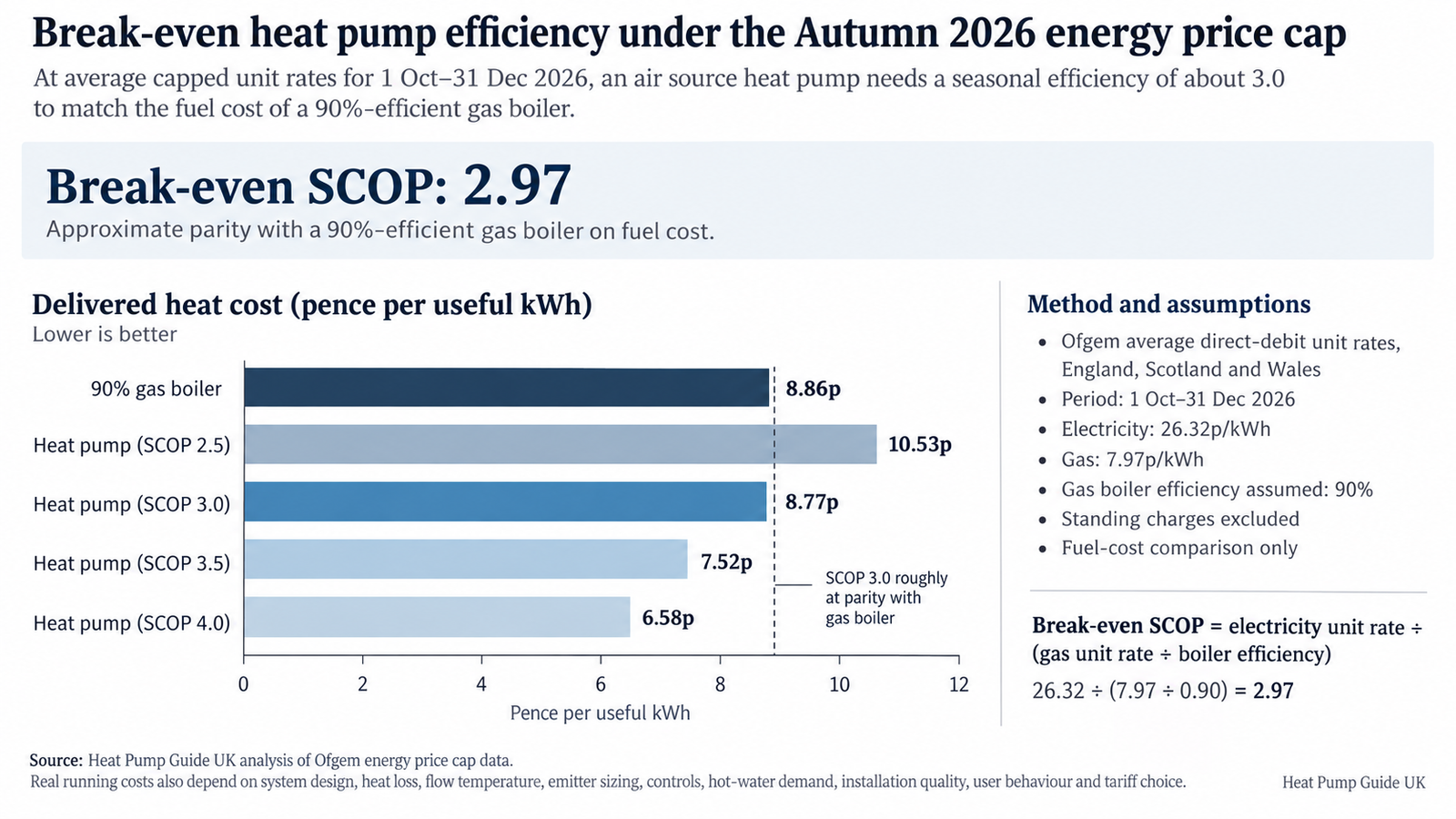 Heat Pump Running Cost IndexCompare costs against gas
 Heat Pump Running Costs UKSee what drives annual costs
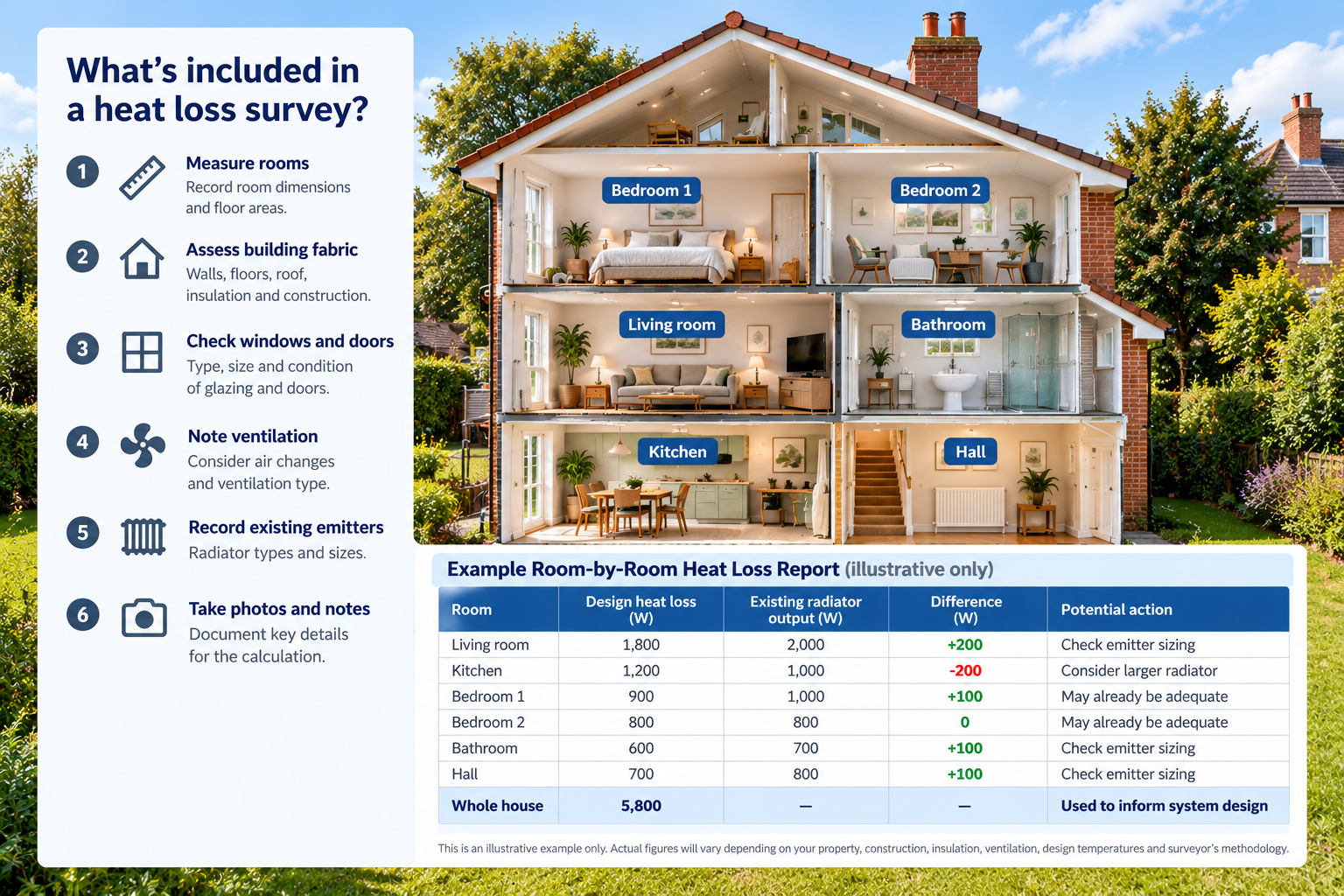 What Size Heat Pump Do I Need?How heat pumps are sized
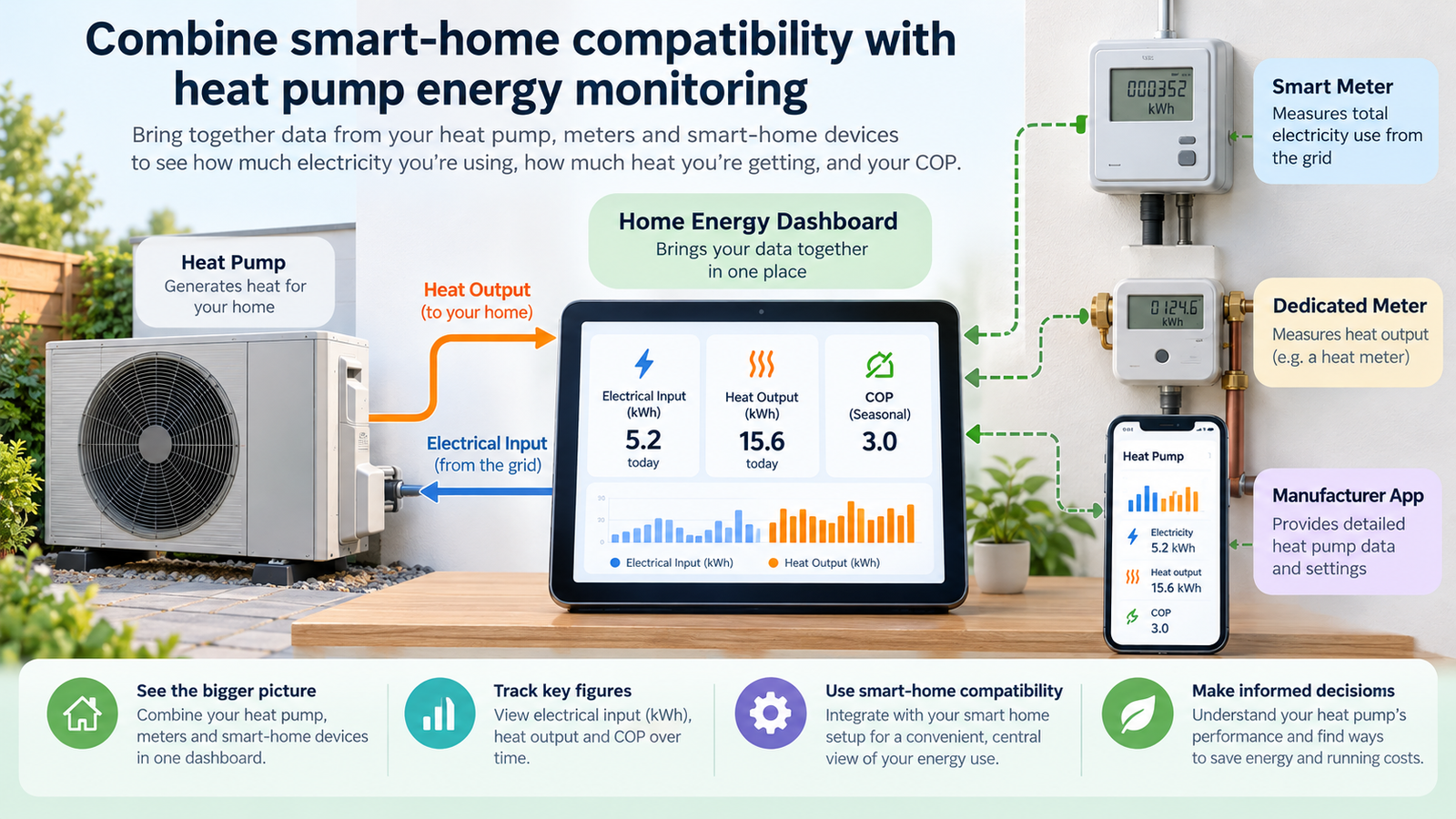 Heat Pump Energy MonitoringSee when your heat pump uses power
 Heat Pump Grants UK£2,500, £7,500 and £9,000 support
Sources and further reading
All sources checked on 21 October 2026.
- Solar by Postcode: UK solar output by month (PVGIS typical-year data)
- DESNZ: Long-term mean temperatures 1991–2020
- Octopus Energy: Smart tariffs
- Octopus Energy: Which smart tariff should I choose?
- Octopus Energy: Octopus Flux
- GOV.UK: Boiler Upgrade Scheme eligibility
- DESNZ: Warm Homes Loan Scheme rules (September 2026)
- legislation.gov.uk: VAT (Installation of Energy-Saving Materials) Order 2024
- Renewable Energy Magazine: MCS installation figures for January to June 2026