
UPDATED OCTOBER 2026
Best Air Source Heat Pumps UK (2026 Guide)
Compare seven of the strongest air source heat pump ranges currently available to UK homeowners, including Daikin, Vaillant, Mitsubishi Electric, Viessmann, Samsung, Panasonic and LG.
compared
homeowner guidance
ranges reviewed

QUICK ANSWER
Our Best Air Source Heat Pump Picks
There is no single heat pump that is objectively best for every home. These are our editorial picks for different homeowner priorities after comparing current UK ranges, retrofit flexibility, controls, noise, operating range and manufacturer support.
Best All-Rounder
Daikin Altherma 4 H
A strong combination of retrofit capability, low-temperature
operation, high-temperature capability and established UK presence.
Best for Retrofit Flexibility
Vaillant aroTHERM plus
R290 technology, high flow-temperature capability and a broad
choice of system configurations make it a strong retrofit option.
Best for Cold-Weather Confidence
Mitsubishi Electric Ecodan R290
A mature UK heat-pump brand with an R290 range designed to continue
operating in very low outdoor temperatures.
Which heat pump would we shortlist first?
For a typical UK homeowner starting from scratch, we would put Daikin Altherma 4 H, Vaillant aroTHERM plus and Mitsubishi Electric Ecodan R290 on the initial shortlist.
That does not mean one of those three will necessarily be right for your property. The final choice should follow a room-by-room heat-loss calculation, emitter assessment, hot-water requirements and a properly designed heating system.
Best Air Source Heat Pumps UK: Quick Comparison
Our categories reflect where each current product range appears particularly strong rather than claiming one specification makes a product universally superior.
| Heat pump | Our pick for | Current range highlight |
|---|---|---|
| Daikin Altherma 4 H | Best all-rounder | R290 system with strong cold-weather and high-flow-temperature capability. |
| Vaillant aroTHERM plus | Retrofit flexibility | R290 monobloc with up to 75°C flow-temperature capability. |
| Mitsubishi Electric Ecodan R290 | Cold-weather confidence | UK-manufactured R290 range available across several domestic outputs. |
| Viessmann Vitocal 150-A | Premium retrofit | R290 monobloc designed specifically with modernisation in mind. |
| Samsung EHS Mono R290 | Quiet / siting-sensitive homes | Modern R290 range with high-temperature capability and quiet-operation focus. |
| Panasonic Aquarea M Series | Flexible R290 system design | Multiple indoor configurations with high-temperature and low-ambient operation. |
| LG THERMA V R290 | Connected controls | R290 system with LG ThinQ and remote service/monitoring capability. |
EFFICIENCY
Which Is the Most Efficient Air Source Heat Pump?
There is no reliable single winner on efficiency. The leading ranges on this page all publish high seasonal efficiency figures, and the gaps between them are usually smaller than the gap between a well-designed and a poorly designed installation of the same unit.
The most useful efficiency comparison is between the exact models two installers are quoting for your home, at the flow temperature your system is designed to run at.
How to compare efficiency figures properly
| Figure | What it tells you | What to watch for |
|---|---|---|
| COP (coefficient of performance) | Heat out divided by electricity in, at one set of test conditions. | A single snapshot. It says little about a whole UK winter. |
| SCOP at 35°C | Seasonal efficiency when the system runs at a low flow temperature, typical of underfloor heating or generously sized radiators. | Only relevant if your home’s design flow temperature is close to 35°C. |
| SCOP at 55°C | Seasonal efficiency at a higher flow temperature, closer to many radiator retrofits. | Usually noticeably lower than the 35°C figure. Compare like with like. |
| Energy label | A banded rating for the product at standard test conditions. | Many current models share the top bands, so the label rarely separates them. |
| Measured SPF (seasonal performance factor) | What a real installation achieved over a year, measured with heat and electricity meters. | The best evidence of real-world performance, but it reflects the whole system, not just the brand. |
What real-world data shows
HeatpumpMonitor.org, an open-source community project, publishes measured annual performance from monitored homes, mostly in the UK. As checked in October 2026, it listed 633 systems with at least a year of metered data. Browsing its system list is a practical way to see how installations of different makes perform in real homes, not just in test conditions.
Treat it as useful evidence rather than a league table. Homes that publish their data are often owned by enthusiasts who have tuned their systems, so they may perform better than average.
Compare Up to 3 Heat Pump Installers Near You
Tell us a little about your property to see installer options available in your area.
Free to use with no obligation
THE BRAND IS ONLY PART OF THE DECISION
What Makes a Heat Pump Good in a Real UK Home?
Modern heat pumps from the major manufacturers are increasingly capable pieces of equipment. The larger differences homeowners experience can come from the system surrounding the heat pump.
That is why two households with the same outdoor unit can see very different comfort and running costs.

HOW WE RANK THEM
How We Chose the Best Air Source Heat Pumps
This is an editorial comparison rather than a laboratory test. We do not assign arbitrary numerical scores because small differences in a brochure specification rarely tell you which system will work best in a particular home.
Instead, we reviewed the current UK product ranges against practical homeowner criteria:
- UK availability and support: whether the current range is actively supported in Britain.
- Retrofit flexibility: available outputs, water temperatures and system configurations.
- Cold-weather operation: the manufacturer’s published operating envelope.
- Noise and siting: particularly relevant on smaller plots.
- Controls: homeowner controls, apps and installer/service tools.
- Refrigerant: the current transition towards lower-GWP refrigerants such as R290.
- System fit: how readily the range can be integrated into typical UK heating and hot-water systems.
We do not rank manufacturers because of commercial relationships, and no manufacturer has paid for its position on this page.
Best Air Source Heat Pumps in Detail
Each section below explains why the range made our shortlist and where we think it fits best.
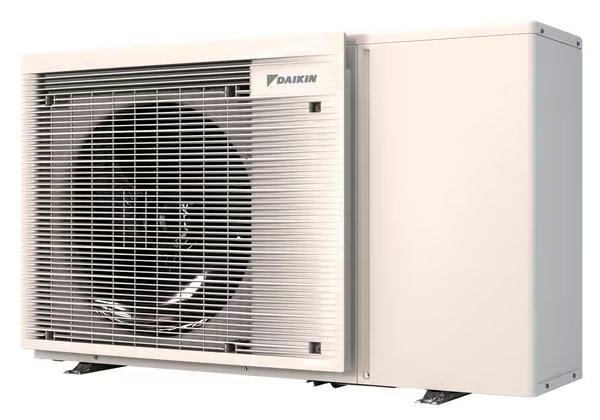
Best All-Rounder
1. Daikin Altherma 4 H
Best for: homeowners wanting a current-generation R290 system with a strong balance of retrofit capability, cold-weather operation and manufacturer support.
Daikin’s current Altherma 4 H moves the range onto R290 and is designed specifically for higher-temperature retrofit applications as well as lower-temperature systems.
Daikin publishes operation down to very low outdoor temperatures and high leaving-water temperatures under defined conditions, making the 4 H particularly interesting for existing homes where emitter upgrades need to be balanced against system efficiency.
- Current-generation R290 refrigerant
- Designed for both retrofit and lower-temperature applications
- High-temperature capability where the design requires it
- Optional app-based control through Daikin Onecta
- Strong overall balance rather than one standout gimmick
Watch for: High maximum water temperature does not mean the system should routinely run hot. Lower flow temperatures generally improve heat-pump efficiency where the property and emitters allow them.
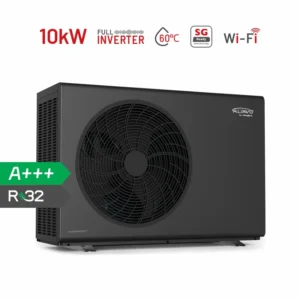
Best for Retrofit Flexibility
2. Vaillant aroTHERM plus
Best for: boiler-replacement projects where a familiar heating brand, flexible indoor-unit options and strong high-temperature capability are useful.
The aroTHERM plus is an established R290 monobloc range and remains one of the most convincing retrofit-focused products in the UK market.
Vaillant publishes flow temperatures up to 75°C and offers a choice of indoor system arrangements, including its integrated uniTOWER. The product is also specifically marketed for quieter residential installations.
- R290 monobloc technology
- Up to 75°C flow-temperature capability
- Choice of indoor system configurations
- Strong fit for boiler-replacement projects
- Designed with residential noise and siting in mind
Watch for: Do not assume an existing radiator system can be left untouched simply because the heat pump can produce high water temperatures. The emitter assessment still matters.
Best for Cold-Weather Confidence
3. Mitsubishi Electric Ecodan R290
Best for: homeowners wanting a well-established UK heat-pump name with a broad R290 range and strong low-temperature operating capability.
Mitsubishi Electric’s current R290 Ecodan range is manufactured at its Livingston facility in Scotland and covers several domestic outputs.
Mitsubishi publishes operation down to -25°C and water temperatures up to 75°C for the R290 range, although the appropriate operating temperature for your home should still be set by the heating design.
- R290 models across several domestic outputs
- Manufactured in Scotland
- Published operation down to -25°C
- High-temperature capability for appropriate applications
- MELCloud Home control and monitoring ecosystem
Watch for: Cold-weather capability should not be confused with guaranteed low running costs. Efficiency still depends heavily on required flow temperature and system design.
Best Premium Retrofit Option
4. Viessmann Vitocal 150-A
Best for: homeowners planning a higher-end heating upgrade who value integrated controls, compact system design and a retrofit-focused product.
The Vitocal 150-A is an R290 monobloc designed with modernisation in mind. Viessmann publishes rated heating outputs across a broad range and high water-temperature capability at low outdoor temperatures.
It also integrates with Viessmann’s energy-management and ViCare control ecosystem, making it particularly relevant to a wider home energy upgrade.
- R290 monobloc
- Designed specifically for modernisation projects
- Broad domestic output range
- Integrated energy-management features
- ViCare app control
Watch for: Premium equipment still cannot compensate for poor heat-loss calculations, incorrect emitters or weak commissioning.
Best for Siting-Sensitive Homes
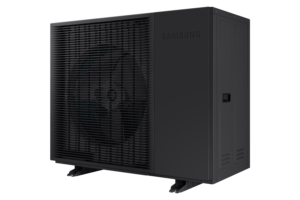
5. Samsung EHS Mono R290
Best for: homes where outdoor-unit positioning, physical design and quiet operation are particularly important.
Samsung’s EHS Mono R290 is a newer-generation monobloc range with 5, 8, 12 and 16kW options and a strong focus on retrofit use, high-temperature operation and residential siting.
Samsung also integrates the range with its SmartThings platform, which may appeal to homeowners already using its connected-home ecosystem.
- R290 refrigerant
- Multiple domestic output options
- Designed with low-noise residential operation in mind
- High-temperature water capability
- SmartThings Energy integration
Watch for: Compare the actual acoustic data for the exact model being proposed and the installer-designed position. A brand-level description such as “quiet” does not replace a proper siting assessment.
Best for Flexible R290 System Design
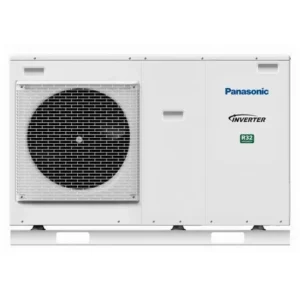
6. Panasonic Aquarea M Series
Best for: homeowners and installers wanting a flexible R290 platform with multiple indoor configurations and connected controls.
Panasonic’s current Aquarea M Series uses R290 and is available in several system formats, including All-in-One, bi-bloc and stand-alone configurations.
Panasonic publishes high water-temperature capability and operation at low outdoor temperatures across the M Series, making it relevant for both retrofit and new-build applications.
- Current-generation R290 platform
- Multiple system configurations
- High-temperature capability where required
- Designed for new build and retrofit applications
- Comfort Cloud and installer service tools available
Watch for: The broad product family means you need to compare the actual model and indoor configuration being quoted, rather than treating “Aquarea” as one specification.
Best for Connected Controls
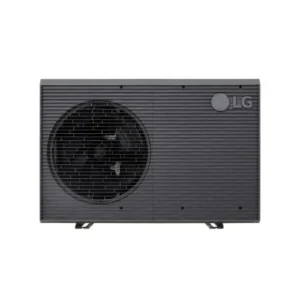
7. LG THERMA V R290
Best for: homeowners who value app-based control, energy monitoring and connected installer/service functions.
LG’s current THERMA V R290 Monobloc combines a low-GWP refrigerant with high-temperature operation and a particularly strong connected controls proposition.
Homeowners can use LG ThinQ for control and energy information, while LG also offers remote monitoring and service functionality for professionals through its wider control platform.
- R290 monobloc platform
- LG ThinQ homeowner controls
- Energy monitoring features
- High-temperature capability
- Remote professional monitoring options
Watch for: Smart features should be treated as a useful extra. Heat-loss calculations, emitter design and installer competence remain more important to heating performance.
CHOOSING FOR YOUR HOME
Which Heat Pump Is Best for Different Types of Property?
Older or higher-heat-loss homes
Do not simply choose the heat pump advertising the highest water temperature. First establish the design heat loss, radiator output and realistic flow temperature.
Smaller plots
Physical dimensions, acoustic performance, boundary distances, airflow and service access become particularly important.
Well-insulated homes
A correctly sized system operating at low flow temperatures can be more important than choosing a particularly powerful unit.
Oil or LPG replacements
Check heat-loss requirements, electricity supply, hot-water storage and current Boiler Upgrade Scheme eligibility before deciding.
COST AND GRANTS
How Much Does a Good Air Source Heat Pump Cost?
Energy Saving Trust currently gives a typical air source heat pump installation cost of around £12,000, although the actual price can vary substantially with the property and work required.
Important cost variables include heat-pump size, hot-water storage, radiator upgrades, electrical work, controls and the complexity of the installation.
In England and Wales, the Boiler Upgrade Scheme currently provides £7,500 towards an eligible air-to-water heat pump. Until March 2027, an eligible off-gas-grid property replacing oil or LPG can receive an additional £1,500, taking the grant to £9,000.
Compare Up to 3 Heat Pump Installers Near You
Tell us a little about your property to see installer options available in your area.
Free to use with no obligation
AVOID THESE
Common Mistakes When Choosing a Heat Pump
Choosing on brand alone
A respected heat-pump brand can still deliver a disappointing system if the equipment is sized or commissioned badly.
Assuming hotter is always better
High-temperature capability can help some retrofit projects, but routinely running a heat pump hotter than necessary can reduce efficiency.
Ignoring radiator calculations
Each room needs enough emitter output at the proposed design temperature. Some homes require radiator changes; others may not.
Comparing headline price only
Two quotes using the same heat-pump brand may include significantly different system designs and levels of work.
COMMON QUESTIONS
Best Air Source Heat Pumps UK FAQs
What is the best air source heat pump in the UK?
There is no universal winner for every property. Our current all-round shortlist starts with Daikin Altherma 4 H, Vaillant aroTHERM plus and Mitsubishi Electric Ecodan R290, but the correct choice depends on your home’s heat loss, emitters, hot-water needs, available space and installer design.
What are the best air source heat pump brands in the UK?
The seven ranges on this page come from Daikin, Vaillant, Mitsubishi Electric, Viessmann, Samsung, Panasonic and LG. All have current R290 ranges for UK homes. Installer experience with a brand, and local support for it, matter as much as the brand itself.
Which is the most efficient air source heat pump?
No single brand is reliably the most efficient in every home. Compare the seasonal efficiency (SCOP) of the exact models you are quoted at your home’s design flow temperature, and remember that installation quality and flow temperature usually matter more than small differences between brochure figures.
Which heat pump is best for an older house?
An older house does not automatically need a particular brand or a high-temperature heat pump. The first step should be a heat-loss assessment followed by radiator and flow-temperature design.
Which heat pump works best in cold weather?
Several current ranges are designed to operate at temperatures well below typical UK winter conditions, including Mitsubishi Ecodan R290, Daikin Altherma 4 H, Panasonic Aquarea M Series and Vaillant aroTHERM plus. Compare the exact model data rather than relying on brand-level claims.
Is R290 better than R32?
R290 has a much lower global-warming potential and is increasingly used in current-generation heat pumps. Refrigerant alone does not determine whether a heat pump is suitable or efficient in your home, however.
How much does an air source heat pump cost?
Energy Saving Trust currently puts a typical air source heat pump installation at around £12,000 before considering available support. Actual quotations can be higher or lower depending on the property, heating-system changes and installation complexity.
Should I choose the heat pump before choosing an installer?
It is useful to shortlist brands, but avoid locking yourself into a specific model too early. A good installer should first establish your property’s heat loss and heating requirements and then explain why the proposed model and output are appropriate.
Useful Guides Before You Choose
Sources & Further Reading
Product information was checked against current manufacturer information. Grant and cost information was checked against GOV.UK and Energy Saving Trust.
OUR VERDICT
Start With the System Design, Then Choose the Brand
Daikin Altherma 4 H is our current best all-round starting point, with Vaillant aroTHERM plus and Mitsubishi Electric Ecodan R290 forming a strong three-brand shortlist for many UK homeowners.
But we would choose a well-designed Vaillant, Mitsubishi, Viessmann, Samsung, Panasonic or LG installation over a badly designed Daikin system every time.
Compare the heat-loss calculation, heat-pump output, flow temperature, radiator changes, controls, hot-water design, warranty and aftercare alongside the brand name.