
HEAT PUMP SIZING GUIDE
What Size Heat Pump Do I Need?
The right heat pump size depends on how much heat your home loses on a cold day — not simply its number of bedrooms, floor area or the size of your existing boiler. Here is how UK heat pump sizing actually works.

AT A GLANCE
Three Things to Know About Heat Pump Size
Heat Loss Sets the Size
Your home’s peak heat loss, measured in kilowatts, is the starting point for choosing the required heat pump capacity.
Bedrooms Are Not Enough
Two three-bedroom houses can have very different heating requirements because insulation, construction, glazing and exposed surfaces differ.
Bigger Is Not Automatically Better
A heat pump should be selected against the calculated load and its actual output under the property’s design conditions, rather than oversized simply for reassurance.
THE NUMBER THAT MATTERS
Heat Pump Size Starts With Your Home’s Heat Loss
A heat pump is normally described by its heating capacity in kilowatts (kW). But choosing the right kW rating is not simply a case of matching the size of the house.
Your home continuously loses heat through its walls, windows, roof, floor and ventilation. The colder it gets outside, the faster that heat is generally lost.
A heating design therefore needs to establish the property’s design heat loss: how much heat must be replaced to maintain the required indoor temperatures when the outdoor temperature reaches the design condition used for your location.
If the calculated whole-house design heat loss were 7 kW, for example, that would mean the property needs approximately 7 kW of heat at those calculation conditions. It does not automatically mean that any appliance carrying “7 kW” in its product name is suitable — its actual output still needs to be checked at the required outdoor and water temperatures.
This is why the first step towards an accurate answer is a proper heat loss survey and room-by-room heat loss calculation.
Compare Up to 3 Heat Pump Installers Near You
Tell us a little about your property to see installer options available in your area.
Free to use with no obligation
ROOM BY ROOM
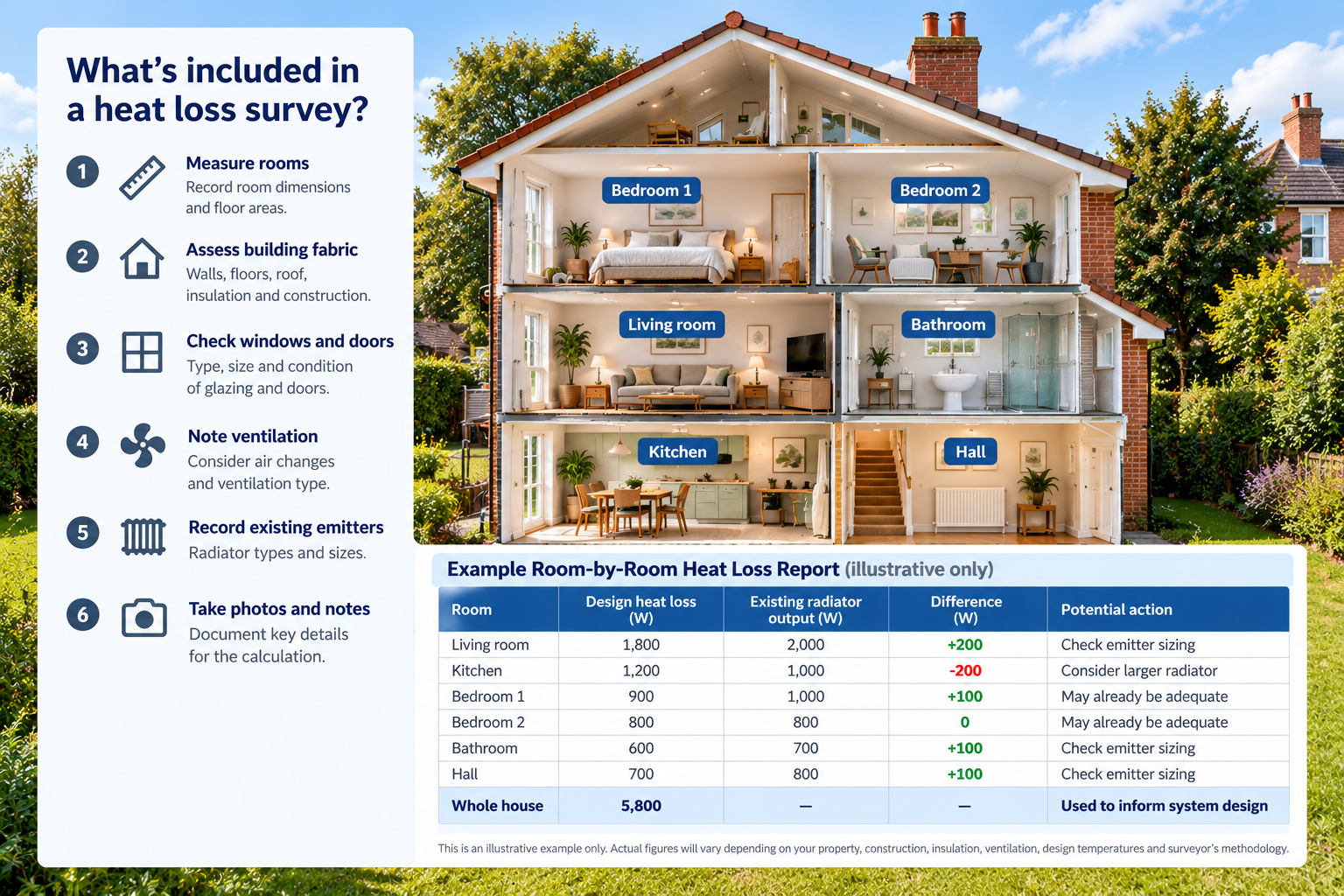
How an Installer Works Out the Size You Need
A proper calculation goes much further than asking how many bedrooms you have. It assesses the heat requirement of each room before combining those figures into a whole-house design heat load.
REAL-WORLD CONTEXT
Is an 8 kW Heat Pump Typical?
It is useful to know what is actually being installed, but national figures should never be used to size an individual home.
For air-to-water heat pumps receiving Boiler Upgrade Scheme payments in England and Wales during April to June 2026, the median installed capacity was 8 kW. The middle half of installations were between approximately 6 kW and 10.8 kW.
| BUS air-to-water installations | Installed capacity | What it means |
|---|---|---|
| Lower quartile | 6 kW | A quarter of systems were at or below this point |
| Median | 8 kW | Half were below and half above the median |
| Upper quartile | 10.8 kW | Three quarters were at or below this point |
These are scheme-wide statistics, not recommended sizes. They do not mean that a typical three-bedroom home needs 8 kW, or that a larger house automatically needs more than 10 kW.
PROPERTY SIZE
What Size Heat Pump for a 2, 3 or 4-Bed House?
Bedroom count is useful for describing a property, but it is a poor basis for specifying a heat pump.
A modern, well-insulated four-bedroom home can potentially have a lower design heat loss than a smaller but poorly insulated detached property. A mid-terrace also has fewer exposed external walls than a detached house of similar floor area.
2-Bed Home
Do not select a heat pump simply from the bedroom count. Floor area, property type, insulation, glazing, ventilation and local design conditions all matter.
3-Bed Home
There is no single correct “3-bed heat pump size”. A three-bed terrace, semi-detached house and detached house can have substantially different heat losses.
4-Bed Home
A larger property may need more capacity, but the final kW requirement still comes from the calculated design heat loss rather than bedroom count alone.
DON’T COPY THE BOILER
Does a 30 kW Boiler Mean You Need a 30 kW Heat Pump?
No. The kW rating printed on your existing boiler should not simply be copied when choosing a heat pump.
Boiler capacity and a home’s peak space-heating requirement are not the same thing. In particular, a combi boiler may have substantial capacity because it has to heat mains water quickly for showers and taps.
An air-to-water heat pump normally supplies stored domestic hot water differently and is selected as part of a complete heating-system design.
Your existing boiler can therefore be much more powerful on paper than the heat pump eventually specified for the same property.
The correct comparison is between the home’s calculated heat demand and the heat pump’s usable output under the required design conditions — not the model number on the old boiler.
OUTPUT CONDITIONS
A “10 kW Heat Pump” Does Not Always Produce 10 kW
This is one of the most important details in heat pump sizing.
Heat pump output can change with operating conditions. For an air source heat pump, important variables include the outdoor air temperature and the water flow temperature the system is being asked to produce.
Energy Saving Trust’s installer guidance specifically warns that a model number does not necessarily equal the output available at the design outdoor temperature for a particular project.
The designer therefore needs to compare your calculated heat load with the manufacturer’s performance data at relevant conditions.
FLOW TEMPERATURE
Why Radiators Affect Heat Pump Sizing
The heat pump is only one part of the heating system. Your radiators or underfloor heating must also be able to transfer enough heat into each room.
Radiators emit less heat when supplied with cooler water. That is why a heat pump design should consider the required room heat output and emitter performance alongside heat pump selection.
If existing radiators cannot provide enough heat at the proposed design flow temperature, the solution may involve larger radiators, different emitters or a different design temperature.
This does not mean every heat-pump installation requires every radiator to be replaced. It means the emitters should be assessed room by room rather than assumed to be suitable.
See our full guide to whether you need new radiators for a heat pump.
TOO BIG OR TOO SMALL
What Happens If a Heat Pump Is the Wrong Size?
If It Is Too Small
A unit that cannot meet the design heat load under the required conditions may struggle to maintain the intended indoor temperature during cold weather or require additional electrical heat where the system design provides for it.
If It Is Too Large
More capacity is not automatically better. An unnecessarily large unit can have a higher minimum output and may cycle more frequently when the property needs relatively little heat.
The Aim
Select a unit whose verified operating envelope suits the calculated design load while also considering modulation, emitters, hydraulics and the wider system design.
OVERSIZING
Should You Add Extra Capacity “Just in Case”?
Adding an arbitrary safety margin is not the same thing as good system design.
The calculation itself should use appropriate assumptions for the building and design conditions. The selected heat pump then needs to be checked against manufacturer performance data.
If the calculated heat load falls between available models, the designer may need to select the next appropriate unit capable of meeting the requirement. That is different from automatically adding several kilowatts because “bigger is safer”.
Energy Saving Trust’s sizing guidance recommends selecting a unit that meets the project’s heat demand at the design outdoor temperature and checking the manufacturer’s output data for the required conditions.
INSULATION
Can Insulation Reduce the Heat Pump Size You Need?
Potentially, yes. If an improvement reduces the building’s design heat loss, the required heating capacity can also fall.
Examples can include improvements to poorly insulated roofs, walls, floors, glazing or uncontrolled draughts where these are appropriate for the property.
The important question is timing.
If significant insulation work is definitely going to be completed before the heat pump is installed, the final system design should reflect the intended building fabric rather than blindly sizing against conditions that will no longer exist.
Equally, do not assume a future improvement will happen and undersize the heating system on that basis unless it forms part of the actual project.
HOT WATER
Does Hot Water Change the Heat Pump Size?
Domestic hot water is part of the overall system design, but it should not be confused with the property’s peak space-heating heat loss.
An air-to-water heat pump will commonly heat a hot-water cylinder at scheduled times rather than provide instantaneous hot water in the way a combi boiler does.
The designer therefore needs to consider:
CURRENT UK REQUIREMENTS
Heat Pump Sizing and the Boiler Upgrade Scheme
For Boiler Upgrade Scheme installations, the heat pump must be sized to meet the property’s full space-heating needs.
Current government-approved standards for the scheme include MIS 3005-D Heat Pump Design Standard Version 3.0.
This reinforces why a grant-funded heat-pump installation should not be specified from a generic bedroom chart or by copying the capacity of the existing boiler.
If you are considering financial support, see our current guide to heat pump grants in the UK.
CHECKING A QUOTE
What to Ask If an Installer Recommends a Heat Pump Size
You do not need to become a heating designer to ask useful questions about a proposed system.
If you have not yet reached this stage, our heat loss survey guide explains what should happen before the final heat pump is specified.
Compare Up to 3 Heat Pump Installers Near You
Tell us a little about your property to see installer options available in your area.
Free to use with no obligation
ONLINE ESTIMATES
Can You Calculate Heat Pump Size Online?
An online heat pump sizing calculator can be useful for understanding whether a quoted figure looks broadly plausible, but it should not be treated as the final specification for a real installation.
A simple calculator may use inputs such as floor area, property age, insulation level, property type and location.
Those inputs can provide an estimate, but a professional design can consider each room, building element, ventilation assumptions, design temperatures, emitter requirements and the actual performance characteristics of the proposed heat pump.
QUICK CHECK
Six Signs the Sizing Process Deserves More Questions
COMMON QUESTIONS
Frequently Asked Questions
What size heat pump do I need for my house?
The correct size should be based on your property’s calculated design heat loss rather than bedroom count alone. A room-by-room heat loss calculation establishes the heating requirement, after which the proposed heat pump’s output should be checked at the relevant outdoor and flow temperatures.
What size heat pump do I need for a 3-bed house?
There is no single correct kW size for every three-bedroom house. A well-insulated three-bed terrace can have a very different heat loss from an older three-bed detached property. Use bedroom-based figures only as rough context, not as a system specification.
Is an 8 kW heat pump enough for a 3-bed house?
It might be, but the bedroom count cannot confirm it. The important comparison is between the home’s calculated design heat loss and the proposed heat pump’s available output under the required operating conditions.
Is an 8 kW heat pump enough for a 4-bed house?
Possibly, but some four-bedroom homes will require less and others more. Floor area, construction, insulation, glazing, ventilation, exposed surfaces and local design conditions all affect the required capacity.
Can a heat pump be too big?
Yes. More capacity is not automatically better. An unnecessarily large heat pump can have a higher minimum output relative to the home’s demand during milder weather, which can contribute to more frequent cycling. Correct sizing should consider both design-day capacity and how the unit operates across changing loads.
Can a heat pump be too small?
Yes. If the heat pump cannot provide enough output to meet the calculated heat requirement under the design conditions, the system may struggle during colder weather or rely more heavily on supplementary electrical heat where provided.
Should I size a heat pump from my gas boiler?
No. The capacity of an existing boiler is not a reliable measure of the home’s design heat loss. This is particularly important with combi boilers, which may have high output ratings partly to provide instantaneous domestic hot water.
Does a bigger house always need a bigger heat pump?
Not necessarily. Floor area matters, but so do insulation, construction, glazing, property type, ventilation and exposed surfaces. A larger efficient property can potentially have a lower design heat loss than a smaller poorly insulated one.
Do I need a heat loss survey before choosing a heat pump?
A detailed room-by-room heat loss calculation is fundamental to properly sizing a heat pump and its emitters. A preliminary quote may use estimates, but the final system design should be based on a sufficiently detailed assessment of the property.
SOURCES & FURTHER READING
Research Sources
- Energy Saving Trust — Green Heat Installer Toolkit: Sizing a Heat Pump.
- Energy Saving Trust — Green Heat Installer Toolkit: Heat Loss Calculations.
- Ofgem — Boiler Upgrade Scheme guidance for installers and property owners.
- Department for Energy Security and Net Zero — Boiler Upgrade Scheme approved standards, September 2026.
- Department for Energy Security and Net Zero — Boiler Upgrade Scheme statistics, July 2026 release.
BOTTOM LINE
So, What Size Heat Pump Do You Need?
The right size is the one that can meet your home’s calculated design heat load under the operating conditions the system is designed for.
For many UK installations, the final number may fall somewhere around the capacities commonly seen in the 6–11 kW part of the market — but that is context, not a sizing method.
Do not choose a heat pump because a bedroom chart says “8 kW”, because your boiler is 30 kW, or because a larger model feels safer.
Start with the room-by-room heat loss calculation, understand the proposed flow temperature and emitter requirements, then ask the installer to show how the chosen heat pump’s actual output matches that design.
Solar panels do not change the size of heat pump you need, because sizing is based on your home’s heat loss on the coldest days, when solar output is at its lowest. Our heat pump, solar and battery guide explains what solar and a battery can and cannot do.