
Commercial Air Source Heat Pumps UK: Complete Guide
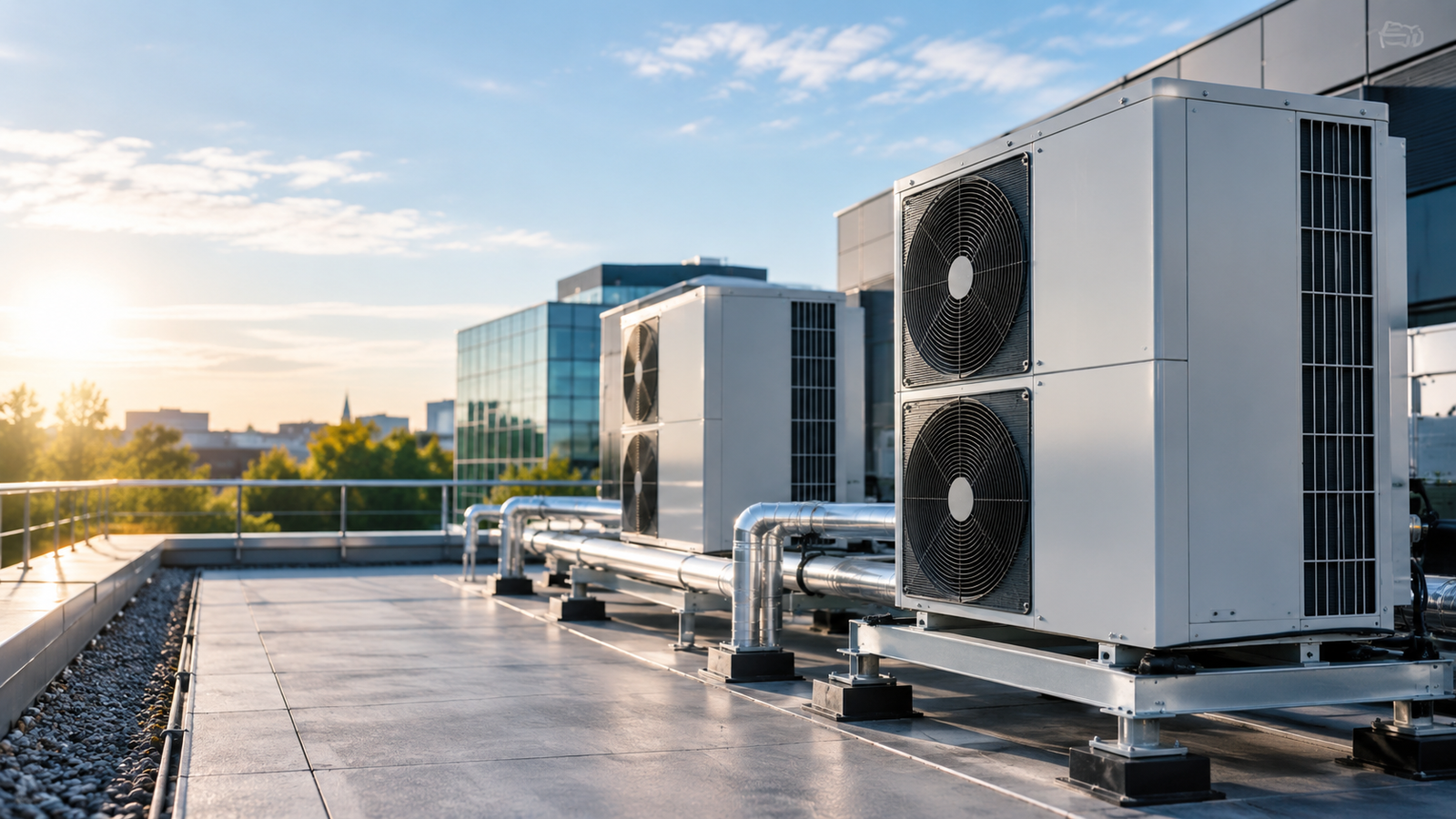
Commercial air source heat pumps can provide heating, cooling and hot water for offices, schools, hotels, retail premises, healthcare buildings and other non-domestic properties, with systems ranging from relatively small units to large modular installations delivering hundreds of kilowatts.
This guide focuses on how commercial air source heat pumps differ from domestic systems, the main air-to-water and air-to-air configurations, sizing, flow temperatures, cascade systems, refrigerants, cold-weather performance and the design decisions that determine whether a project performs well.
- UK commercial heat pump research
- For businesses & specifiers
- Editorially independent

Quick Answer: What Is a Commercial Air Source Heat Pump?
A commercial air source heat pump extracts heat from the outside air and transfers it into a commercial building or heating system using a refrigeration cycle.
The term can describe both air-to-water systems, which heat water for radiators, fan coils, underfloor heating or hot water, and air-to-air systems, which transfer heating or cooling directly into occupied spaces through indoor units.
Most central-heating projects use air-to-water
When businesses talk about replacing commercial boiler plant with an air source heat pump, they are commonly referring to an air-to-water system because it can connect to a building’s water-based heating distribution. Air-to-air systems are more commonly used where direct space heating and cooling are required.
For a broader comparison of air, ground and water-source systems, start with our Commercial Heat Pumps UK guide.
Commercial Air-to-Water vs Air-to-Air Heat Pumps
Both technologies take energy from the outside air, but they distribute that energy differently inside the building.
| Feature | Commercial Air-to-Water | Commercial Air-to-Air |
|---|---|---|
| Heat distribution | Hot water circulated through a hydronic system | Heated or cooled air delivered directly into occupied spaces |
| Typical emitters | Radiators, fan coils, underfloor heating and air-handling coils | Wall, ceiling, cassette, ducted or other indoor units |
| Cooling | Possible with suitable reversible equipment and emitters | Commonly integrated as part of the same system |
| Domestic hot water | Can be integrated where the system and storage arrangement are designed for it | Usually requires a separate hot-water solution unless specialist equipment is used |
| Boiler replacement | Often the more direct route where an existing wet heating system is retained | Changes the building’s heat-distribution approach |
| Typical applications | Schools, offices, healthcare, hotels, public buildings and central heating systems | Offices, shops, restaurants, hotels and zoned commercial spaces |
Neither system is automatically better. The correct choice depends on whether the building needs central hot-water distribution, room-by-room heating and cooling, domestic hot water, or a combination of these services.
How Does a Commercial Air-to-Water Heat Pump Work?
A commercial air-to-water heat pump uses an outdoor heat exchanger to absorb energy from the surrounding air. The refrigerant circuit raises this energy to a useful temperature, after which a heat exchanger transfers it into the building’s water-based heating system.
That heated water can then supply:
- Radiators
- Underfloor heating
- Fan coil units
- Air handling unit coils
- Heating circuits serving multiple zones
- Indirect domestic hot-water storage
- Heat exchangers serving secondary systems
Some commercial units are reversible and can also produce chilled water for cooling.
How Powerful Are Commercial Air Source Heat Pumps?
There is no single capacity range that defines a commercial air source heat pump. Current UK-market equipment extends from units in the tens of kilowatts into large systems delivering several hundred kilowatts.
| Current Manufacturer Example | Published Output / Range | Refrigerant / Temperature Information |
|---|---|---|
| Baxi Auriga HP | 20kW, 26kW, 30kW and 40kW models | Mid-temperature commercial air-to-water range; Baxi publishes supply temperatures up to 60°C |
| Baxi Auriga HP+ | Commercial high-temperature range | R290; Baxi publishes supply temperatures up to 80°C |
| Daikin EWYE-CZ | 16kW–70kW | R454C; published hot-water temperatures up to 70°C |
| Daikin EWYT-B | 82kW–650kW heating capacity | R32 commercial air-to-water heat pump range |
| Rinnai R290 commercial & industrial range | 40kW–410kW | R290; published hot-water capability up to 75°C under stated operating conditions |
These are examples of currently published manufacturer ranges, not rankings or recommendations. Capacity, temperature and efficiency figures vary with operating conditions and should always be checked against current technical data before specification.
For wider brand research, see our independent Commercial Heat Pump Manufacturers UK comparison.
Single, Cascade and Modular Commercial ASHP Systems
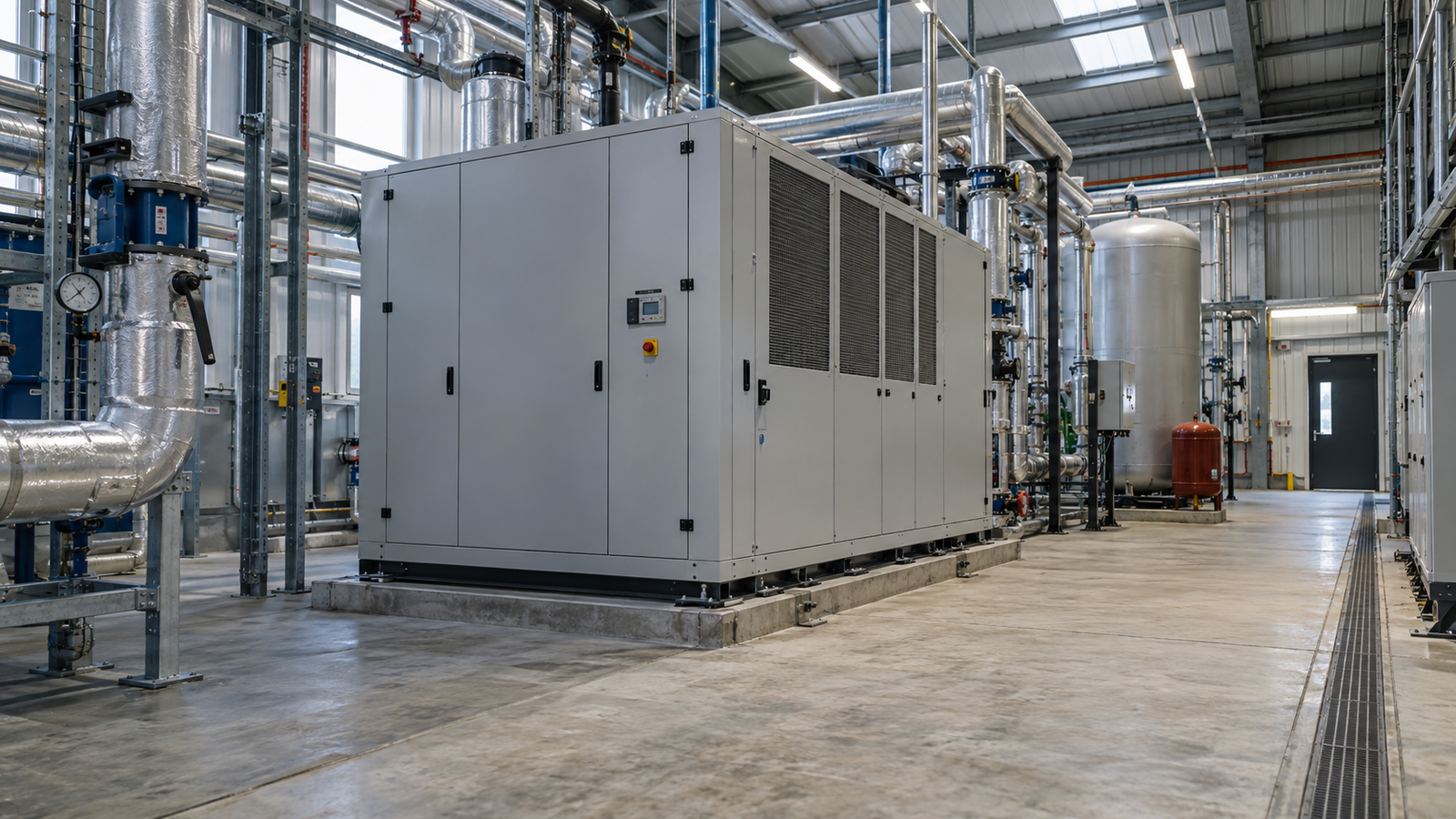
A commercial installation does not necessarily require one very large heat pump. Depending on the load and equipment being used, several smaller units can be combined into a cascade or modular system.
Single Heat Pump
One unit serves the required heating or cooling load. This can simplify controls and hydraulics where the building demand fits comfortably within one unit’s operating range.
Cascade System
Multiple heat pumps are sequenced together, allowing capacity to increase or decrease as building demand changes.
Modular Plant
Larger projects can use modular equipment designed specifically to operate as part of a larger plant arrangement.
Bivalent / Hybrid Plant
A heat pump can sometimes operate alongside another heat source where project requirements justify retaining supplementary plant.
Cascade systems can offer benefits such as improved capacity matching, staged operation and a degree of resilience, but they require an appropriate control and hydraulic strategy.
The number of units should not be chosen simply by dividing peak heat demand by the nominal output printed on a product datasheet. Our commercial heat pump design and installation guide explains the wider specification process.
Where Are Commercial Air Source Heat Pumps Used?
Air source systems are particularly attractive where there is no suitable ground or water source and where installing external units is practical.
| Building Type | Possible Heat Pump Role | Important Design Issue |
|---|---|---|
| Offices | Heating, chilled-water cooling or direct air heating/cooling | Zoning, occupancy and simultaneous heating/cooling requirements |
| Schools | Central heating and potentially hot water | Existing emitters, older building fabric and occupancy schedules |
| Hotels | Space heating, cooling and domestic hot water | Large and time-sensitive hot-water demand |
| Retail | Heating and cooling | Long operating hours, door opening and ventilation loads |
| Healthcare | Heating, cooling and hot water | Resilience, comfort requirements and hot-water temperatures |
| Warehouses | Space heating and cooling where required | Large volume, air distribution and intermittent occupancy |
| Industrial Buildings | Building heating or lower-temperature process duties | Whether the requirement is building heat or genuine process heat |
Where the main requirement is manufacturing process heat, waste-heat recovery or very large thermal loads, our separate Industrial Heat Pumps UK guide is the more appropriate starting point.
How Should a Commercial Air Source Heat Pump Be Sized?
Commercial ASHP sizing should begin with the building’s actual thermal requirements, not the rated capacity of the boiler being replaced.
A proper assessment should consider:
- Design heat loss at the relevant outdoor design temperature
- Heating load throughout the year, not only the theoretical peak
- Domestic hot-water demand and recovery requirements
- Cooling load where reversible operation is required
- Required flow and return temperatures
- Actual heat-pump output at low outdoor temperatures
- Defrost behaviour
- Part-load performance and minimum modulation
- Operating hours and occupancy
- Required resilience or backup capacity
An existing commercial boiler installation may contain considerable spare capacity. Replacing the same nominal kW figure with heat pumps can therefore result in unnecessary oversizing unless the building load is properly assessed.
Oversizing can increase capital cost and may make efficient part-load operation more difficult, while undersizing without a deliberate bivalent strategy can leave the system unable to meet design conditions.
Why Flow Temperature Matters
Flow temperature is one of the most important variables in an air-to-water heat pump project.
As the temperature lift between the outdoor heat source and the water leaving the heat pump increases, the compressor generally has to work harder. Lower distribution temperatures can therefore help improve heat-pump efficiency where the building and emitters can operate effectively at those temperatures.
| Emitter / Application | Design Consideration |
|---|---|
| Underfloor heating | Large emitter area can make it well suited to relatively low water temperatures |
| Fan coil units | Can provide useful output at lower temperatures when correctly selected |
| Radiators | Output must be recalculated at the proposed heat-pump flow and return temperatures |
| Air handling unit coils | Existing coils may need checking or resizing for lower water temperatures |
| Domestic hot water | Usually requires a higher temperature than space heating and may need a separate control or storage strategy |
High-temperature equipment is now available where lower-temperature conversion is impractical. See our High-Temperature Heat Pumps guide for the trade-offs between higher water temperatures, retrofit practicality and efficiency.
Do Commercial Air Source Heat Pumps Work in Cold Weather?
Yes. Commercial ASHPs are designed to continue extracting heat from outdoor air below 0°C, but available capacity and efficiency change as outdoor conditions become more demanding.
Current manufacturer examples illustrate this operating range. Baxi states that its Auriga commercial systems can operate down to -20°C ambient, while Daikin publishes an ambient operating range down to -25°C for its EWYE-CZ under the manufacturer’s stated conditions.
Those figures should not be interpreted as proof that every heat pump maintains its nominal output or headline efficiency at those temperatures.
Defrost also matters
In cold, humid weather, ice can form on an air-source heat pump’s outdoor heat exchanger. The unit periodically needs to remove that ice through a defrost cycle.
For a commercial system, the design therefore needs to consider:
- Capacity during cold design conditions
- How defrost affects delivered heat
- Whether multiple units can avoid defrosting simultaneously
- System water volume or thermal storage where required
- Defrost-water drainage
- Ice formation around outdoor equipment
Cold-weather performance should be assessed using manufacturer performance data at the project’s actual design conditions rather than a single nominal output figure.
Can Commercial ASHPs Provide Heating and Cooling?
Yes. Many commercial air-source systems are reversible and can provide both heating and cooling.
For air-to-water systems, this can mean supplying hot water during the heating season and chilled water to fan coils or air-handling systems when cooling is required.
Air-to-air and VRF/VRV-style systems commonly provide direct heating and cooling to individual building zones.
Some larger commercial systems can go further by recovering heat between different parts of a building when heating and cooling demands occur at the same time.
Cooling can materially change the project case
Where a building already requires both heating and mechanical cooling, the comparison should consider the complete heating-and-cooling system rather than comparing a heat pump only with the existing boiler.
Commercial Hot Water With an Air Source Heat Pump
Commercial domestic hot water can be more challenging than space heating because temperatures are higher and demand can be concentrated into short peak periods.
This is particularly important in:
- Hotels
- Leisure facilities
- Healthcare buildings
- Care facilities
- Restaurants and hospitality
- Changing facilities
The design may need to consider storage volume, recovery time, peak draw-off, return circulation, hygiene requirements and whether space heating and hot water should be produced by the same heat pump.
Higher-temperature refrigerant technologies, including R290 heat pumps, are becoming increasingly visible in this part of the commercial market.
R290 Commercial Air Source Heat Pumps
R290 is the refrigerant designation for propane and is now used in a growing range of air source heat pumps.
Its use is not confined to small domestic equipment. Rinnai currently publishes R290 commercial and industrial air-to-water equipment extending from 40kW to 410kW, while Baxi’s high-temperature commercial Auriga HP+ also uses R290.
R290 can be well suited to high-temperature applications, but propane is flammable. Safety measures, equipment positioning, charge size, clearances and project-specific requirements therefore need to be considered by competent designers.
Our dedicated R290 Heat Pumps UK guide looks at the refrigerant in more detail across domestic, commercial and industrial applications.
Other Commercial ASHP Refrigerants
R290 is only one part of the market. Commercial air-to-water systems currently use several refrigerants depending on product design, output and intended application.
Examples in current UK manufacturer ranges include:
- R290 — propane, increasingly visible in higher-temperature commercial equipment
- R32 — used in a number of commercial air-to-water and air-to-air systems
- R454C — used by Daikin in its 16–70kW EWYE-CZ commercial air-to-water range
- Other refrigerants — still present across larger and specialist commercial equipment
Refrigerant should not be selected in isolation. Required capacity, temperature, efficiency, safety classification, product availability, maintenance strategy and future regulatory exposure all matter.
Electrical Supply and Commercial Heat Pumps
Electrical capacity should be investigated early in a commercial ASHP project.
The required electrical input is lower than the useful heat output because the heat pump transfers energy rather than converting electricity directly into heat. Even so, replacing substantial fossil-fuel boiler capacity with electric heat pumps can create a significant new electrical demand.
Designers may need to assess:
- Available incoming supply capacity
- Three-phase distribution
- Maximum electrical input at design conditions
- Starting characteristics
- Other major building electrical loads
- Electric backup or immersion loads
- Planned EV charging, solar PV or battery installations
- Potential network or supply upgrades
- Demand-management opportunities
Discovering an electrical-capacity constraint after equipment has been selected can materially change project cost and programme, which is why it forms part of our commercial heat pump procurement checklist.
Noise, Siting and Planning
Commercial air source heat pumps move significant volumes of air across outdoor heat exchangers, making siting an important part of system design.
Consider:
- Manufacturer sound power and sound pressure data
- Distance to neighbouring properties
- Bedrooms, offices or other noise-sensitive spaces
- Operating hours, including overnight operation
- Reflections from walls, courtyards and enclosures
- Airflow and recirculation between multiple units
- Maintenance access
- Visual impact
- Defrost-water drainage
Can a Commercial ASHP Replace Existing Boiler Plant?
It can, but successful retrofit involves more than replacing one heat generator with another.
The existing system should be assessed for:
- Actual building heat loss
- Historic boiler oversizing
- Radiator and coil output at lower temperatures
- Existing pump and pipework arrangements
- Domestic hot-water generation
- Electrical capacity
- Plant-room and outdoor-unit space
- Controls and BMS integration
- Required redundancy
A useful retrofit technique can be to investigate whether an existing boiler-heated building remains comfortable when its heating-water temperature is reduced. This does not replace engineering calculations, but it can provide useful evidence about how the existing emitters behave at lower temperatures.
Where retaining lower-temperature operation is impractical, the project team can compare emitter upgrades with higher-temperature heat-pump options.
How Efficient Are Commercial Air Source Heat Pumps?
There is no single efficiency figure that describes a commercial ASHP in every application.
Published COP and SCOP figures are useful only when the test conditions and temperature application are understood.
COP
Coefficient of performance describes heat delivered relative to electrical input at a specified operating point.
SCOP
Seasonal coefficient of performance estimates performance across a defined heating season and test profile.
Real commercial performance depends on:
- Outdoor temperature
- Required water temperature
- Return-water temperature
- Part-load operation
- Defrost cycles
- Hot-water production
- Pump and fan energy
- Controls
- Installation and commissioning
- Building demand profile
A strong headline SCOP does not tell you how a heat pump will perform when producing the water temperature required by a specific commercial building on a cold day.
Commercial Air Source Heat Pump Running Costs
Running costs depend on how much useful heat the building needs and how efficiently the heat pump supplies it, together with the business’s electricity tariff and operating profile.
Basic relationship
Heat-pump electricity use ≈ useful heat supplied ÷ seasonal system efficiency
This is only the starting point. Commercial analysis should also consider pumps, fans, backup heating, hot water, cooling, standing charges, time-of-use tariffs and any wider changes to the building’s energy system.
Because project sizes vary so widely, we do not publish a generic annual running-cost claim for commercial ASHPs.
See our dedicated Commercial Heat Pump Costs & Running Costs UK guide for the full financial framework.
How Much Does a Commercial Air Source Heat Pump Cost?
There is no reliable single UK price for a commercial ASHP installation.
The total can include much more than the outdoor heat-pump units:
- Heat-pump equipment
- Hydraulic modules and pumps
- Buffer or thermal storage
- Hot-water storage
- Heat exchangers
- Controls and BMS integration
- Electrical distribution upgrades
- Emitter changes
- Pipework
- Acoustic measures
- Structural bases and access
- Professional design
- Commissioning
A 30kW light-commercial retrofit and a multi-unit 500kW project should therefore not be grouped into the same headline installation-price range.
For that reason, our commercial heat pump cost guide explains how to build up a credible project budget rather than presenting a misleading generic average.
Are Commercial Air Source Heat Pumps Eligible for the Boiler Upgrade Scheme?
Some smaller eligible non-domestic properties in England and Wales can use the Boiler Upgrade Scheme for qualifying air-to-water heat pumps.
The current scheme limits mean BUS is much more relevant to smaller commercial installations than to the larger systems discussed elsewhere on this page.
What to Compare Between Commercial ASHP Manufacturers
Manufacturer selection should be based on the proposed operating conditions rather than brand recognition alone.
| Specification Area | What to Check |
|---|---|
| Capacity | Delivered heating output at the required outdoor and water temperatures |
| Temperature | Operating envelope rather than maximum headline flow temperature alone |
| Efficiency | COP or seasonal data at comparable test conditions |
| Modulation | How effectively capacity can reduce during part-load operation |
| Refrigerant | Type, safety requirements and long-term product strategy |
| Cascade capability | Number of units, sequencing and controls |
| Noise | Published sound data and low-noise configurations |
| Controls | BMS protocols, remote monitoring and system integration |
| Support | UK design, commissioning, training, warranty and service support |
Our Commercial Heat Pump Manufacturers UK guide brings this information together using transparent editorial criteria and published technical data.
Commercial ASHP Design and Procurement Checklist
Before selecting equipment, establish:
- What is the calculated design heating load?
- What does the annual load profile look like?
- Is cooling required?
- What is the separate domestic hot-water demand?
- What flow temperature is actually necessary?
- Can existing emitters achieve the required output?
- What capacity does the proposed heat pump deliver at design conditions?
- What happens during defrost?
- What is the minimum unit output at part load?
- Is a cascade arrangement appropriate?
- What level of redundancy is required?
- Is sufficient electrical capacity available?
- Is the outdoor location acoustically suitable?
- How will controls integrate with the existing BMS?
- How will actual energy performance be metered?
- Who is responsible for commissioning and optimisation?
Compare designs, not just products
Two quotations using reputable heat pumps can produce very different outcomes if their assumptions about heat loss, temperatures, emitters, hydraulics and controls are different.
Continue to our Commercial Heat Pump Installation, Design & Procurement Guide for the detailed project process.
Commercial Air Source vs Industrial Heat Pumps
Large commercial air source heat pumps can overlap with industrial equipment, but size alone does not define the application.
A 300kW air-to-water heat pump providing space heating to an office complex is still fundamentally a commercial building-services application. An industrial heat pump might instead recover heat from a manufacturing process and raise it to a temperature that can be reused elsewhere in production.
Commercial Building
Start with building heat loss, cooling demand, hot water, emitters and occupancy.
Industrial Process
Start with process temperatures, waste-heat sources, operating hours and production requirements.
For process heat and larger industrial applications, read our Industrial Heat Pumps UK guide.
Commercial Air Source Heat Pump Research by Topic
| If You Are Researching… | Continue Here |
|---|---|
| The wider commercial heat-pump market | Commercial Heat Pumps UK → |
| Commercial brands and equipment ranges | Commercial Heat Pump Manufacturers UK → |
| Capital and operating costs | Commercial Heat Pump Costs → |
| Feasibility, design and procurement | Commercial Heat Pump Installation Guide → |
| Process heat and industrial systems | Industrial Heat Pumps UK → |
| Propane refrigerant | R290 Heat Pumps UK → |
| Higher flow temperatures | High-Temperature Heat Pumps UK → |
Frequently asked questions
What is a commercial air source heat pump?
A commercial air source heat pump extracts energy from the outside air and uses a refrigeration cycle to provide heating, cooling or hot water to a non-domestic building. Systems can be air-to-water or air-to-air.
How large can a commercial air source heat pump be?
Commercial systems range from units in the tens of kilowatts to modular and large air-to-water equipment delivering several hundred kilowatts. Industrial applications can extend further.
Can a commercial ASHP replace a gas boiler?
Yes, where the building, heating system and electrical infrastructure are suitable. The system should be designed around actual heat demand, required water temperatures and emitter performance rather than simply matching the existing boiler capacity.
Can commercial air source heat pumps provide cooling?
Many can. Reversible air-to-water systems can produce chilled water, while commercial air-to-air systems commonly provide both heating and cooling.
What temperature can a commercial ASHP produce?
It depends on the equipment. Current products range from lower and mid-temperature systems to high-temperature models with manufacturer-published water temperatures of 70°C, 75°C or 80°C under specified conditions. Maximum temperature should not be confused with optimum efficiency.
Do commercial heat pumps work below freezing?
Yes. Commercial ASHPs are designed to operate in sub-zero conditions, but available output, efficiency and defrost behaviour need to be checked at the project’s actual outdoor design temperature.
What is a commercial heat pump cascade?
A cascade uses several heat pumps controlled together so capacity can be staged as demand changes. This can provide greater total output and may improve flexibility and resilience when designed correctly.
Are R290 heat pumps available for commercial buildings?
Yes. R290 commercial systems are available in the UK, including equipment in the tens and hundreds of kilowatts. Propane’s flammability means project-specific safety requirements must be considered.
How much does a commercial air source heat pump cost?
There is no useful single UK average because project size and complexity vary enormously. A credible budget should include equipment, hydraulics, controls, electrical work, emitters, hot-water systems, building works, design and commissioning where required.
Sources and further reading
Heat Pump Guide UK uses primary manufacturer information and authoritative technical sources wherever practical. Product specifications and scheme rules can change, so figures should be reconfirmed before specification or investment decisions.
- Baxi Commercial – Air Source Heat Pumps
- Daikin Applied UK – Air-to-Water Heat Pumps
- Daikin – EWYE-CZ High-Temperature Commercial Heat Pump
- Rinnai UK – R290 Commercial & Industrial Heat Pumps
- Carbon Trust – Heat Pumps Guide for Businesses
- Carbon Trust – Heat Pump Retrofit Guidance
- Ofgem – Boiler Upgrade Scheme Property Owner Guidance