
Commercial Heat Pumps UK: Complete Guide for Businesses
Commercial heat pumps can provide space heating, cooling and hot water for offices, schools, hotels, retail premises, public buildings and other non-domestic properties. Larger and more specialised systems can also support industrial processes and heat recovery.
This independent UK guide explains the main commercial heat pump technologies, how commercial systems differ from domestic installations, what affects efficiency and cost, current grant support, and the questions businesses, estates teams, consultants and specifiers should ask before choosing a system.
- For businesses & specifiers
- Independent UK research
- Technical claims checked

Quick Answer: What Is a Commercial Heat Pump?
A commercial heat pump is a heat pump system used to provide heating, cooling, hot water or a combination of these services in a non-domestic building or commercial application.
The underlying refrigeration cycle is the same principle used in smaller heat pumps, but commercial projects can involve much larger heating loads, multiple heat pumps working together, building management system integration, high hot-water demand, three-phase electrical supplies, complex distribution systems and requirements for redundancy or simultaneous heating and cooling.
Commercial does not automatically mean industrial
Commercial heat pumps normally relate to building services such as space heating, cooling and domestic hot water. Industrial heat pumps can also recover waste heat or provide process heat at much larger capacities and different temperature requirements. The two markets overlap, but they should not be treated as identical.
The Carbon Trust has specific heat pump guidance for businesses and identifies air-source, ground-source and waste-heat-recovery systems among the options organisations may consider.
Explore Our Commercial Heat Pump Guides
This page provides the overall picture. For more detailed research, use the specialist commercial guides below.
Commercial Air Source Heat Pumps
How commercial ASHP systems work, typical configurations, operating temperatures, larger outputs and retrofit considerations.
Read Commercial ASHP GuideCommercial Heat Pump Manufacturers
Compare manufacturers, technologies, refrigerants, output ranges and commercial capabilities using independently researched criteria.
Compare ManufacturersCommercial Heat Pump Costs
Understand equipment costs, installation factors, electricity use, operating costs and why commercial quotations vary so widely.
See Costs & Running CostsCommercial Installation & Design
Heat-loss assessment, electrical capacity, emitters, hydraulics, controls, commissioning and questions to ask during procurement.
Read Installation GuideIndustrial Heat Pumps
Large-scale systems, industrial process heat, waste-heat recovery and the important differences between commercial and industrial applications.
Explore Industrial Heat PumpsR290 Heat Pumps
Propane refrigerant explained, including domestic systems, larger commercial equipment, high-temperature capability and safety considerations.
Read R290 GuideHigh-Temperature Heat Pumps
When higher flow temperatures may help with retrofit, hot water and process applications — and the potential efficiency trade-offs.
Read High-Temperature GuideCommercial Heat Pumps vs Domestic Heat Pumps
There is no universal capacity at which a heat pump suddenly becomes commercial. A small office or shop may use equipment similar in output to a large domestic property, while major commercial installations can use several large units connected in cascade.
| Consideration | Typical Domestic Project | Commercial Project |
|---|---|---|
| Main demand | Home heating and hot water | Heating, cooling, hot water or multiple simultaneous loads |
| System size | Usually one relatively small heat pump | Can range from light-commercial equipment to multi-unit systems delivering hundreds of kilowatts |
| Controls | Heating controls and weather compensation | May integrate with a building management system, zoning, metering and central plant controls |
| Heat distribution | Radiators or underfloor heating | Radiators, underfloor heating, fan coils, air handling units, heat exchangers or process equipment |
| Hot water | Household cylinder demand | Can include substantial peak loads in hotels, leisure, healthcare and other applications |
| Design priorities | Comfort, efficiency and running cost | Efficiency, capacity, resilience, operating hours, controls, maintenance and whole-life cost |
Types of Commercial Heat Pump
The best technology depends on the building, available heat source, required temperatures, heating and cooling profile, electrical infrastructure and space available for equipment.
| Heat Pump Type | Typical Commercial Role | Main Considerations |
|---|---|---|
| Air-to-water heat pump | Wet central heating, fan coils, underfloor heating and hot-water systems | Outdoor temperature, flow temperature, noise, defrost and emitter sizing |
| Air-to-air / direct expansion | Heating and cooling individual rooms or zones | Indoor-unit layout, zoning, refrigerant pipework and separate hot-water requirements |
| Ground-source heat pump | Building heating and cooling using boreholes or ground arrays | Ground investigation, drilling or land availability and higher infrastructure requirements |
| Water-source heat pump | Uses a suitable water source or shared water loop as the heat source or sink | Source availability, permissions, water conditions and system design |
| Heat-recovery system | Recovers heat that would otherwise be rejected and reuses it elsewhere | Most valuable where useful heating and cooling demands overlap |
| Commercial hot-water heat pump | Dedicated domestic hot-water production | Peak demand, storage, recovery time, hygiene temperatures and system integration |
| Industrial / process heat pump | Process heating, waste-heat recovery and industrial decarbonisation | Source temperature, required process temperature, operating hours and integration with production |
Some commercial projects combine technologies rather than relying on a single unit. This can include multiple heat pumps in cascade, separate systems for space heating and hot water, thermal storage, or a heat pump working alongside other plant.
How Large Are Commercial Heat Pumps?
Commercial heat pumps cover a very wide output range, so system capacity should be determined from the building’s actual heating and cooling requirements rather than from a broad commercial label.
Current UK manufacturer ranges demonstrate how wide the market has become. Baxi lists individual commercial air-source models in outputs including 20kW, 26kW, 30kW and 40kW, with larger cascade configurations available. Rinnai also markets an R290 commercial and industrial range spanning 40kW to 410kW.
| Current Manufacturer Example | Published Capacity | What It Demonstrates |
|---|---|---|
| Baxi Auriga commercial ASHP | 20kW, 26kW, 30kW and 40kW individual models | Commercial equipment can begin within relatively modest output ranges |
| Baxi Auriga cascade configurations | Up to 320kW on the published mid-temperature range | Multiple units can be combined to meet larger building loads |
| Rinnai R290 commercial & industrial range | 40kW to 410kW | Single commercial product families can extend into much larger applications |
These examples are included to illustrate scale, not as product recommendations or a complete market comparison. Specifications were checked against manufacturer information in August 2026 and should be reconfirmed before specification.
Our dedicated commercial heat pump manufacturers guide looks more closely at how to compare suppliers, while the industrial heat pumps guide covers systems designed for larger process and industrial applications.
Clade Engineering
Advertisement feature
Clade Engineering is a UK-based commercial and industrial heating and refrigeration engineering company established in 1985. Its current heat-pump portfolio is designed and manufactured in the UK and includes systems using the natural refrigerants CO₂ (R744) and R290 (propane).
Clade’s published range extends from equipment at around 50kW into modular and multi-megawatt applications. Its commercial portfolio includes air-source systems for space heating and hot-water duties, with some current models capable of flow temperatures up to 80°C.
Higher-temperature capability can be useful in some retrofit and hot-water applications, but it does not remove the need for proper system design. Heat demand, pipework, emitters, required flow temperature and hydraulic design still need to be assessed for the individual building.
Clade also provides system design, UK manufacture, installation and aftercare support. This can reduce the number of separate parties involved across specification, delivery and ongoing servicing, although the final procurement decision should still be based on project-specific performance, design requirements and whole-life support.
For a fuller look at Clade’s current commercial range and how it fits into the wider UK supplier market, see our Commercial Heat Pump Manufacturers UK guide.
Where Are Commercial Heat Pumps Used?
Commercial heat pumps can be applied anywhere there is a suitable heating, cooling or hot-water requirement, but different sectors create very different design challenges.
Offices
Often require zoned heating and cooling, with opportunities to integrate heat pumps with fan coils, air handling systems or direct-expansion equipment.
Schools & Education
Heating profiles can be predictable, but existing emitters, older building fabric, electrical capacity and school operating periods need careful assessment.
Hotels & Hospitality
Space heating may be only part of the challenge because domestic hot-water demand can be substantial and highly time-dependent.
Retail
Heating and cooling demand, occupancy, ventilation and long opening hours can all influence system selection.
Healthcare & Care Buildings
High comfort expectations, hot-water requirements and resilience can make system design more complex than a simple boiler replacement.
Industrial Sites
Heat pumps may serve buildings, recover waste heat or contribute to process heating. These applications are covered separately in our industrial heat pumps UK guide.
Commercial Air Source Heat Pumps
Air-to-water systems are one of the most visible commercial heat pump categories because they can connect to conventional hydronic heating systems and can be installed without boreholes or a natural water source.
Commercial air source systems are available for new buildings and retrofits, but successful replacement of boiler plant depends on more than matching the boiler’s nameplate output.
The building’s design heat loss, required flow temperature, heat-emitter output, hot-water requirement, operating pattern and performance at low outdoor temperatures all need to be understood.
Existing boiler plant may be oversized and its rated output does not tell you the building’s actual heat demand. Commercial heat-pump selection should be based on a proper load assessment and the temperatures at which the proposed system will operate.
For a detailed look at larger air-to-water systems, cascade configurations, retrofit considerations and commercial operating temperatures, read our full Commercial Air Source Heat Pumps UK guide.
Do Commercial Heat Pumps Work With Existing Radiators and Heating Systems?
Sometimes, but this needs to be established through design calculations rather than assumed.
Heat emitters deliver less output as the temperature difference between the emitter and the room falls. A building designed around high boiler flow temperatures may therefore need larger radiators, additional emitters, fan-assisted units, changes to air handling equipment or improvements to building fabric before a heat pump can operate efficiently at a lower temperature.
High-temperature heat pumps can make some retrofit projects easier, but the ability to produce a high flow temperature does not mean that operating at the highest possible temperature will always produce the best efficiency or lowest running cost.
Flow temperature is a system-design decision
The aim should normally be to establish the lowest practical operating temperature that still meets the building’s heating and hot-water requirements. The final design depends on the emitters, heat loss, operating conditions and heat-pump performance envelope.
Commercial Heat Pump Efficiency and Running Costs
Heat-pump efficiency cannot be judged from a single headline efficiency figure.
COP, or coefficient of performance, describes the relationship between heat output and electrical input at a particular operating condition. A COP of 3 means approximately three units of heat are delivered for each unit of electricity used by the heat pump at that stated condition.
Seasonal performance is usually more useful when assessing annual running costs because outdoor temperatures, heating demand and required water temperatures change throughout the year.
A simple starting relationship is:
Basic energy relationship
Approximate heat-pump electricity use = useful heat demand ÷ seasonal system efficiency
That still does not produce a reliable financial forecast until the electricity tariff, operating hours, auxiliary electrical loads and actual system performance are understood.
Commercial running costs can be affected by:
- Building heat loss and energy-efficiency measures
- Required flow and return temperatures
- Outdoor or source temperature
- Heating and cooling operating hours
- Hot-water volume and peak demand
- Emitter and distribution-system sizing
- Heat-pump part-load performance
- Defrost operation on air-source systems
- Pumps, fans and other auxiliary electrical loads
- Controls and building management system strategy
- Electricity tariff and time-of-use profile
- Installation and commissioning quality
Our commercial heat pump costs and running costs guide looks at these variables in more detail and explains how to compare project economics without relying on unrealistic headline savings.
Can a Commercial Heat Pump Replace a Gas Boiler?
Yes, in suitable buildings a heat pump can provide the primary heating duty previously served by gas, oil or LPG plant. But a heat pump should not automatically be treated as a like-for-like boiler replacement.
The Carbon Trust’s work on heat-pump retrofit highlights the importance of good system design rather than simply exchanging one heat generator for another.
Before removing existing boiler plant, the project team should establish:
- The building’s actual peak heat requirement
- The seasonal heating profile rather than only peak demand
- Whether existing emitters can meet demand at the proposed flow temperature
- How domestic hot water will be generated
- Whether the electrical supply can accommodate the proposed load
- Whether resilience or duty/standby capacity is required
- How existing controls and the BMS will interface with the new system
- Whether cooling or heat recovery could improve the overall project case
These questions are explored in more detail in our commercial heat pump installation, design and procurement guide.
High-Temperature Commercial Heat Pumps
High-temperature heat pumps can make electrification possible in buildings where reducing water temperatures would otherwise require substantial changes to the heating or hot-water system.
Current commercial products illustrate the direction of the market. Baxi publishes flow temperatures of up to 80°C for its R290 Auriga HP+ range, while Rinnai publishes hot-water capability of up to 75°C for its larger R290 commercial and industrial range.
Those figures are manufacturer-specific operating capabilities, not a promise that every project should be designed to operate continuously at those temperatures.
Higher temperature can solve one problem while creating another
Where a heat pump has to work across a larger temperature lift, efficiency can fall. Designers should therefore compare the cost of emitter or system improvements with the long-term effect of operating the heat pump at a higher temperature.
R290, CO₂ and Other Commercial Heat Pump Refrigerants
Refrigerant is becoming a more important part of commercial heat-pump selection because it can influence operating temperatures, environmental impact, equipment design, safety requirements, maintenance and future regulatory exposure.
R290 / Propane
R290 heat pumps are increasingly available across domestic, commercial and industrial applications. Commercial R290 equipment can include larger-capacity systems and products designed for relatively high water temperatures.
As a hydrocarbon refrigerant, propane is flammable, so equipment location, charge quantity and relevant safety requirements need to be addressed by competent designers and installers.
CO₂ / R744
CO₂ heat pumps can be particularly relevant where there is a strong hot-water requirement. System selection should be based on the actual temperature profile, storage strategy and demand rather than refrigerant choice alone.
Other Refrigerants
Commercial products also use refrigerants including R32 and R454B. There is no single refrigerant that is automatically best for every commercial building.
The right choice depends on the application, temperature requirement, equipment design, safety constraints, regulatory requirements and long-term service strategy.
Commercial Heat Pump Cascade and Modular Systems
Instead of installing one very large heat pump, commercial projects can use multiple units connected in a cascade or modular arrangement.
This can allow the system to bring additional units online as demand increases and can provide greater flexibility at part load. It may also help with maintenance strategy and resilience because the entire heating capacity does not necessarily depend on a single compressor circuit.
However, a multi-unit system still needs carefully designed hydraulics, controls, sequencing, buffer volume where required, electrical infrastructure and sufficient outdoor-unit spacing and airflow.
Potential Advantages
- Modular capacity
- Better matching to changing loads
- Potential resilience benefits
- Phased or flexible system design
Design Challenges
- Controls and sequencing
- Hydraulic integration
- Electrical capacity
- Outdoor-unit space and airflow
Many manufacturers offer commercial systems that can operate in cascade. See our commercial heat pump manufacturer comparison for a broader view of the UK market.
How Much Do Commercial Heat Pumps Cost?
There is no single credible average price for a commercial heat-pump installation in the UK.
A relatively straightforward light-commercial air-source installation and a multi-hundred-kilowatt system serving a large building are fundamentally different projects. Ground-source systems, major electrical upgrades, complex hot-water systems and industrial heat-recovery projects introduce further variation.
When comparing commercial proposals, consider the complete project cost rather than only the heat-pump unit price.
| Cost Area | What May Be Included |
|---|---|
| Heat-pump plant | Heat pumps, chillers, modules and manufacturer controls |
| Hydraulics | Pumps, buffer vessels, headers, valves, heat exchangers and pipework |
| Heat emitters | Radiator changes, fan coils, coils within air handling equipment or underfloor systems |
| Hot water | Cylinders, calorifiers, storage, heat exchangers and supplementary equipment |
| Electrical work | Cabling, distribution equipment, controls and potentially supply-capacity upgrades |
| Building works | Plant bases, penetrations, enclosures, access, groundworks or boreholes |
| Acoustic measures | Location changes, screens or other noise-mitigation measures where required |
| Professional services | Feasibility, surveys, detailed design, planning, project management and commissioning |
A useful commercial comparison should therefore include both capital expenditure and an evidence-based estimate of operating expenditure.
See our dedicated Commercial Heat Pump Costs & Running Costs UK guide for a deeper breakdown of the factors that affect project cost, electricity use and financial comparisons.
Commercial Heat Pump Design and Procurement Checklist
For businesses considering a commercial heat pump, the quality of the design brief can be as important as the brand of equipment eventually selected. Before setting the brief, review common commercial heat-pump misconceptions about building suitability and system design.
1. Establish the Building’s Heat Demand
Use a proper load assessment rather than assuming the existing boiler capacity represents the required heat-pump output.
2. Understand the Load Profile
Identify peak demand, normal operating demand, seasonal changes, occupancy patterns and out-of-hours requirements.
3. Separate Space Heating and Hot-Water Loads
A building with modest space heating but very high hot-water demand may require a different design from a building dominated by space heating.
4. Determine the Required Flow Temperature
Assess radiators, fan coils, underfloor heating, air-handling coils and other emitters to establish the lowest practical design temperature. Where this is difficult, investigate whether a high-temperature heat pump is appropriate rather than assuming the existing system must be retained unchanged.
5. Check Electrical Capacity Early
A larger heat-pump installation can create a significant electrical load. Establish supply capacity and potential upgrade requirements before the project reaches detailed design.
6. Assess Outdoor-Unit Location
Air-source equipment requires suitable airflow, service access and consideration of noise, defrost water, visual impact and neighbouring properties.
7. Decide How Resilience Will Be Provided
Buildings that cannot tolerate a heating interruption may need multiple units, duty/standby planning or another appropriate resilience strategy.
8. Plan the Control Strategy
Establish how heat pumps, pumps, valves, storage, supplementary equipment and existing BMS controls will work together.
9. Specify Metering and Monitoring
Good monitoring makes it easier to compare actual energy use and delivered heat with the assumptions used at design stage.
10. Define Commissioning and Handover
Commercial heat pumps should be commissioned as part of the complete heating system, with operating settings, controls and responsibilities clearly documented.
Compare the proposed system, design assumptions and predicted operating conditions — not just manufacturer names and headline kW outputs.
For more detail on feasibility, specification, procurement and commissioning, continue to our Commercial Heat Pump Installation & Design Guide.
Commercial Heat Pump Installation Considerations
Installation complexity varies substantially between sites. Important issues can include:
- Electrical supply: available capacity, distribution infrastructure and potential network implications
- Noise: sound power, equipment location, operating periods and neighbouring receptors
- Plant space: access, maintenance clearances, airflow and future replacement
- Defrost: drainage and management of water from air-source equipment during cold conditions
- Hydraulics: flow rates, system volume, separation and variable-flow requirements
- Controls: weather compensation, sequencing, zoning and BMS integration
- Hot water: storage volume, recovery, peak usage and hygiene strategy
- Existing emitters: output at the proposed operating temperatures
- Refrigerant safety: location and system requirements appropriate to the refrigerant being used
- Maintenance: safe access, service support, spare parts and long-term plant strategy
Installation should be considered as part of the whole system rather than as a separate exercise after a heat pump has already been selected.
Commercial Heat Pumps vs Industrial Heat Pumps
Commercial and industrial heat pumps should be connected editorially but treated as separate topics.
| Commercial Building Heat Pump | Industrial Heat Pump | |
|---|---|---|
| Main purpose | Space heating, cooling and domestic hot water | Process heat, heat recovery, heating and sometimes simultaneous cooling |
| Typical setting | Office, school, hotel, retail, healthcare or public building | Factory, manufacturing plant or industrial process |
| Design starting point | Building heating/cooling load | Process temperatures, available waste heat and production requirements |
| Scale | Can range from light commercial to hundreds of kilowatts | Can extend into megawatt-scale installations |
| Key opportunity | Building heat decarbonisation | Electrifying process heat and recovering otherwise wasted energy |
HPA UK explicitly addresses commercial, public-sector and industrial heat pumps as important but distinct parts of the UK’s non-domestic heat market.
If your interest is process heat, waste-heat recovery or much larger systems, continue to our dedicated Industrial Heat Pumps UK guide.
Commercial Heat Pump Grants and Funding in 2026
Funding depends heavily on the type and size of project. Businesses should not assume that a scheme available to householders will automatically support a large commercial installation.
Boiler Upgrade Scheme
The Boiler Upgrade Scheme can be used for an eligible heating system in a building used for business in England and Wales, not only a home.
Under Ofgem’s current July 2026 guidance:
- £7,500 is available for qualifying air-to-water heat pumps and ground-source heat pumps.
- £9,000 is available for eligible off-gas-grid properties replacing oil or LPG with an air-to-water or ground-source heat pump. This uplift is currently available until 31 March 2027.
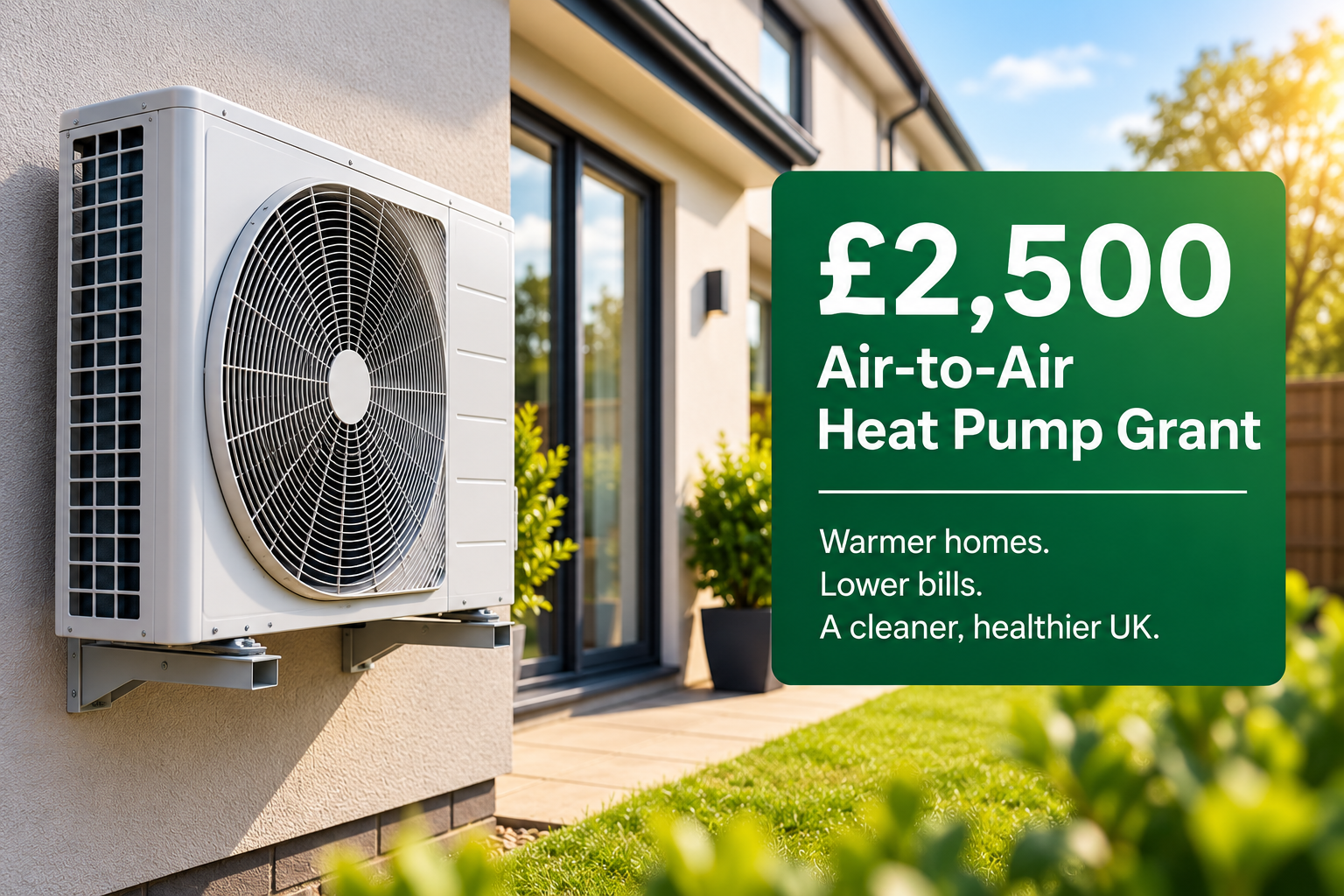
- The £2,500 air-to-air heat pump grant is restricted to residential properties.
- The current capacity limit is 45kWth for an individual heat-pump system.
- A qualifying multi-heat-pump system can have a maximum total capacity of 70kWth.
- Shared ground-loop systems have separate rules and can reach a higher collective capacity.
GOV.UK – Boiler Upgrade Scheme →
Ofgem – Current Property Owner Guidance →
Public-Sector Funding
The Public Sector Decarbonisation Scheme has supported heat decarbonisation and energy-efficiency projects in public buildings. Phase 4 is closed to new applications, so it should not be presented as funding that a new project can currently apply for.
GOV.UK – Public Sector Decarbonisation Scheme →
Industrial Funding
The Industrial Energy Transformation Fund supported industrial energy-efficiency and decarbonisation projects, including heat-pump projects, but the fund is now closed to new applicants.
For the technology side of these projects rather than current funding availability, see our industrial heat pump guide.
Are Commercial Heat Pumps Worth It?
A commercial heat pump can be a strong option when the building and heat distribution system are suitable, the design operating temperatures allow good efficiency, electricity infrastructure is available and the system is matched to the building’s actual demand.
The case can be particularly interesting where a project can:
- Replace fossil-fuel heating with a well-designed electric system
- Use low-temperature heating effectively
- Provide both heating and cooling
- Recover heat that would otherwise be rejected
- Match long operating hours with good part-load efficiency
- Combine heat pumps with on-site electricity generation or an appropriate energy strategy
They can be harder to justify where a building requires continuously high temperatures, has unsuitable emitters, lacks electrical capacity, has major space or noise constraints, or where the proposed design is based on unrealistic efficiency assumptions.
Financial viability should be assessed using realistic project costs and operating assumptions. Our commercial heat pump cost guide explains the major variables in more detail.
The heat pump is only one part of the project
For commercial buildings, system design, distribution temperatures, controls, electrical infrastructure, hot-water strategy and commissioning can matter just as much as the name on the heat pump itself.
How to Compare Commercial Heat Pump Manufacturers
Do not compare manufacturers only by maximum output or headline efficiency.
A useful commercial comparison should consider:
- Available output range
- Performance at the required outdoor and water temperatures
- Heating-only, cooling and heat-recovery capability
- Maximum practical flow temperature
- Refrigerant
- Modulation and part-load performance
- Cascade or modular capability
- Noise data
- BMS and controls compatibility
- UK technical and design support
- Commissioning support
- Warranty terms
- Maintenance requirements and spare-parts support
Heat Pump Guide UK’s Commercial Heat Pump Manufacturers UK guide explains how to assess commercial suppliers using published technical information and project-specific criteria.
Commercial Heat Pump Research by Topic
| If You Are Researching… | Start Here |
|---|---|
| Air-to-water systems for commercial buildings | Commercial Air Source Heat Pumps UK → |
| Which companies manufacture commercial systems | Commercial Heat Pump Manufacturers UK → |
| Installation price and operating economics | Commercial Heat Pump Costs & Running Costs → |
| Feasibility, design and procurement | Commercial Heat Pump Installation Guide → |
| Factories and process heating | Industrial Heat Pumps UK → |
| Propane refrigerant and commercial R290 systems | R290 Heat Pumps UK → |
| Higher-temperature heating and retrofit applications | High-Temperature Heat Pumps → |
Frequently asked questions
What is a commercial heat pump?
A commercial heat pump is a heat-pump system used for heating, cooling, hot water or related duties in a non-domestic building or commercial application. Commercial systems can range from relatively small units to large modular installations.
How big is a commercial heat pump?
There is no universal commercial size threshold. Current products range from equipment in the tens of kilowatts to systems delivering several hundred kilowatts, with larger industrial heat pumps extending further.
Can commercial heat pumps replace gas boilers?
Yes, in suitable buildings, but they should not automatically be treated as like-for-like boiler replacements. Heat demand, flow temperature, emitters, hot water, electrical capacity and controls all need to be assessed. Our commercial installation guide explains the design process in more detail.
Can businesses get a heat pump grant?
Some eligible business properties in England and Wales can use the Boiler Upgrade Scheme. Current capacity limits mean it is mainly relevant to smaller non-domestic systems rather than large commercial installations.
Are high-temperature heat pumps suitable for commercial buildings?
They can be useful where higher water temperatures are required, particularly in retrofit and hot-water applications. However, performance should be checked at the actual operating temperatures rather than assuming maximum temperature capability will provide the best efficiency. See our high-temperature heat pump guide.
What is the difference between a commercial and industrial heat pump?
Commercial heat pumps usually serve building heating, cooling and hot water. Industrial heat pumps may also provide process heat or recover waste heat from manufacturing and other industrial processes.
How much does a commercial heat pump cost?
There is no reliable single UK average because commercial projects vary enormously in capacity and complexity. Costs can include the heat-pump plant, hydraulics, emitters, electrical upgrades, controls, storage, building work, design and commissioning. See our full commercial heat pump costs guide.
Which companies make commercial heat pumps in the UK?
A number of UK and international manufacturers supply commercial heat-pump equipment, with significant differences in output, refrigerant, operating temperatures, applications and support models. See our Commercial Heat Pump Manufacturers UK guide for guidance on comparing suppliers.
What is an R290 commercial heat pump?
R290 is the refrigerant designation for propane. It is increasingly used in heat pumps across domestic and larger commercial applications, including some high-temperature systems. Read our R290 heat pump guide for the technology, benefits and safety considerations.


Related home heat pump guides
If you are researching heat pumps for a residential property rather than a commercial building, these homeowner guides are a better starting point.

Sources and further reading
Heat Pump Guide UK uses primary and authoritative sources wherever practical. Product specifications and funding rules can change, so technical information should be reconfirmed before specification or investment decisions.
- Carbon Trust – Heat Pumps Guide for Businesses
- Carbon Trust – Heat Pump Retrofit in Existing Buildings
- HPA UK – Commercial, Public Sector and Industrial Heat Pumps
- GOV.UK – Boiler Upgrade Scheme
- Ofgem – Boiler Upgrade Scheme Property Owner Guidance
- GOV.UK – Public Sector Decarbonisation Scheme
- GOV.UK – Industrial Energy Transformation Fund
- Baxi Commercial – Commercial Heat Pump Range
- Rinnai UK – R290 Commercial & Industrial Heat Pumps