
Air Conditioning Cost UK: Installation & Running Costs
How much does home air conditioning cost in the UK? A professionally installed single-room split system will commonly cost considerably more than a portable unit, while multi-room and whole-house systems can run into several thousand pounds.
This guide explains what you could pay for portable, single-split, multi-split and ducted air conditioning, what affects installation quotes and how to estimate the electricity cost of actually running your AC.
- UK cost guide
- Installation & running costs
- Updated for 2026

Quick Answer: How Much Does Air Conditioning Cost in the UK?
For a professionally installed fixed air-conditioning system, a useful starting point for a straightforward single-room split installation is roughly £1,500–£3,000.
Multi-room systems cost more and can quickly reach several thousand pounds as additional indoor units, longer pipe runs, condensate drainage and electrical work are added.
| Air Conditioning Type | Indicative Cost | Best Suited To |
|---|---|---|
| Portable AC | Usually hundreds rather than thousands | Occasional single-room cooling |
| Single-room split | Approx. £1,500–£3,000 installed | Bedroom, office or living room |
| Multi-split | Often £3,000–£7,000+, depending on rooms and complexity | Several rooms |
| Whole-house / extensive multi-room | Potentially £7,000–£10,000+ depending on design | Large multi-room installations |
| Ducted system | Potentially £8,000–£15,000+ where substantial ductwork is required | Renovations and discreet whole-home cooling |
These figures are planning ranges, not fixed prices. The final cost depends heavily on the equipment selected, number of rooms, pipe routes, electrical work, access and installation complexity.
A useful real-world benchmark
Checkatrade’s current 2026 guide gives an average materials price of around £620–£890 for a 12,000 BTU wall-mounted unit, with average installation costs of approximately £960–£1,380 on top.
That gives a useful benchmark of roughly £1,580–£2,270 for the unit and installation before any unusual additional work.
If you’re still deciding between portable, split, multi-split and ducted equipment, see our Home Air Conditioning UK guide before comparing prices alone.
Why Do Air-Conditioning Quotes Vary So Much?
Two homeowners asking for what sounds like the same system can receive very different quotes.
The equipment itself is only part of the cost. Installation complexity can make a substantial difference.
Important factors include:
- Number of rooms being conditioned
- Cooling requirement of each room
- Brand and specification of equipment
- Single-split vs multi-split design
- Number of outdoor units
- Length and complexity of refrigerant pipework
- Where condensate can drain
- Whether condensate pumps are required
- Electrical work and dedicated supplies
- Access to indoor and outdoor installation positions
- Scaffolding or working-at-height requirements
- How pipework and trunking will be concealed
- Commissioning and controls
A straightforward bedroom installation where the indoor and outdoor units are positioned on opposite sides of the same external wall can therefore be very different from a multi-room system requiring pipework through lofts, ceilings and several floors.
How Much Does Single-Room Air Conditioning Cost?
For many UK homeowners, the first permanent air-conditioning installation is for one problem room.
Common examples include:
- A bedroom that becomes too hot to sleep in
- A loft conversion
- A south-facing home office
- A garden room
- An open-plan kitchen and living area
For a straightforward professionally installed wall-mounted split system, approximately £1,500–£3,000 is a sensible broad planning range based on current UK market pricing.
The lower end is more achievable where the installation is simple. Premium equipment, difficult access, longer pipework, upgraded electrics or complicated condensate drainage can increase the price.
Don’t choose the unit by room size alone.
A suitable system should account for factors such as room dimensions, glazing, orientation, insulation, occupancy and internal heat gains. Oversizing or undersizing equipment can affect comfort, noise, efficiency and how well the system controls temperature.
For more detail on whether a one-room system is suitable in the first place, see our Home Air Conditioning UK guide.
How Much Does Multi-Split Air Conditioning Cost?
A multi-split system connects several indoor air-conditioning units to one outdoor unit, subject to the design and capabilities of the equipment.
Current UK market guides commonly place smaller multi-split installations at around £3,000–£7,000, but larger or more complicated installations can cost considerably more.
The number of indoor units alone does not determine the price.
A quote also needs to account for:
- Outdoor-unit capacity
- Individual indoor-unit sizes
- Pipe lengths
- Routing between floors
- Condensate drainage
- Electrical supplies
- Controls
- Access
- Commissioning
There may also be situations where two smaller outdoor systems make more practical sense than connecting every indoor unit to one large multi-split.
If the system is large enough to serve several rooms, it is also worth understanding whether the same equipment could be designed for winter heating. See our Air-to-Air Heat Pumps UK guide.
What Are UK Homeowners Actually Being Quoted?
Published cost guides are useful for planning, but recent homeowner quotes demonstrate how much multi-room pricing can vary.
| Example | System | Reported Quote |
|---|---|---|
| Two rooms | Mitsubishi multi-split, two 3.5kW indoor units | £3,700 |
| Three rooms | Multi-split installation | £5,142 |
| Two rooms | Daikin multi-split, two 3.5kW indoor units | £5,860 |
| Four rooms | Bosch multi-split with four indoor units | Just over £7,300 |
| Four rooms | Premium Mitsubishi system | £9,900 |
These are individual homeowner-reported 2026 quotes, not national averages. They are included to demonstrate the variation possible between properties, brands and system designs rather than to predict what your installation should cost.
How Much Does Whole-House Air Conditioning Cost?
There isn’t one standard definition of whole-house air conditioning.
It might mean:
- Four or five wall-mounted indoor units
- Several separate split systems
- One or more multi-split systems
- A concealed ducted installation
For this reason, whole-house costs vary substantially.
A larger wall-mounted multi-room installation can readily reach £7,000–£10,000 or more, while a complex concealed ducted installation can move beyond that.
The more extensive the installation becomes, the more important it is to compare the system as a complete home heating-and-cooling investment rather than simply multiplying the cost of one bedroom air conditioner by the number of rooms.
If you’re considering whole-house AC purely for cooling, see our Home Air Conditioning UK guide. If you’re spending this much on reversible equipment and also want winter heating, compare it with our Air-to-Air Heat Pump Cost UK guide.
How Much Does Ducted Air Conditioning Cost?
Ducted systems can provide a much more discreet appearance because conditioned air enters rooms through grilles rather than obvious wall-mounted units.
The trade-off is installation complexity.
Current consumer estimates commonly put extensive ducted domestic systems at approximately £8,000–£15,000+, although particularly complicated retrofits can exceed this.
The cost depends heavily on whether suitable ceiling, loft or service voids already exist.
A ducted system incorporated during a major renovation can be considerably easier to install than trying to conceal extensive ductwork throughout a finished house.
Our Home Air Conditioning UK guide explains how ducted systems compare with wall-mounted split and multi-split equipment.
Portable vs Fixed Air Conditioning Cost
Portable air conditioners are substantially cheaper to buy because there is no permanent refrigeration installation.
Portable AC
- Lower initial cost
- No permanent outdoor unit
- No professional refrigerant installation
- Can be moved between rooms
- Compressor remains inside the room
- Exhaust hose needs to discharge outside
Fixed Split AC
- Higher upfront cost
- Permanent installation
- Outdoor compressor
- Better suited to regular cooling
- Multi-room options available
- Many systems can also provide heating
If you only need cooling for a few unusually hot days, the extra cost of a permanent installation may be difficult to justify purely on financial grounds.
If the same room overheats regularly, or you want both heating and cooling, the comparison becomes different.
For the broader pros and cons of portable, fixed, split and multi-split systems, see our complete home air conditioning guide.
Compare Up to 3 Air Conditioning Installers Near You
Tell us a little about your property to see installer options available in your area.
Free to use with no obligation
How Much Does Air Conditioning Cost to Run?
The running cost depends on how much electricity the system actually consumes and the price you pay for each kilowatt-hour.
For 1 July to 30 September 2026, Ofgem’s average electricity rate for a Direct Debit household on the standard variable price cap is 26.11p per kWh.
Your actual electricity tariff may be higher or lower.
Running-cost formula
Electricity consumed (kWh) × electricity unit rate = electricity cost
At 26.11p/kWh:
| Electricity Consumed | Cost at 26.11p/kWh |
|---|---|
| 0.25 kWh | About 7p |
| 0.5 kWh | About 13p |
| 0.75 kWh | About 20p |
| 1 kWh | About 26p |
| 2 kWh | About 52p |
| 5 kWh | About £1.31 |
These figures show the cost of consuming a given amount of electricity. They do not mean an air conditioner necessarily consumes that amount every hour.
Modern inverter-driven air conditioners adjust their output as conditions change. Electrical demand can therefore vary significantly during operation.
Why ‘Air Conditioning Costs Xp Per Hour’ Can Be Misleading
You will often see air-conditioning running costs reduced to a single pence-per-hour figure.
That can be useful as an illustration, but it is not a universal running cost.
Actual electricity consumption changes according to:
- Outdoor temperature
- Desired indoor temperature
- Room heat gain
- Glazing and solar gain
- Insulation
- Equipment efficiency
- Equipment sizing
- Fan and operating mode
- How long the room has already been conditioned
- Whether doors and windows remain closed
A system working hard to cool a hot room from 30°C will not necessarily draw the same power once the room has reached its target temperature.
For that reason, the most useful way to estimate your cost is to use the expected electrical consumption of the exact system being proposed and your own electricity tariff.
Worked Air-Conditioning Running Cost Examples
The examples below are deliberately based on electricity consumed rather than pretending every air conditioner has the same hourly power demand.
Example 1: Bedroom cooling
Suppose your air conditioner consumes a total of 2kWh during an evening and overnight cooling period.
At 26.11p/kWh:
2 × £0.2611 = approximately £0.52
Running it like this for 30 nights would therefore use 60kWh and cost approximately £15.67 at that electricity rate.
Example 2: Heavier multi-room use
Suppose several units together consume 8kWh across a hot day.
8 × £0.2611 = approximately £2.09
Ten days at that level of electricity consumption would use 80kWh and cost approximately £20.89.
What Affects Air-Conditioning Running Costs Most?
1. How hot the house gets
A room with substantial solar gain through large south- or west-facing windows can require considerably more cooling than a shaded room.
2. Your temperature setting
Trying to maintain an unnecessarily low indoor temperature increases the amount of heat the system needs to remove.
3. Number of rooms
Cooling one bedroom is very different from conditioning a complete three- or four-bedroom home.
4. Equipment efficiency
Air conditioners vary in seasonal cooling efficiency. Compare the efficiency data for the exact models being proposed rather than assuming every split system performs the same.
5. Property heat gain
Glazing, orientation, shading, insulation, ventilation and internal heat sources all influence cooling demand.
6. Electricity tariff
Two identical systems consuming the same electricity can have different running costs if their owners pay different unit rates.
How Can You Reduce Air-Conditioning Costs?
Reducing unwanted heat gain can reduce how hard the air conditioner needs to work.
- Use external shading where practical
- Close blinds or curtains before strong sunlight heats the room
- Keep windows and external doors closed while AC is operating
- Avoid unnecessarily low temperature settings
- Cool occupied rooms rather than automatically conditioning the whole house
- Clean filters in accordance with manufacturer instructions
- Use cooler outdoor air for ventilation when conditions allow
Air conditioning should complement sensible passive cooling rather than replace it.
What Other Installation Costs Should You Budget For?
When comparing quotes, check exactly what is included.
Potential additional items include:
- Dedicated electrical circuits
- Consumer-unit work
- Condensate pumps
- Longer refrigerant pipe runs
- Decorative trunking
- Core drilling
- Scaffolding or access equipment
- Outdoor mounting brackets or bases
- Wi-Fi or upgraded controllers
- Making good after installation
A cheaper headline quote is not necessarily better value if important installation work has simply been excluded.
Can You Install Split Air Conditioning Yourself?
A portable air conditioner can generally be positioned and operated by the homeowner according to its instructions.
A fixed split system is different.
UK rules require people carrying out work on equipment containing fluorinated greenhouse gases to hold the appropriate F-gas qualifications.
For stationary refrigeration, air-conditioning and heat-pump systems, this covers activities including installation, maintenance, servicing and refrigerant recovery.
So while online equipment prices can make a DIY installation look attractive, fixed refrigerant systems are not comparable with plugging in a portable appliance.
Is Air Conditioning Worth the Cost in the UK?
That depends heavily on why you want it.
It May Make More Sense If…
- Your bedroom regularly overheats
- You work from home in an uncomfortable room
- You have a loft conversion or high solar gain
- You want reliable cooling rather than occasional relief
- You also value winter heating
Think More Carefully If…
- You only experience discomfort a few days per year
- Shading could solve most of the overheating
- You are installing several expensive units solely for occasional cooling
- You have not considered the heating capability of the equipment
If you’re still weighing up whether fixed AC is appropriate rather than just the price, see our Home Air Conditioning UK guide.
Before Spending £5,000–£10,000 on Air Conditioning, Consider the Heating
This becomes particularly important with larger multi-room installations.
Many modern fixed split and multi-split air-conditioning systems are reversible. Instead of only moving heat out of your house during summer, they can reverse the refrigeration cycle during winter and move heat into the house.
At that point, the equipment is functioning as an air-to-air heat pump.
The cost comparison changes
If you’re considering spending several thousand pounds installing permanent air conditioning throughout your home, don’t evaluate the investment purely against the number of hot days each year.
Ask whether the same system could also provide useful winter heating and potentially reduce your reliance on your existing boiler or other heating system.
This doesn’t mean every air-conditioning installation should replace central heating. A system sized primarily for summer cooling may not have been designed to meet the property’s room-by-room winter heat loss.
But for a substantial multi-room installation, it is a question worth answering before choosing the equipment.
There are now two useful next steps: read our Air-to-Air Heat Pumps UK guide to understand the technology, or use our Air-to-Air Heat Pump Cost UK guide to compare whole-home installation and heating costs.
Could You Get £2,500 Towards the System?
There is not a general government grant for adding ordinary summer air conditioning to your home.
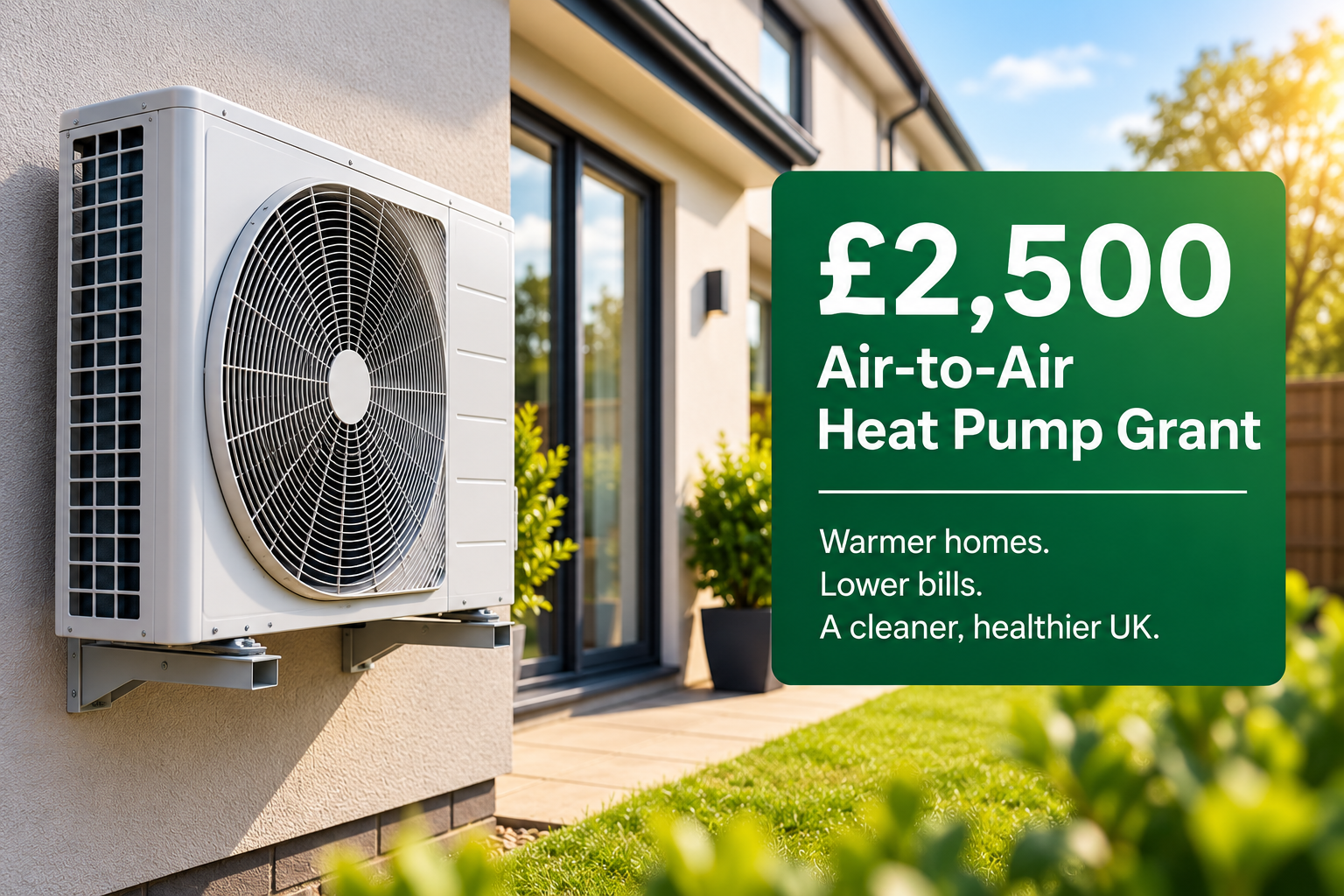
However, qualifying residential air-to-air heat-pump installations can now receive £2,500 through the Boiler Upgrade Scheme in England and Wales, subject to the scheme requirements.
This makes the distinction between installing supplementary cooling and installing an eligible home heating system particularly important.
Do not assume that any reversible air conditioner automatically qualifies. The installation and property need to satisfy the Boiler Upgrade Scheme requirements.
Our Air-to-Air Heat Pump Cost UK guide includes examples showing how the £2,500 support changes an eligible installation price.
What Should an Air-Conditioning Quote Include?
Before comparing prices, make sure you’re comparing like with like.
- Exact outdoor-unit model
- Exact indoor-unit model or models
- Equipment capacities
- Supply and installation
- Refrigerant pipework
- Condensate drainage
- Electrical work
- Outdoor mounting arrangements
- Trunking and pipework finish
- Controls and Wi-Fi functionality where applicable
- Pressure testing and commissioning
- Making good
- Warranty
- Any servicing requirements
If one quote is substantially cheaper, look for differences in equipment, installation scope and warranty before assuming it offers better value.
If the quote includes several reversible indoor units and heating is part of the proposal, also compare it against a properly designed air-to-air heating system rather than treating it only as an air-conditioning purchase. See our Air-to-Air Heat Pumps UK guide.
Important:
Air-conditioning prices and running costs vary considerably. Installation cost depends on equipment, property layout, electrical work, pipe routes, drainage and access. Running cost depends on cooling demand, system efficiency, electricity tariff, controls, weather and usage. The figures in this guide are planning estimates rather than quotations or guaranteed running costs.
Compare Up to 3 Air Conditioning Installers Near You
Tell us a little about your property to see installer options available in your area.
Free to use with no obligation
Air conditioning cost FAQs
How much does it cost to install air conditioning in a UK house?
A straightforward single-room fixed split installation will commonly fall somewhere around £1,500–£3,000 based on current UK market pricing. Multi-room and whole-house systems can cost several thousand pounds more depending on equipment and installation complexity.
How much does air conditioning cost to run?
It depends on actual electricity consumption and your tariff. At the current Ofgem average Direct Debit price-cap electricity rate of 26.11p/kWh, every 1kWh consumed costs about 26p. This does not mean every air conditioner costs 26p per hour because electrical demand varies during operation.
How much does air conditioning cost for one bedroom?
A professionally installed single-split system for one room will often fall in the broad £1,500–£3,000 range, although equipment choice and installation complexity can push the cost outside that range.
How much does whole-house air conditioning cost?
Whole-house costs vary significantly because systems can use multiple splits, multi-splits or concealed ductwork. Larger multi-room installations can readily cost £7,000–£10,000 or more, while extensive ducted systems can cost more again.
Is fixed air conditioning expensive to run?
Not necessarily, but there is no universal hourly cost. Running costs depend on system efficiency, cooling demand, temperature settings, property heat gain, usage and electricity tariff.
Can air conditioning heat my house too?
Many modern fixed split systems are reversible and can provide heating as well as cooling. In heating mode they operate as air-to-air heat pumps, although a whole-home heating system needs to be designed for the property’s winter heat requirement.
Can I get a grant towards air conditioning?
There isn’t a general grant for installing ordinary summer air conditioning. However, eligible residential air-to-air heat-pump installations in England and Wales can currently receive £2,500 through the Boiler Upgrade Scheme.

Sources and further reading
Installation prices are based on current UK consumer cost guides and are presented as broad planning estimates. Electricity calculations use Ofgem’s current average price-cap rate.