
Heat Pump vs Air Conditioning UK: Which Is Better for Heating?
With UK summers getting hotter, more homeowners are considering air conditioning. But modern air conditioning can often heat as well as cool – raising an interesting question: could an air-to-air system replace your central heating instead of installing a conventional air-to-water heat pump?
- UK heating and cooling comparison
- Updated for 2026 grant changes
- Independent homeowner advice

Quick Answer: Heat Pump or Air Conditioning?
The first thing to understand is that modern reversible air conditioning is itself a type of heat pump. Most domestic systems sold for both heating and cooling are air-to-air heat pumps. They transfer heat into your rooms in winter and can reverse the process to provide cooling in summer.
What UK homeowners usually call an air source heat pump, meanwhile, is an air-to-water heat pump. Instead of blowing warm air into rooms, it heats water for radiators or underfloor heating and can normally provide domestic hot water too.
The simple choice
Choose air-to-water if you want a more conventional whole-home central heating replacement using radiators or underfloor heating and domestic hot water.
Consider air-to-air if summer cooling is important, you are comfortable heating rooms using indoor fan units and you have a separate solution for hot water.
If air-to-air is new to you, start with our complete UK air-to-air heat pump guide. If your main reason for researching this technology is keeping your home cool in summer, see our home air conditioning guide instead.
Heat Pump vs Air Conditioning: What’s Actually the Difference?
The terminology makes this comparison more confusing than it needs to be.
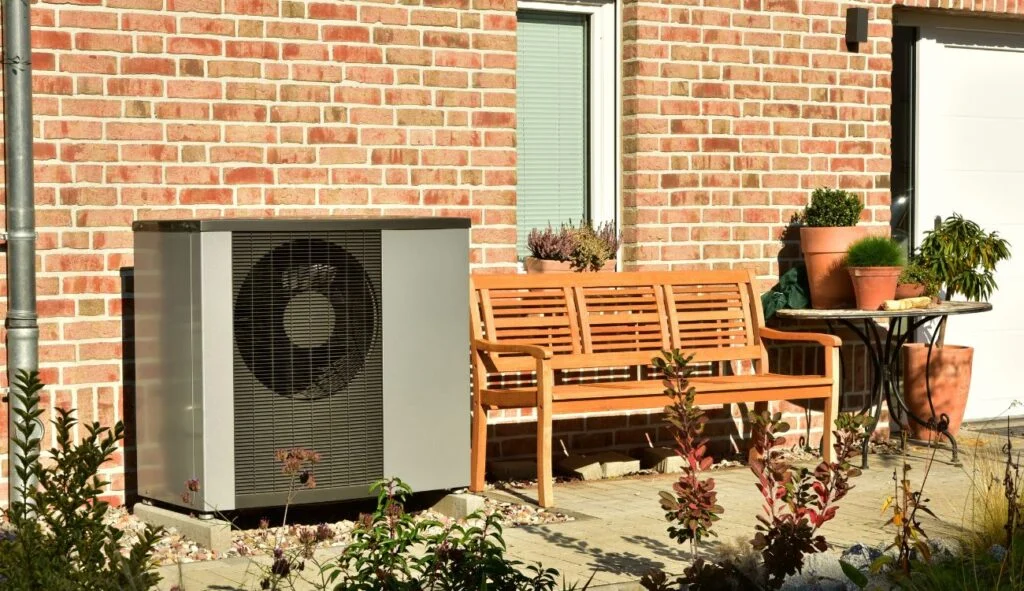
An air-to-water heat pump extracts heat from outdoor air and transfers it into water. That heated water circulates through your radiators or underfloor heating. It can also heat water stored in a cylinder for showers, baths and taps.
A modern reversible air conditioning system usually works as an air-to-air heat pump. It also extracts heat from outdoor air, but transfers that energy directly into the air inside your home through wall-mounted, floor-mounted or concealed indoor units.
In summer, the refrigeration cycle can be reversed so heat is removed from the house and discharged outside.
Air-to-Water Heat Pump
- Heats water for the central heating system
- Works with suitable radiators or underfloor heating
- Normally provides domestic hot water
- Designed primarily around heating
- Standard systems do not provide room air conditioning
Air-to-Air Heat Pump
- Heats rooms directly through indoor fan units
- Can usually reverse to provide summer cooling
- Does not need radiators
- Can heat individual rooms or multiple zones
- Usually requires a separate hot-water solution
For a fuller explanation of split systems, multi-split layouts, indoor units, hot water and whole-home heating design, see our Air-to-Air Heat Pumps UK guide.
Air-to-Water vs Air-to-Air Heat Pump Comparison
| Feature | Air-to-Water Heat Pump | Air-to-Air / Air Conditioning |
|---|---|---|
| Winter heating | Yes | Yes |
| Summer cooling | Usually no | Yes, with a reversible system |
| Radiators | Uses radiators or underfloor heating | Not normally required |
| Domestic hot water | Normally yes, via a cylinder | Usually requires a separate solution |
| Heat distribution | Water-based central heating | Warm air from indoor units |
| Room zoning | Possible through heating controls | Individual indoor units can provide strong room-by-room control |
| Boiler Upgrade Scheme | Up to £7,500 for eligible installations | Up to £2,500 for eligible installations |
| Best suited to | Whole-home central heating replacement | Homes prioritising heating plus cooling or targeted zones |
Neither system is automatically better. Property layout, heat loss, existing heating, hot-water demand, installation design and how you want to control individual rooms all matter.
Why Air Conditioning Is Becoming More Relevant in UK Homes
Historically, most UK heating decisions have concentrated almost entirely on keeping homes warm during winter. Cooling has been much less important than it is in countries with hotter climates.
That assumption is becoming less reliable.
Met Office climate projections point towards hotter summers and an increased likelihood of extreme heat. The English Housing Survey also reported that around 3 million homes in England experienced overheating in 2024, with reported overheating rising from 7% of occupied homes in 2019 to 12% in 2024.
A Heating Decision That Also Considers Summer
If you expect to install air conditioning anyway, it is worth considering whether installing separate cooling and central-heating systems is the most sensible approach.
A reversible air-to-air heat pump can potentially perform both jobs, although that does not automatically make it suitable as the sole heating system for every property.
If cooling is your main priority, there are two different starting points:
- Portable air conditioning: lower upfront cost and no permanent installation, usually best for occasional cooling in one room.
- Fixed air conditioning / air-to-air heat pump: higher installation cost but generally quieter, more efficient and capable of providing regular heating as well as cooling.
Passive measures should still come first where practical. External shading, blinds, ventilation and reducing excessive solar gain can all help limit overheating without consuming electricity.
Can Air Conditioning Really Heat a House in Winter?
Yes. A reversible air conditioning unit does not heat a room in the same way as a conventional electric fan heater.
In heating mode it operates as a heat pump, moving energy from outside the property into the room. That means it can deliver more heat energy than the electrical energy consumed by the compressor and fans.
The Department for Energy Security and Net Zero published dedicated research in July 2026 examining the use of reversible air-to-air heat pumps in UK homes, including their heating, cooling, energy use and running costs.
However, whether they can successfully replace your existing central heating depends heavily on the design.
Whole-house coverage matters
A single indoor unit in a downstairs living room should not be treated as equivalent to a properly designed whole-house heating system.
Closed doors, hallways, separate bedrooms and complex layouts can restrict the movement of warm air. A larger property may therefore need several indoor units connected to one or more outdoor units.
A competent design should consider room-by-room heat loss and ensure each occupied area can maintain the required temperature during cold weather.
Our complete air-to-air guide explains whole-home layouts, single-split vs multi-split systems, indoor-unit choices and how hot water needs to be handled.
Heat Pump vs Air Conditioning Installation Costs
One of the most interesting differences is the potential upfront cost.
Energy Saving Trust currently gives a typical installed cost of around £11,000 for an air-to-water air source heat pump. The final cost varies substantially according to property size, heat demand, radiator upgrades, hot-water requirements and installation complexity.
For air-to-air systems, Energy Saving Trust research gives indicative costs of around £1,900 for a single-room installation and around £3,700 for a three-bedroom semi-detached home.
| System | Current EST Indicative Cost | Important Considerations |
|---|---|---|
| Air-to-water heat pump | Around £11,000 | Radiators, cylinder, pipework and electrical work can affect the final price |
| Air-to-air – single room | Around £1,900 | Not comparable with whole-home central heating |
| Air-to-air – three-bed semi | Around £3,700 | System layout and number of indoor units can change the cost significantly |
Important: These are indicative figures published by Energy Saving Trust rather than fixed installation prices. A £1,900 single-room air conditioning installation should not be compared directly with an £11,000 whole-home air-to-water system. Compare systems designed to meet the same heating requirement.
If you are comparing a conventional air-to-water installation, see our air source heat pump installation cost guide.
For the alternative system, our air-to-air heat pump cost guide looks specifically at multi-room installation, whole-home heating, running costs, hot-water implications and the effect of the £2,500 BUS grant.
If you only want to know how much it costs to install AC for summer cooling, see our separate UK air conditioning cost guide. That covers single-room, multi-split and whole-house cooling costs without assuming the system will replace your central heating.
Can You Get a Grant for Air Conditioning Used as Heating?
Potentially, yes – and this is an important change for 2026.
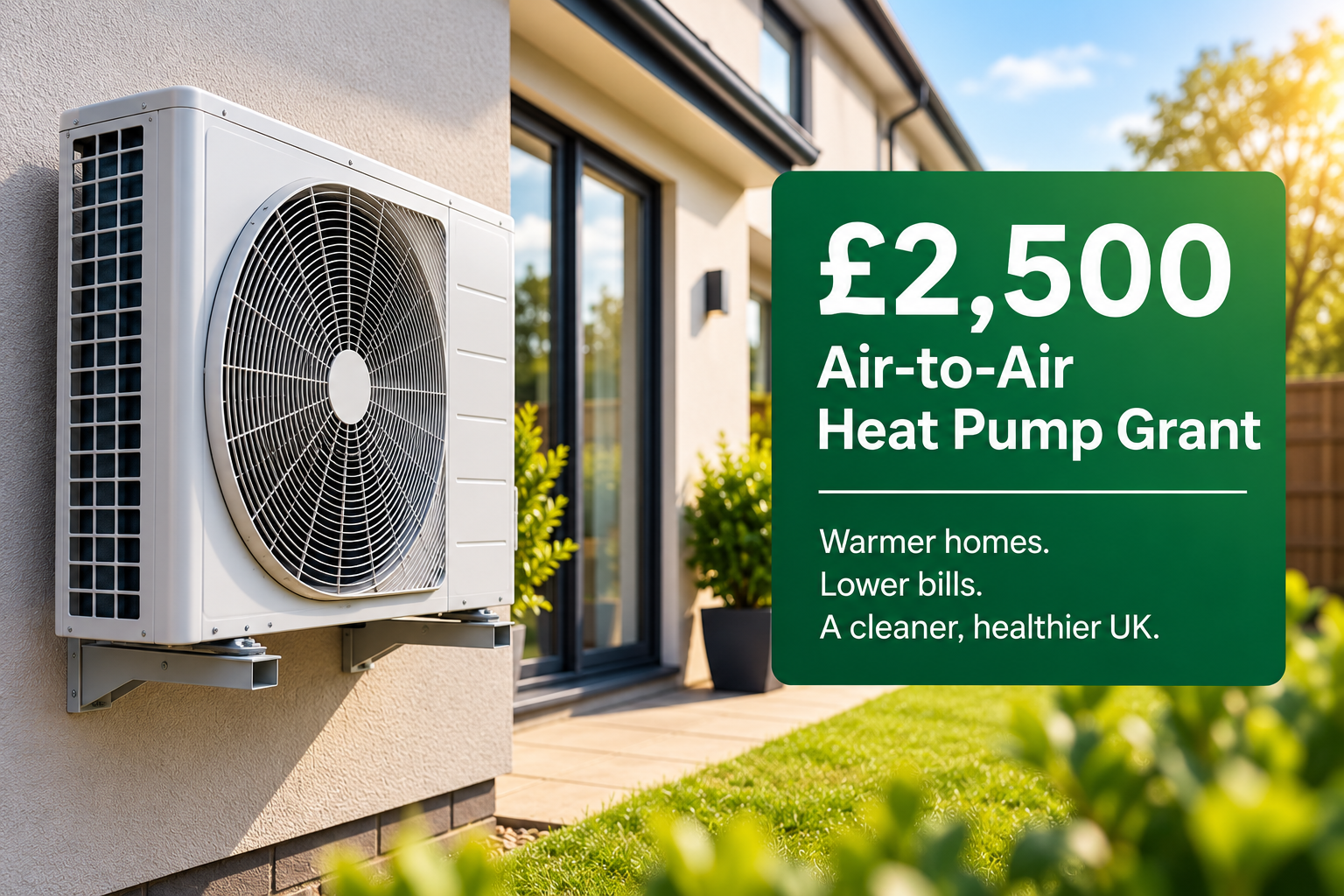
Eligible residential air-to-air heat pump installations in England and Wales can now receive £2,500 through the Boiler Upgrade Scheme.
For comparison, eligible air-to-water heat pumps currently receive £7,500.
| Technology | BUS Grant |
|---|---|
| Air-to-air heat pump | £2,500 |
| Air-to-water heat pump | £7,500 |
| Ground source heat pump | £7,500 |
Eligibility conditions apply and the installation must meet the relevant scheme requirements. The Boiler Upgrade Scheme covers England and Wales; Scotland and Northern Ireland have different support arrangements.
There is also temporarily additional support for qualifying off-gas-grid properties heated by oil or LPG, so check the latest scheme rules before making a decision.
It is important not to treat the £2,500 support as a general air-conditioning voucher. If grant eligibility is an important part of the financial comparison, our air-to-air heat pump cost guide explains how the grant affects whole-home installation costs.
Air Conditioning vs Heat Pump Running Costs for Heating
This comparison needs care because both systems use electricity and both are heat pumps.
The running cost of either system can be estimated using:
Basic running-cost calculation
Heat required ÷ seasonal efficiency × electricity price = approximate electricity cost
For example, a system with a seasonal performance factor of 3 would require approximately 1kWh of electricity to deliver 3kWh of heat over the period represented by that efficiency figure.
That does not mean every heat pump will achieve the same efficiency. Real performance depends on outdoor temperature, equipment selection, system sizing, target room temperature, controls, maintenance and how the property is used.
Current electricity prices
For context, Ofgem’s average electricity unit rate for a Direct Debit household on the price-capped standard variable tariff from 1 July to 30 September 2026 is 26.11p/kWh. Your actual tariff may be higher or lower.
Because both air-to-air and air-to-water systems use electricity, the better financial result will depend heavily on their actual seasonal efficiency in the particular property rather than simply the fuel price.
Our Air-to-Air Heat Pump Cost UK guide includes worked space-heating examples showing how heat demand, seasonal efficiency and electricity price combine to affect annual heating cost.
For the wider methodology applying to conventional heat pumps, see our UK heat pump running cost guide.
Could Air-to-Air Be Cheaper to Run?
It can be in some circumstances, but it should not be assumed.
Air-to-air systems avoid the need to transfer heat into water and then distribute it through radiators. They can also provide very direct zoning: if you only need to heat occupied areas, individual indoor units can make that straightforward.
On the other hand, a badly positioned or undersized system may struggle to distribute heat evenly. Running several units at high temperatures or repeatedly heating a property from cold can also change the result.
An air-to-water system designed around low flow temperatures can also operate very efficiently. Its advantage is that heat can be distributed throughout the home using a familiar wet central-heating system.
Running-cost comparisons should therefore use the proposed system designs and seasonal performance figures rather than assuming one technology always wins.
The Challenges of Heating a UK Home With Air Conditioning
The lower installation cost and ability to cool make air-to-air systems attractive, but there are important compromises.
1. You Still Need Hot Water
Most air-to-air heat pumps do not heat water for showers, baths and taps. You therefore need a separate hot-water system, which must be included in both installation and running-cost comparisons. For a look at more integrated options and their limitations, see our guide to heating, hot water and cooling from one system.
2. Indoor Units Are Visible
Wall-mounted air conditioning units are more visually noticeable than radiators in some rooms. Concealed and alternative indoor-unit designs exist, but these can make installation more involved.
3. Warm Air Feels Different
Air-to-air systems use fans to distribute heat. Some homeowners prefer the quieter radiant and convective warmth produced by radiators or underfloor heating.
4. Room Layout Matters
Warm air does not automatically travel evenly through a multi-room property. Bedrooms and other enclosed rooms may need their own indoor units.
5. Indoor Fan Noise
Indoor units contain fans. Sound levels vary by model and operating mode, so bedrooms in particular deserve careful consideration.
6. More Than One Outdoor Unit May Be Needed
The appropriate arrangement depends on the property and equipment. Larger homes may require multi-split systems or multiple outdoor units rather than one simple room system.
If these practical issues are more important to you than heating-system comparisons, our home air conditioning guide goes into more detail on bedrooms, whole-house cooling, indoor-unit types, multi-splits, ducted systems, noise and outdoor-unit positioning.
What About Radiators?
This is one area where air-to-air systems can simplify a retrofit.
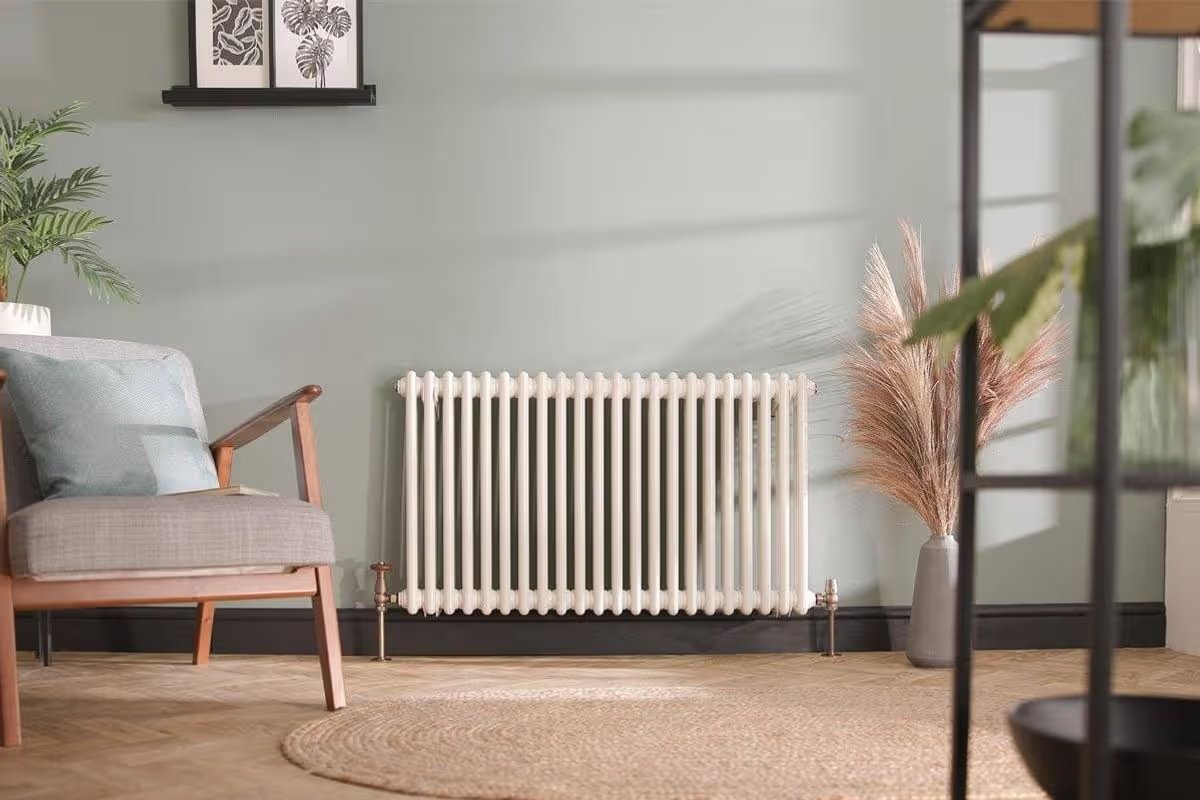
An air-to-water heat pump generally operates most efficiently at lower water temperatures than a traditional boiler. Existing radiators therefore need to be checked against the room’s calculated heat loss at the proposed design flow temperature.
Some properties need larger radiators or other emitter upgrades.
Air-to-air systems bypass this issue because they deliver heat directly into the room rather than through the existing wet heating circuit.
That does not remove the need for proper system sizing. Instead of checking radiator output, the designer needs to make sure each indoor unit can meet the room’s heat requirement under the chosen winter design conditions.
What Happens to Your Existing Boiler and Radiators?
If an air-to-air system is intended to become the primary heating system, deciding what to do with the existing boiler and wet heating system is an important part of the project.
Keeping a boiler purely as backup can sound attractive, but it leaves you maintaining two heating systems and may affect eligibility for financial support depending on the proposed configuration and current scheme rules.
Removing the wet heating system altogether creates another question: how will domestic hot water be produced?
This is why an air-to-air conversion should be assessed as a whole-home heating and hot-water strategy, not simply as an air conditioning installation.
The separate air-to-air heat pump cost guide looks at this complete-system comparison, including the financial effect of needing separate domestic hot-water provision.
Planning Permission and Outdoor Units
Outdoor heat-pump equipment can fall within permitted development rights where the relevant conditions are satisfied, but the rules depend on the installation, property and UK nation.
Restrictions can also apply to listed buildings, conservation areas and certain locations around a property.
If you are considering multiple outdoor units, do not assume that the rules applying to one conventional heat-pump installation automatically apply in exactly the same way to the proposed air conditioning arrangement.
Before installation: Ask the installer to confirm planning requirements, applicable MCS requirements and any noise assessment needed for the exact equipment and proposed outdoor-unit positions.
When Air-to-Air Heating Makes the Most Sense
An air-to-air heat pump deserves serious consideration where several of these apply:
- Your home already suffers from summer overheating.
- You were considering installing air conditioning anyway.
- You want independent temperature control in different rooms.
- Your property does not already have a suitable wet central-heating system.
- Replacing or substantially upgrading radiators would add considerable complexity.
- You have a practical separate solution for domestic hot water.
- The layout allows indoor units to heat all important rooms effectively.
- You are comfortable with fan-assisted heating and visible indoor units.
If cooling is what initially brought you to this comparison, start with the Home Air Conditioning UK guide. If you are seriously considering air-to-air as your main heating system, move next to the complete Air-to-Air Heat Pump guide.
When an Air-to-Water Heat Pump Makes More Sense
A conventional air-to-water heat pump may be the stronger option where:
- You want a direct replacement for a gas, oil or LPG boiler.
- Your existing radiators or underfloor heating are suitable or can be upgraded.
- You want one system to provide space heating and stored domestic hot water.
- Summer cooling is not a priority.
- You prefer radiator or underfloor heating to warm-air heating.
- Your home’s layout would require a large number of separate indoor air units.
- You want to take advantage of the higher current Boiler Upgrade Scheme grant available for eligible air-to-water systems.
Could You Have Both?
Yes. Installing an air-to-water heat pump for whole-home heating and separate air conditioning in selected rooms is another option.
For example, a homeowner might use an air-to-water heat pump for radiators and hot water while adding cooling to bedrooms or a south-facing living area that becomes uncomfortable during hot weather.
The disadvantage is obvious: you are paying for and maintaining two systems.
Before taking this route, it is worth comparing the total installation cost with a properly designed air-to-air system that could potentially provide both functions.
Our Air Conditioning Cost UK guide can help estimate the additional cost of separate cooling, while the Air-to-Air Heat Pump Cost guide looks at the alternative of using one reversible system for both heating and cooling.
Verdict: Is Air Conditioning a Viable Alternative to a Heat Pump?
For some UK homes, yes – but the comparison is really between two different types of heat pump.
Air-to-water remains a natural option for homeowners who want to replace a boiler while retaining radiator or underfloor heating and producing domestic hot water from the same heating system.
Air-to-air becomes particularly interesting where summer cooling is also a priority. It can heat in winter, cool in summer, avoid radiator upgrades and may have a lower initial installation cost.
The arrival of the £2,500 Boiler Upgrade Scheme grant for eligible air-to-air installations also makes the technology more relevant to UK homeowners than it was previously.
But there are compromises: domestic hot water needs solving separately, indoor units need suitable locations, fan noise and appearance need consideration, and a whole-home installation needs to be designed around room-by-room heat demand rather than assuming one air conditioning unit will heat an entire house.
The question worth asking in 2026
If you are replacing your heating system and think you may want air conditioning as UK summers become hotter, compare the total cost and practicality of an air-to-water heat pump plus separate cooling against a properly designed reversible air-to-air system.
Accuracy note Heating and cooling performance cannot be predicted from technology type alone. Results depend on property heat loss, equipment sizing, outdoor conditions, system design, controls, installation quality, room layout, comfort settings and electricity tariff. Current grants, tariffs and planning requirements should be checked again before making an installation decision.
Compare Up to 3 Heat Pump Installers Near You
Tell us a little about your property to see installer options available in your area.
Free to use with no obligation
Frequently asked questions
Is air conditioning a heat pump?
Most modern reversible air conditioning systems are air-to-air heat pumps. They transfer heat outside when cooling and reverse the process to transfer heat inside when heating.
Can air conditioning heat a house in the UK?
Yes, provided the system is designed for the property’s winter heat demand. A whole-home system may need several indoor units, so a single air conditioning unit should not automatically be treated as a replacement for central heating.
Is air conditioning cheaper than a heat pump?
Air-to-air systems can have a lower installation cost than air-to-water heat pumps, but comparisons must cover equivalent areas of the home and include a solution for domestic hot water. Running costs depend on system efficiency, electricity tariff, heat loss, controls and usage.
Can you get a grant for air conditioning in the UK?
Eligible air-to-air heat pump installations in residential properties in England and Wales can currently receive £2,500 through the Boiler Upgrade Scheme. It is not simply a general grant for any air conditioning installation; the system and installation must satisfy the scheme requirements.
Does an air-to-air heat pump provide hot water?
Most do not. A separate hot-water solution is therefore usually required, although some equipment and system configurations can differ.
Which is better: air-to-air or air-to-water?
Neither is universally better. Air-to-water integrates well with wet central heating and domestic hot water, while air-to-air offers heating and cooling and can avoid radiator upgrades. Property layout, heat loss, hot-water demand, comfort preferences and installation design should determine the choice.
Related guides
 Home Air Conditioning UK: Complete Guide
 Air-to-Air Heat Pumps UK: Complete Guide
 Air Conditioning Cost UK
 Air-to-Air Heat Pump Cost UK
 Best Air Source Heat Pumps UK
 Air Source Heat Pump Cost UK
 Heat Pump Running Costs UK
 Heat Pump Grants UK
 Do You Need New Radiators for a Heat Pump?
 Are Heat Pumps Worth It?
Sources and further reading
This guide uses current government, Ofgem, Energy Saving Trust and Met Office information on air-to-air heat pumps, grants, installation costs, energy prices and the changing risk of overheating in UK homes.
- Department for Energy Security and Net Zero: Suitability of reversible air-to-air heat pumps for UK domestic use
- Energy Saving Trust: Air-to-air heat pumps
- GOV.UK: Boiler Upgrade Scheme: what you can get
- Ofgem: Boiler Upgrade Scheme
- Ofgem: Energy price cap unit rates and standing charges
- Met Office: Climate change in the UK
- GOV.UK: English Housing Survey: weather resilient homes