
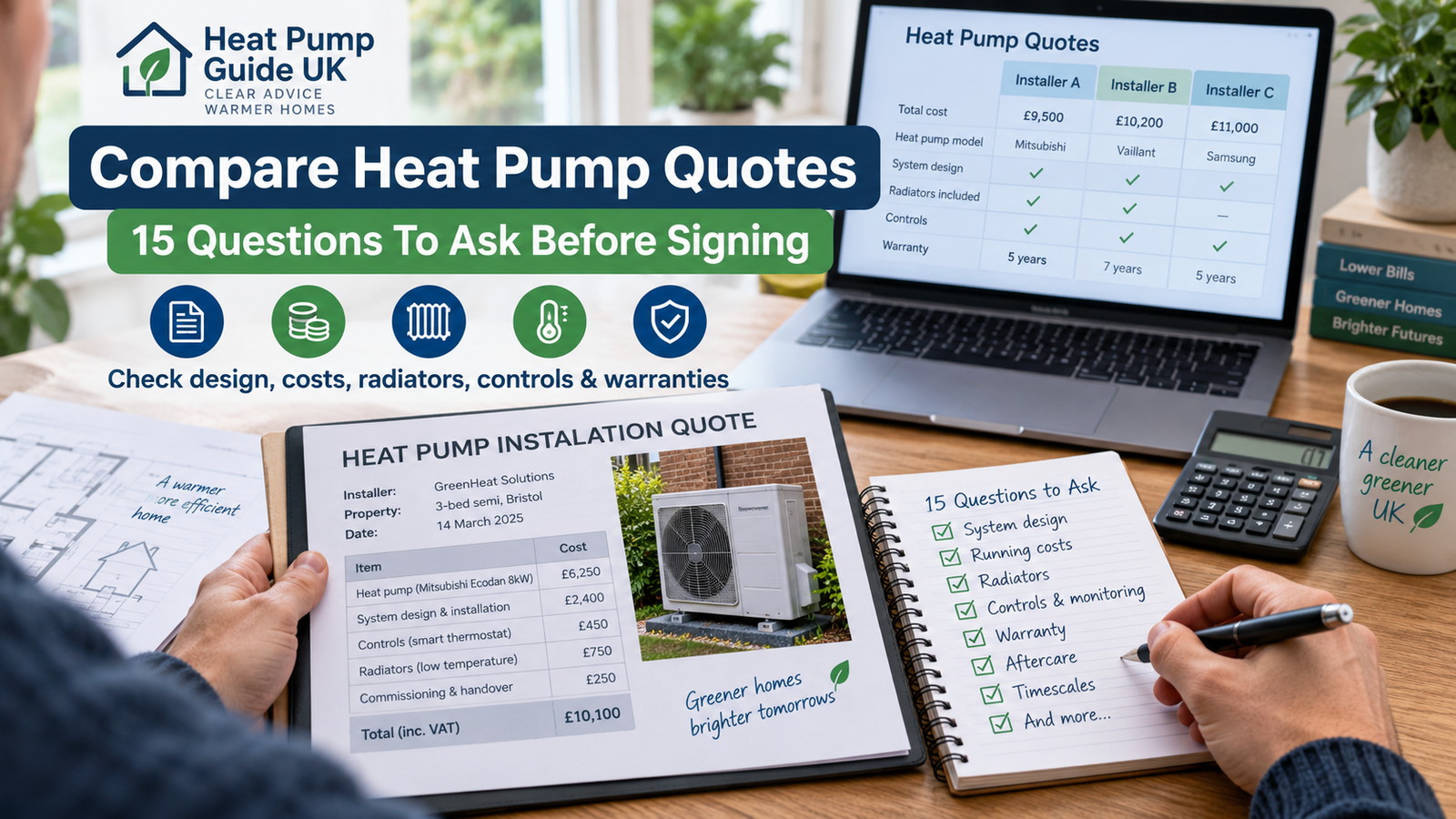
How to Compare Heat Pump Quotes: 15 Questions to Ask Before Signing
Last updated: September 2026
Two heat pump installers can assess the same house and produce quotes that are thousands of pounds apart. The important question is not simply which one is cheapest, but what system has actually been designed and what the price includes.
Use these 15 questions to compare heat pump quotes on a like-for-like basis before signing a contract.

• Independent UK heat pump researcher
• Reviewed for accuracy
Quick Answer: How Should You Compare Heat Pump Quotes?
Start by getting quotes from at least three suitably qualified installers (see our guide to finding and comparing heat pump installers), then compare the design, specification and installation scope rather than looking only at the final price.
Government and Energy Saving Trust guidance also recommends obtaining multiple quotes rather than accepting the first offer.
Do not compare only the bottom line
A £10,000 quote and a £13,000 quote may not describe the same installation. One could include radiator upgrades, a new cylinder, electrical work, controls and commissioning while the other leaves several of those costs outside the headline price.
The 15 Questions to Ask Before Choosing a Heat Pump Installer
Ask every installer the same questions. Ideally, get the answers in writing so you can compare each proposal properly.
1. Have You Carried Out a Room-by-Room Heat-Loss Calculation?
This is one of the most important questions in the entire quote.
A heat pump should be sized around how much heat the property loses during cold conditions, not simply around the size of the existing boiler.
Ask whether the installer has calculated heat loss for each room and what design outdoor temperature has been used.
2. What Flow Temperature Has the System Been Designed For?
Flow temperature is the temperature of the water leaving an air-to-water heat pump for the heating system.
It matters because heat pumps generally operate more efficiently at lower flow temperatures.
Ask the installer:
- What is the proposed design flow temperature?
- Can the house reach the required room temperatures at that setting?
- What changes would allow the system to operate at a lower temperature?
Do not assume the lowest possible flow temperature is automatically the best design. The system still needs to heat the property properly on cold days.
3. Which Exact Heat Pump Model Is Included?
A quote saying only “8kW air source heat pump” is not enough.
Ask for:
- manufacturer;
- exact model number;
- rated capacity;
- relevant operating-temperature data;
- product warranty; and
- whether the quoted equipment is MCS certified where required.
This lets you compare equipment properly and helps prevent a different model being substituted later without explanation.
If you are still comparing manufacturers, see our Best Air Source Heat Pumps UK guide.
4. What Is the Predicted Seasonal Performance?
Ask what seasonal performance the installer expects from the proposed design.
MCS documentation includes a system performance estimate, and current MCS guidance requires relevant performance information to be provided before the contract is agreed.
The estimate should be based on the actual proposed system rather than a manufacturer’s best-case efficiency figure.
Why this matters
A heat pump with an impressive brochure efficiency can perform very differently once installed. Property heat loss, flow temperature, emitter sizing, controls, weather and installation quality all affect real-world results.
5. Which Radiators Need Replacing?
Do not accept a vague allowance such as “radiator upgrades included”.
Ask the installer to identify:
- which existing radiators can stay;
- which need replacing;
- the proposed replacement sizes or outputs; and
- whether pipework changes are required.
Different installers can make very different assumptions here, which is one reason quotations can vary substantially.
See our guide to whether you need new radiators for a heat pump.
6. Is a Hot-Water Cylinder Included?
If you currently have a combi boiler, moving to an air-to-water heat pump will usually involve a different approach to domestic hot water.
Ask whether the quotation includes:
- a new hot-water cylinder;
- the cylinder capacity;
- immersion heater;
- pipework changes;
- controls;
- removal of old equipment; and
- installation in the proposed location.
A cheap quote that excludes the cylinder is not directly comparable with one that includes a complete hot-water installation.
7. What Controls Are Included?
Controls can have a major influence on how comfortably and efficiently a heat pump operates.
Ask whether the quote includes:
- weather compensation;
- room controls;
- hot-water scheduling;
- app control where available;
- zoning;
- commissioning of the controls; and
- a homeowner handover explaining how to use them.
The important issue is not simply whether the controls are “smart”. They need to work properly with the heat-pump system.
8. Is All Electrical Work Included?
Some homes may need electrical work as part of a heat-pump installation.
Ask whether the quotation includes everything required, such as:
- new circuits;
- isolators;
- consumer-unit work where necessary;
- cabling;
- connections for immersion or backup heating; and
- any required electricity-supply assessment.
GOV.UK specifically recommends asking installers whether the electricity supply needs upgrading and whether any associated cost is included.
9. What Building Work and Making Good Are Included?
A heat pump installation can involve more than plumbing and electrical work.
Check who is responsible for:
- wall penetrations;
- external pipework;
- base or mounting arrangement;
- boxing-in pipework;
- removing redundant tanks or boiler equipment;
- making good walls and floors; and
- disposing of old equipment.
If another trade will be needed, find out whether that cost is already included.
10. What Is Specifically Excluded From the Price?
This question is often more revealing than asking what is included.
Ask the installer to provide a written exclusions list.
Potential exclusions might include:
- additional radiator changes discovered later;
- upgraded electrical supply;
- decorating;
- asbestos-related work;
- planning-related costs;
- structural work;
- additional pipework; or
- unexpected groundworks.
11. What Warranty and Aftercare Are Included?
Ask separately about the product warranty and the installer’s workmanship or installation guarantee.
Also ask:
- Who do you call if the system develops a fault?
- Does the installer provide the first service?
- What ongoing servicing is recommended?
- Are labour costs covered under warranty?
- What happens if the installer stops trading?
- Is remote monitoring available?
Post-installation support can be especially important because some problems are caused by setup or commissioning rather than failed equipment.
12. What Electricity Use and Running Costs Are Predicted?
Ask for an estimate based on the proposed system design rather than a generic statement that a heat pump will “save money”.
Useful figures include:
- estimated annual heat demand;
- predicted seasonal performance;
- estimated annual electricity consumption; and
- the assumptions used for any projected running cost.
The actual bill can still differ because weather, occupancy, hot-water use, tariffs and system operation vary.
Compare the wider numbers in our Heat Pump Running Costs UK guide.
13. How Does the Payment Schedule Work?
Before paying a deposit, understand exactly when each payment becomes due.
Ask:
- how much deposit is required;
- when subsequent payments are due;
- whether any payment is tied to equipment delivery;
- what happens if the specification changes;
- what cancellation rights apply; and
- how any Boiler Upgrade Scheme grant is shown.
If you are claiming the Boiler Upgrade Scheme, an MCS-certified installer normally applies for the grant and the support is reflected in the amount you pay.
14. What Is the Installation Timescale?
Ask for more than an approximate installation date.
You should understand:
- when the detailed design will be completed;
- when equipment will be ordered;
- the expected installation date;
- how many days work is expected to take;
- how long you may be without heating or hot water; and
- whether other trades need to attend separately.
GOV.UK also recommends asking how long the household is likely to be without heating or hot water during installation.
15. Are You MCS Certified for This Installation?
If you intend to use the Boiler Upgrade Scheme, your installer must meet the relevant MCS requirements.
Do not rely only on a logo on a website. Check the business and certification where appropriate.
MCS-certified installers are also required to belong to an approved consumer protection scheme such as RECC or HIES.
Following an MCS installation, you should receive the relevant commissioning documentation and certification.
Simple Heat Pump Quote Comparison Checklist
Before deciding, put each quote side by side and compare these items:
| Check | Quote A | Quote B | Quote C |
|---|---|---|---|
| Room-by-room heat loss completed | □ | □ | □ |
| Design flow temperature stated | □ | □ | □ |
| Exact heat pump model stated | □ | □ | □ |
| Seasonal performance estimate | □ | □ | □ |
| Radiator changes specified | □ | □ | □ |
| Hot-water cylinder included | □ | □ | □ |
| Electrical work included | □ | □ | □ |
| Controls specified | □ | □ | □ |
| Exclusions clearly listed | □ | □ | □ |
| Warranty and aftercare stated | □ | □ | □ |
| Total price after grant | £ | £ | £ |
Red Flags When Comparing Heat Pump Quotes
I would be particularly cautious if an installer:
- pressures you to sign immediately;
- offers a large same-day discount;
- cannot explain how the heat pump has been sized;
- does not provide a clear equipment specification;
- avoids discussing design flow temperature;
- provides no meaningful radiator assessment;
- promises specific savings without explaining the assumptions;
- has large unspecified allowances in the quotation; or
- will not provide key commitments in writing.
Government consumer guidance specifically warns against businesses that pressure customers into signing or offer cheaper deals only if they commit immediately.
Is the Cheapest Heat Pump Quote the Best?
Not necessarily.
The cheapest quotation may still represent excellent value if the system is well designed and everything you need is included. Equally, the most expensive quotation is not automatically the best.
The objective is to identify which installer has proposed the most appropriate whole heating system for the property at a fair price.
System design, property heat loss, flow temperature, emitter sizing, controls, installation quality and commissioning can all affect comfort and eventual running costs.
Heat Pump Quote FAQ
How many heat pump quotes should I get?
Getting at least three quotes is a sensible starting point. Government and Energy Saving Trust advice also recommends comparing several suitably qualified installers rather than relying on a single quotation.
What should a heat pump quote include?
A good quotation should clearly identify the proposed heat pump, system design, relevant radiator or emitter changes, hot-water equipment, controls, electrical and installation work, warranties, exclusions and total price.
Should a heat-loss calculation be included?
A detailed heat-loss assessment is fundamental to designing a suitable heat-pump system. The final design should be based on the heat requirements of the property rather than simply copying the output of the existing boiler.
Why do heat pump quotes vary so much?
Quotes can vary because installers specify different heat pumps, radiators, cylinders, controls, electrical work and installation scopes. Different assumptions about the property and system design can also change the price substantially.
Do I need an MCS installer?
If you want to use the Boiler Upgrade Scheme, the installer and installation must meet the relevant MCS requirements. MCS certification also provides an established framework for design, installation and consumer protection.
Sources & Further Reading
Related Guides
Compare the Whole Installation, Not Just the Price
A good quote should make it clear what system is being installed, how it has been designed and exactly what your money is paying for.