
INDOOR & OUTDOOR AC POSITIONING
Air Conditioning Unit Positioning UK
Where your air conditioner is installed affects comfort, airflow, noise, servicing and even how much pipework is needed. See what to consider before agreeing the position of indoor and outdoor AC units.
QUICK ANSWER
Where Is the Best Place to Put an Air Conditioning Unit?
For a typical wall-mounted split system, the indoor unit is usually positioned high on a solid wall where it can move air across the room without blowing directly at people.
The outdoor unit needs good airflow, suitable clearance, a solid mounting position, drainage and access for servicing. It should also be positioned with neighbour noise and planning requirements in mind.
There is no universal “best wall” or universal clearance measurement for every AC system. The final position needs to work with the exact equipment, room layout, pipe routes and manufacturer’s installation instructions.
INDOOR UNIT
Where Should a Wall-Mounted Air Conditioner Go?
The goal is to allow conditioned air to travel through the occupied space without being blocked or creating an uncomfortable draught.
Current Daikin UK guidance recommends positioning a wall-mounted unit high on a solid wall and, where practical, centrally along the room’s longer dimension so air can travel across the space.
It also advises against placing the unit where curtains, furniture or large cupboards obstruct airflow.
Exact positioning should still be confirmed by the installer because refrigerant pipework, condensate drainage and the construction of the wall also matter.

ROOM COMFORT
Good and Poor Indoor Unit Positions
Usually Better Positions
- High on an unobstructed wall
- Where airflow can travel across the room
- Above a doorway where the room layout suits it
- Away from strong direct sunlight
- Accessible for filter cleaning and servicing
- Where condensate can be drained effectively
Positions Worth Avoiding
- Directly above the head of a bed
- Directly over a sofa or desk where occupants sit for long periods
- Behind curtains or tall furniture
- Above large wardrobes that block airflow
- Close to strong heat sources
- Where maintenance access would be difficult
AVOID DIRECT DRAUGHTS
Should an Air Conditioner Be Positioned Above a Bed or Sofa?
Generally, it is better to avoid directing conditioned air continuously onto someone sitting or sleeping directly below the unit.
Daikin’s current UK guidance specifically advises against positioning a wall-mounted unit above the head of a bed or directly over a sofa where possible.
The issue is primarily comfort. Even when the room temperature is appropriate, concentrated airflow onto one person can feel cold or draughty.
A position that lets the air travel through the wider room usually gives a more even result.
For Bedrooms, Prioritise:
- Airflow across rather than directly onto the bed
- Low indoor sound levels
- Easy access to filters
- Minimal visible trunking where possible
- A practical condensate drain route
AIRFLOW
What About Doors, Windows and Natural Airflow?
Indoor-unit positioning needs to work with the way air already moves through the room.
Avoid Opposing Airflows
Daikin advises avoiding positions directly opposite doors or windows where natural airflow can work against the air conditioner’s discharge.
Think About Open-Plan Spaces
In a long or open-plan room, the unit should be positioned so its airflow reaches the occupied area rather than disappearing immediately into an adjoining space.
Don’t Rely on Air Travelling Around Corners
One indoor unit cannot always cool several separated rooms effectively simply because their doors are open.
TEMPERATURE SENSING
Keep the Indoor Unit Away From Heat Sources
Indoor air conditioners use temperature sensing to control output.
Positioning the unit beside significant heat-producing equipment can make the air around the sensor less representative of the wider room.
Daikin advises keeping indoor units away from heat sources and direct sunlight because these can make the system work harder than necessary.
Potential sources include strong solar gain, lighting, televisions, computers and other equipment producing concentrated heat.
Think About:
- Direct afternoon sunlight
- Large televisions
- Computer equipment
- Kitchen heat
- Strong artificial lighting
- Other appliances producing continuous heat
OUTDOOR UNIT
Where Should the Outdoor Air Conditioning Unit Go?
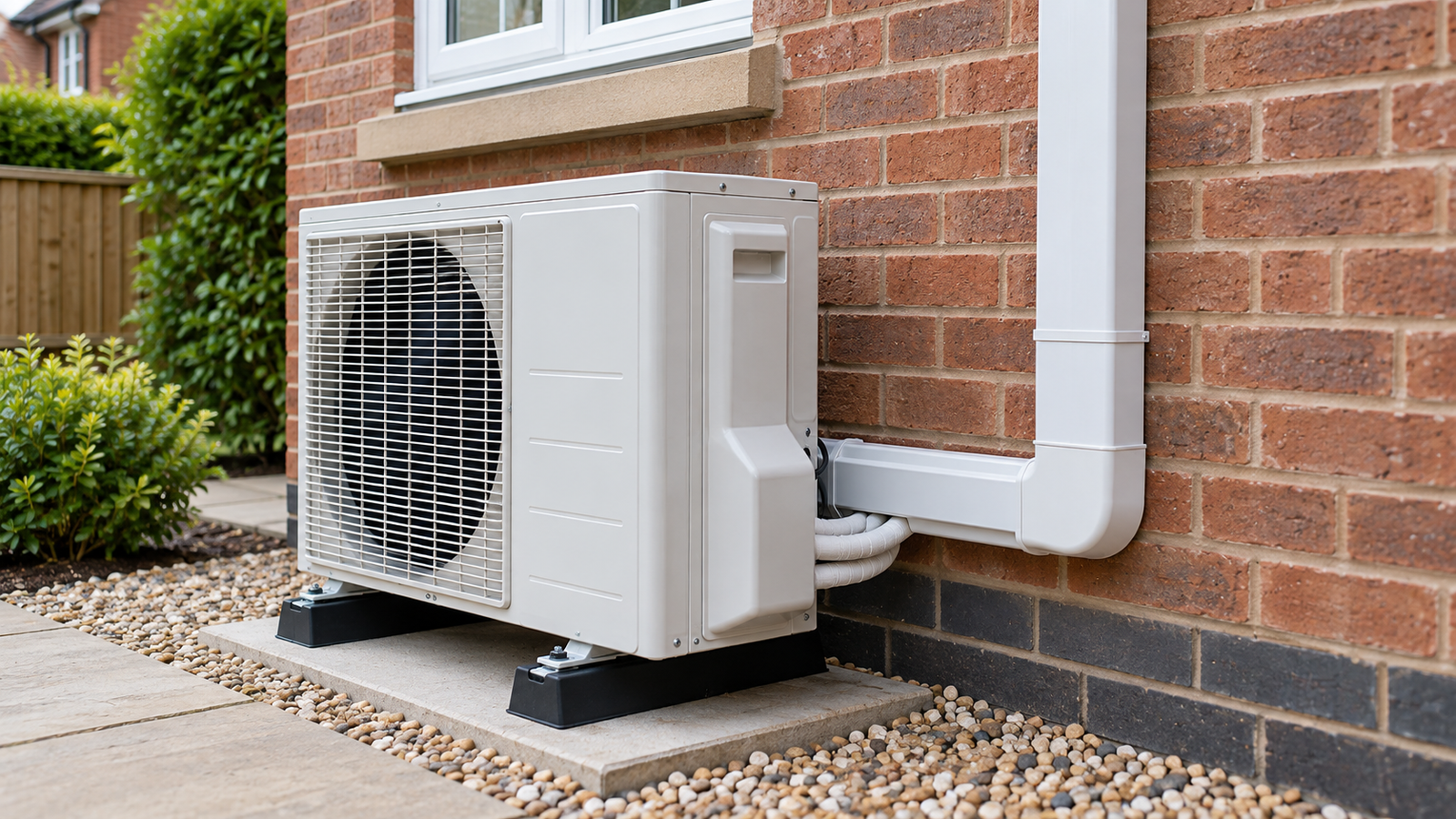
The outdoor unit needs to take in outdoor air and discharge heat effectively, so it should not be boxed into a tight space.
Manufacturer guidance typically requires clearances around the equipment, but those distances vary between models and installation arrangements.
The unit also needs to be accessible for servicing, positioned on a suitable support and kept reasonably clear of vegetation, leaves and other material that could restrict airflow.
Noise, appearance, drainage and planning considerations should all be assessed before the final position is agreed.
OUTDOOR LOCATION CHECKLIST
A Good Outdoor Position Needs More Than an Empty Patch of Wall
Clear Airflow
Both the air inlet and discharge need enough unobstructed space for the specific unit.
Service Access
An engineer should be able to inspect and service the equipment safely without dismantling permanent structures.
Stable Mounting
The wall bracket, ground stand or mounting base needs to support the equipment without excessive vibration.
Neighbour Noise
Consider nearby bedroom windows, neighbouring properties and positions where walls or corners may reflect sound.
Vegetation & Debris
Leaves, shrubs and other obstructions should not be allowed to block the outdoor heat exchanger or airflow.
Drainage
Reversible systems can produce condensate or defrost water outdoors during heating, so drainage around the unit also matters.
IMPORTANT
How Much Clearance Does an Outdoor AC Unit Need?
There is no single clearance figure that should be applied to every air conditioner.
Daikin’s homeowner guidance describes clear airflow as essential and gives broad examples of around 200–300mm from walls in some small-room applications. Other current Daikin guidance recommends considerably greater clearance around air inlets and outlets depending on the configuration.
Current installation manuals contain model-specific diagrams with different distances depending on which sides are obstructed.
The correct approach is therefore to use the manufacturer’s installation instructions for the exact outdoor unit being fitted, rather than copying a generic number from an online guide.
NOISE
Outdoor Unit Position Can Change How Noise Is Experienced
Published sound levels are important, but the physical position of the condenser matters too.
Daikin advises considering nearby bedrooms and avoiding corners or obstructions where sound and vibration may be amplified.
Mounting arrangements also matter. Anti-vibration measures and a solid support can help avoid transmitting unnecessary vibration into the building.
For an installation relying on permitted development rights, the applicable planning and MCS sound requirements may also affect where the unit can be positioned.
Avoid Treating Noise as an Afterthought
- Check neighbouring bedroom windows.
- Consider your own bedrooms too.
- Avoid unnecessarily enclosed corners.
- Use appropriate anti-vibration mounting.
- Check planning sound requirements where applicable.
PIPEWORK & DRAINAGE
The Neatest Position Is Not Always the Best Technical Position
Indoor and outdoor equipment need to be connected by refrigerant pipework, electrical cabling and normally a condensate drain.
Refrigerant Pipework
The route needs to remain within the manufacturer’s permitted pipe lengths and height differences for the selected system.
Condensate Drainage
Indoor units produce water when cooling. Gravity drainage is often preferable where practical, while some layouts may need a condensate pump.
Visible Trunking
Ask where external or internal pipe covers will run before installation rather than discovering the route after holes have been drilled.
Compare Up to 3 Air Conditioning Installers Near You
Tell us a little about your property to see installer options available in your area.
Free to use with no obligation
BEFORE INSTALLATION
Agree Every Unit Position During the Survey
You should know where the equipment is going before work starts.
That includes not only the indoor and outdoor units, but also pipe covers, condensate drains, electrical isolators and any visible external trunking.
Moving equipment after installation can require refrigerant recovery, new pipework, drainage changes, wall repairs and recommissioning.
Ask the Installer to Show You:
- Exact indoor-unit position
- Exact outdoor-unit position
- Air discharge direction
- Pipework route
- Condensate route
- External trunking
- Electrical isolator position
- Maintenance access
MULTIPLE ROOMS
Positioning Gets More Important With Multi-Room Air Conditioning
A multi-room system may involve indoor units on different floors or opposite sides of the property.
The installer then has to balance indoor airflow, outdoor-unit capacity, pipe lengths, drainage routes, exterior appearance and access.
That is why system layout should be considered as a whole rather than choosing an indoor-unit position in each room independently.
See our Whole House Air Conditioning UK and Single-Split vs Multi-Split Air Conditioning guides for multi-room design options.
THE BOTTOM LINE
Good AC Positioning Balances Comfort, Airflow and Installation Practicality
Indoor units should distribute air effectively without creating uncomfortable draughts or being blocked by furniture.
Outdoor units need clear airflow, suitable mounting, access and consideration for noise, drainage and planning.
The shortest pipe route should not automatically dictate the entire design, and neither should appearance alone.
The best installation is one where indoor comfort, technical requirements and the visual finish have all been considered before the installer starts drilling.
CONTINUE YOUR RESEARCH
Air Conditioning Installation Guides
Air Conditioning Installation UK
See the complete survey, installation and commissioning process.
AC Planning Permission UK
Check how outdoor-unit position can affect planning.
Air Conditioner Size Guide
Understand how capacity should be selected for each room.
Single-Split vs Multi-Split
See how system architecture affects equipment positions.
Whole House Air Conditioning
Plan AC across several rooms or zones.
Ducted Air Conditioning UK
Compare concealed equipment with visible wall-mounted units.
Compare Air Conditioning Quotes
Check whether proposed positions and pipe routes are included clearly.
Air Conditioning Installers Near Me
Compare installers for your home project.
COMMON QUESTIONS
Frequently Asked Questions
Where should a wall-mounted air conditioner be positioned?
It is generally positioned high on a solid wall where air can move freely across the room. Avoid blocked areas and positions that direct airflow continuously onto beds, sofas or desks.
Can an air conditioner go above a bed?
It can sometimes be physically installed there, but it is generally better to avoid positioning the unit directly above the head of the bed because the airflow can create an uncomfortable draught while sleeping.
How far should an outdoor AC unit be from a wall?
There is no universal distance for every system. Clearance requirements depend on the exact outdoor unit and which sides are obstructed. Follow the manufacturer’s installation instructions for the model being fitted.
Can the outdoor AC unit go beside a neighbour’s window?
The position should consider noise impact, planning requirements and manufacturer guidance. A location close to a neighbour’s habitable-room window deserves particular scrutiny before installation.
INDEPENDENT GUIDANCE
About the Author

David Tooth
Independent UK heat pump researcher
Heat Pump Guide UK provides independent information to help homeowners understand air conditioning, heat pumps, system design, running costs and installation decisions.
Final unit positions depend on the exact equipment, manufacturer requirements, building construction, room layout, airflow, drainage, pipework and planning considerations.
Sources and Further Information
- Daikin UK — Choosing an air conditioner location
- Daikin UK — Indoor and outdoor placement guidance
- Daikin UK — Indoor unit positioning guidance
Positioning guidance checked September 2026. Installation clearances, maximum pipe lengths and mounting requirements vary by exact equipment. The manufacturer’s current installation manual takes precedence over generic guidance.