
PLANNING & HOME AIR CONDITIONING
Air Conditioning Planning Permission UK
Do you need permission before fitting fixed air conditioning to your home? The answer depends on where you live, whether the system can heat as well as cool, where the outdoor unit goes and whether the property has planning restrictions.
QUICK ANSWER
Do You Need Planning Permission for Home Air Conditioning?
Not always. Some domestic fixed air-conditioning systems can fall within permitted development rights, meaning a separate planning application is not required if all of the relevant conditions are met.
However, the rules are not identical across England, Wales, Scotland and Northern Ireland.
A particularly important distinction is whether the equipment is a reversible air-to-air heat pump providing heating and cooling or a cooling-only air-conditioning system.
In England and Wales, current permitted development rights can cover qualifying air-source heat pumps that provide heating or heating and cooling. Cooling-only equipment does not benefit from those heat-pump permitted development rights.
If there is any doubt, check with your local planning authority before installation.
AIR CONDITIONING OR HEAT PUMP?
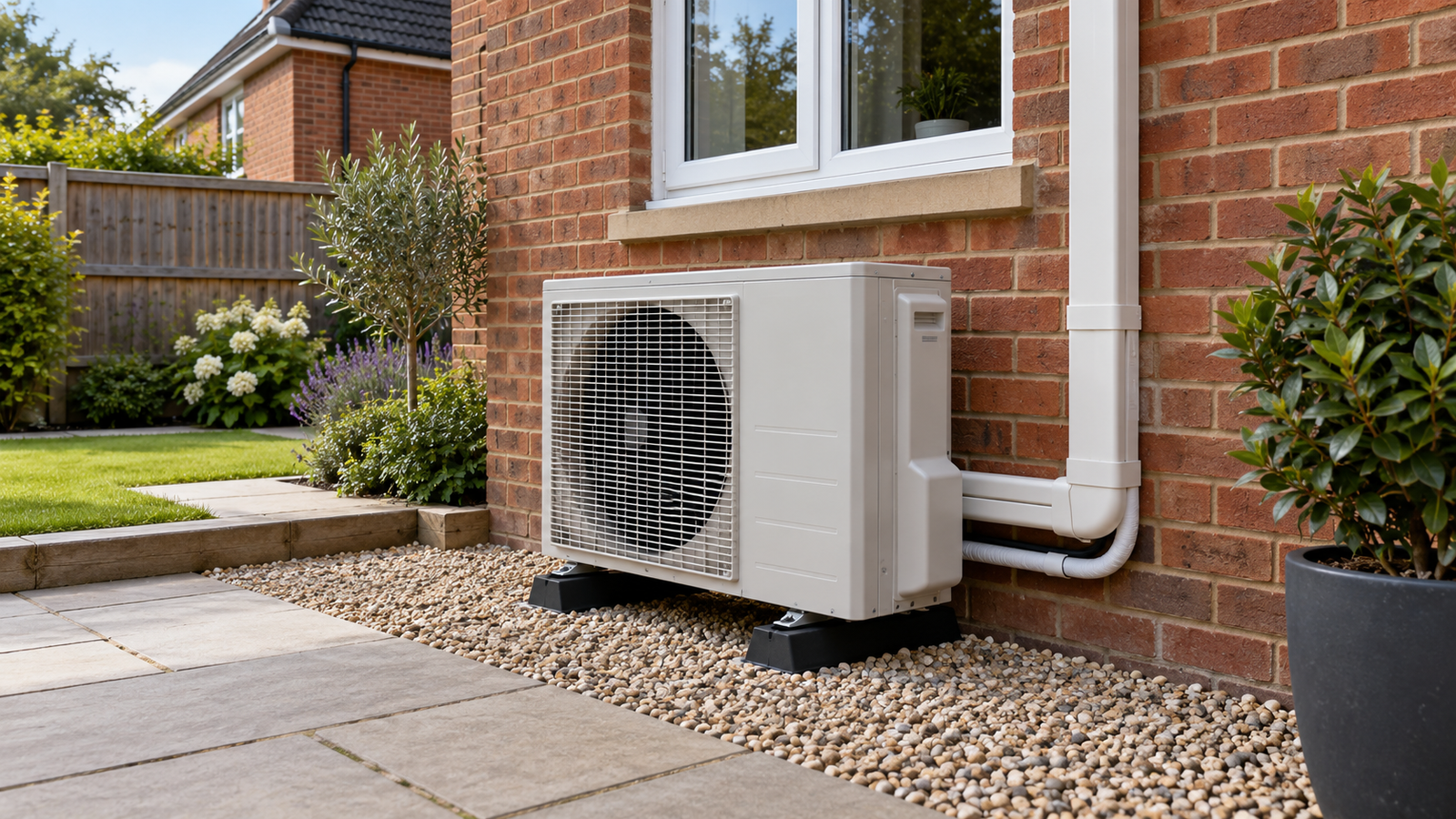
Many Modern Split Air Conditioners Are Also Air-to-Air Heat Pumps
Most modern fixed split air conditioners are reversible. They can remove heat from the home in summer and reverse the refrigeration cycle to provide warm air in winter.
That distinction matters for planning because permitted development rules relating to domestic air-source heat pumps may apply to qualifying reversible systems.
A unit that is designed solely to provide cooling can fall outside those rights.
Do not assume that simply calling equipment an “air conditioner” or a “heat pump” determines its planning status. The actual function, installation and property circumstances matter.
UK RULES
Planning Rules Differ Across the UK
Planning is devolved, so do not rely on guidance written for another UK nation.
England
Domestic air-source heat pumps can qualify as permitted development where all Class G requirements are satisfied.
Changes introduced in May 2025 widened the rules to include air-source heat pumps capable of heating and cooling, which brought qualifying air-to-air systems within the permitted development framework.
Cooling-only units are not covered by this particular permitted development right.
Wales
Domestic air-source heat-pump permitted development rights were updated on 1 June 2026.
Qualifying equipment can be used for heating or heating and cooling. A unit designed solely for cooling does not qualify under these heat-pump rights.
The Welsh rules also contain restrictions relating to unit size, number, roof position, listed buildings, conservation areas and proximity or visibility to highways.
Scotland
Scotland has separate permitted development rights for domestic air-source heat pumps under Class 6H.
The current Scottish conditions state that equipment benefiting from those rights must be used for domestic heating or hot water. The rules therefore differ from the newer England and Wales provisions that expressly accommodate heating-and-cooling systems.
Check the proposed use and installation with the local planning authority before relying on permitted development rights for reversible AC.
Northern Ireland
Northern Ireland also has permitted development provisions for domestic air-source heat pumps, subject to limits and conditions including location, boundaries, roof installation, listed buildings and protected areas.
If you are unsure whether your proposed AC system falls within those rights, contact the planning office for your council before work begins.
ENGLAND
When Can Air-to-Air AC Be Permitted Development in England?
The current England rules are significantly more accommodating than they were before May 2025.
Heating + Cooling Is Allowed
A qualifying air-source heat pump can now provide cooling as well as heating and still potentially benefit from permitted development rights.
Cooling-Only Is Different
The permitted development right does not extend to equipment used solely for cooling.
MCS Planning Standards Apply
The installation must comply with the relevant MCS planning standard, including the required sound assessment methodology.
Up to Two on a Detached House
Current rules can allow up to two qualifying air-source heat pumps on or within the curtilage of a detached dwellinghouse.
One on Other Homes
Non-detached houses and blocks of flats remain subject to tighter limits on the number of qualifying units.
Unit Size Is Limited
For dwellinghouses, the outdoor compressor unit including housing must remain within the current permitted-development volume limit.
The May 2025 changes also removed the previous blanket one-metre-from-boundary rule for qualifying domestic air-source heat pumps in England.
CHECK BEFORE INSTALLING
When Is Planning Permission More Likely to Be Needed?
Permitted development is conditional. Falling outside the relevant conditions does not necessarily mean the installation will be refused — it means a planning application may be required.
Cooling-Only Equipment
In England and Wales, cooling-only AC cannot rely on the heat-pump permitted development right used by qualifying heating-and-cooling systems.
Listed Buildings
Listed properties have additional controls. Planning permission and/or listed building consent may be required depending on the work.
Conservation Areas
Permitted development rights can be more restricted, particularly where equipment is visible from public roads or affects a protected elevation.
Flats & Maisonettes
Rights and restrictions can differ from ordinary houses, and leasehold or freeholder approval may also be relevant.
Prominent Outdoor Locations
Roof mounting, front elevations and highly visible positions can face tighter restrictions depending on the country and property.
Multiple Outdoor Units
The number of permitted units is limited, so multi-room installations using several condensers need particular attention.
NOISE & NEIGHBOURS
Planning Is Not Just About What the Outdoor Unit Looks Like
Noise is one of the reasons planning rules place conditions on the position and specification of external heat-pump equipment.
For an installation relying on heat-pump permitted development rights in England, the relevant MCS planning standard includes a sound calculation intended to assess impact at neighbouring habitable-room windows or doors.
The position of the condenser therefore matters even where planning permission is not required.
Walls, corners and enclosed spaces can also affect how sound is experienced, so equipment should not simply be placed wherever the shortest pipe run happens to be.
ASK THE INSTALLER
Before Agreeing the Outdoor Position
- Is this location compliant with the applicable planning rules?
- Has neighbour noise been considered?
- Will an MCS planning sound assessment be needed?
- Can the unit be accessed for servicing?
- Will pipework or trunking be visible from the road?
- Could another location reduce visual or noise impact?
DON’T CONFUSE THE DIFFERENT APPROVALS
No Planning Application Does Not Mean “No Rules”
Planning Permission
Controls the development and its impact on matters such as appearance, location and neighbouring amenity.
Building Regulations
These are separate from planning. Installation work can still need to comply with applicable building and electrical requirements even where planning permission is not required.
Lease or Freeholder Consent
Leasehold properties can require permission from a landlord, freeholder or management company independently of the planning system.
FLATS & LEASEHOLD HOMES
Planning Permission May Be Only One of the Issues
If you live in a flat, the outside wall, roof or balcony where you want to position the condenser may not legally belong to you in the same way as the internal space.
Your lease may restrict alterations, external equipment or penetrations through the building fabric.
You may therefore need consent from a landlord, freeholder or management company even where the planning system itself would allow the work.
Check this before ordering equipment or paying a non-refundable installation deposit.
For a Flat, Check:
- Planning status
- Lease restrictions
- Freeholder or management-company consent
- External wall ownership
- Noise impact on nearby flats
- Safe and practical service access
- Condensate drainage route
BEFORE YOU INSTALL
How to Check Whether Your AC Needs Planning Permission
Confirm the System Type
Find out whether the equipment is cooling-only or a reversible air-to-air heat pump providing heating and cooling.
Confirm the Outdoor Position
Establish exactly where the condenser, mounting equipment and external pipework will be located.
Check the Property
Identify whether it is listed, in a conservation area, a flat, leasehold or subject to other planning restrictions.
Ask the Installer
A competent installer should be able to explain whether the proposed installation is intended to rely on permitted development rights.
Check With the Council
If the position is unclear, ask the local planning authority rather than relying on an assumption after the equipment has been fitted.
Keep the Evidence
Retain system details, plans, sound calculations and any written planning or freeholder confirmation relevant to the installation.
PLANNING YOUR INSTALLATION
Agree the Outdoor Unit Position Before Work Starts
Moving the condenser after installation can mean altering pipework, drainage, electrics and mounting arrangements.
Before accepting a proposal, make sure you know exactly where the outdoor unit will go and whether that position creates any planning, noise, appearance or access issues.
Our Air Conditioning Installation UK guide explains the full survey, installation and commissioning process.
Compare Up to 3 Air Conditioning Installers Near You
Tell us a little about your property to see installer options available in your area.
Free to use with no obligation
CONTINUE YOUR RESEARCH
Air Conditioning Installation Guides
Air Conditioning Installation UK
See what happens from survey through to commissioning.
Air Conditioning Installers Near Me
Compare installer options serving your area.
Compare Air Conditioning Quotes
Check the complete specification before choosing an installer.
Best Home Air Conditioning Systems
Compare fixed system types for UK homes.
Single-Split vs Multi-Split
See how the number of outdoor units changes with system design.
Air Conditioner Size Guide
Understand how cooling capacity should be selected.
Air Conditioning Cost UK
Understand the main factors affecting installation price.
Home Air Conditioning UK
Read our main guide to home cooling options.
COMMON QUESTIONS
Frequently Asked Questions
Do I need planning permission for air conditioning in England?
Not necessarily. A qualifying reversible air-source heat pump that provides heating and cooling can benefit from permitted development rights if all relevant Class G conditions are met. Cooling-only equipment cannot rely on that particular permitted development right.
Does air conditioning need planning permission in a conservation area?
Additional restrictions apply in conservation areas and differ between UK nations. The proposed position of the outdoor unit is particularly important, so check with the relevant planning authority before installation.
Do I need planning permission for air conditioning in a flat?
Possibly. Planning rights differ for flats, and you may also need separate consent from the freeholder, landlord or management company before attaching equipment or running pipework through communal or external parts of the building.
Does a reversible air conditioner count as a heat pump?
Technically, a reversible split air conditioner is an air-to-air heat pump because it can move heat in either direction. Whether it qualifies for a particular planning right depends on the legal conditions applying in that part of the UK.
INDEPENDENT GUIDANCE
About the Author

David Tooth
Independent UK heat pump researcher
Heat Pump Guide UK provides independent guidance to help homeowners understand air conditioning, heat pumps, installation requirements, costs and system choices.
Planning rules depend on the property, proposed equipment, location and UK nation. This guide provides general information rather than a formal planning determination.
Sources and Further Information
- Planning Portal — Home air conditioning and planning permission
- England — 2025 amendment to air-source heat-pump permitted development rights
- GOV.WALES — Domestic heat-pump planning permission
- Scottish Government — Householder permitted development rights for air-source heat pumps
- Northern Ireland — Air-source heat-pump permitted development rules
Planning information checked September 2026. Planning rules and permitted development rights can change. Where the planning status of a specific installation is uncertain, confirm it with the relevant local planning authority before work begins.