
Heat Pump Guide UK Research
UK Heat Pump Running Cost Index: Autumn 2026
Our independent analysis of current UK energy prices shows that an air source heat pump operating at a seasonal efficiency of around SCOP 2.97 would broadly match the fuel cost of a 90%-efficient gas boiler under the October–December 2026 energy price cap.
Average electricity unit rate used in the analysis.
Average gas unit rate used in the analysis.
Calculated heat-pump break-even point against a 90%-efficient gas boiler.
Headline finding
A Heat Pump Needs a SCOP of About 3.0 to Match Gas on Fuel Cost
Using Ofgem’s average Direct Debit unit rates applying from 1 October to 31 December 2026, our calculation puts fuel-cost parity with a 90%-efficient gas boiler at a heat-pump seasonal coefficient of performance of approximately 2.97.
Put more simply, a heat pump averaging around three units of useful heat for every unit of electricity consumed would have a similar energy cost per useful kilowatt-hour of heat to the illustrative gas boiler used in this comparison.
A heat pump performing above that level would have a lower calculated fuel cost per unit of useful heat. A system operating below it would have a higher calculated fuel cost.
This is a fuel-cost comparison only. It is not a prediction of an individual household’s annual bill or a guarantee that a heat pump will be cheaper than gas.
Autumn 2026 index
Heat Pump vs Gas Boiler: Cost per Useful kWh of Heat
The graphic below compares the calculated cost of producing one useful kilowatt-hour of heat at different heat-pump efficiency levels with an illustrative 90%-efficient gas boiler.
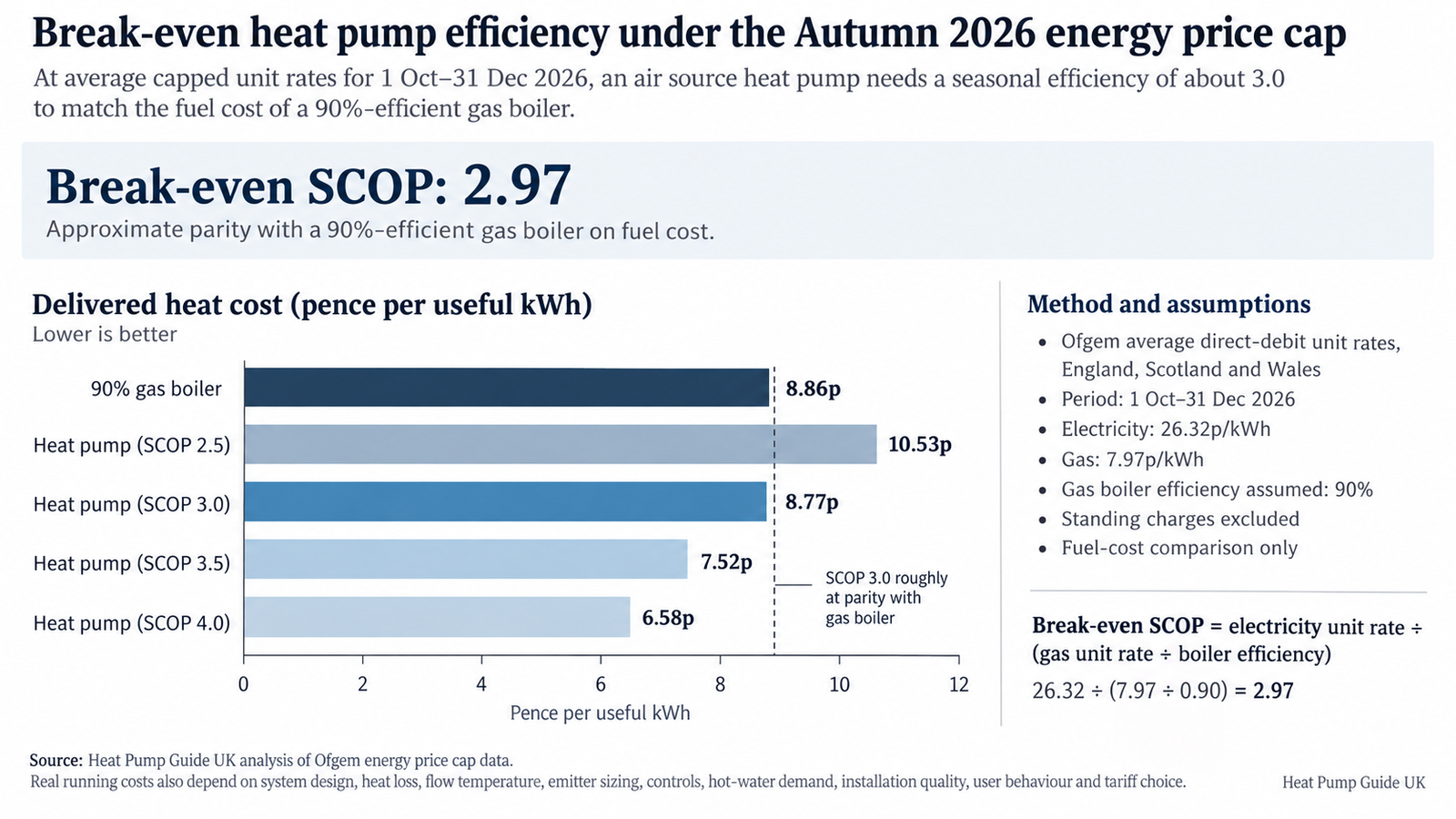
Autumn 2026 Delivered Heat Cost Comparison
Electricity costs considerably more per purchased kilowatt-hour than gas, but heat pumps can deliver several units of useful heat for each unit of electricity consumed. The relevant comparison is therefore the cost of useful heat rather than the headline fuel unit rate alone.
| Heating system | Assumed efficiency | Fuel unit rate | Calculated cost per useful kWh |
|---|---|---|---|
| Gas boiler | 90% | 7.97p/kWh gas | 8.86p |
| Air source heat pump | SCOP 2.5 | 26.32p/kWh electricity | 10.53p |
| Air source heat pump | SCOP 3.0 | 26.32p/kWh electricity | 8.77p |
| Air source heat pump | SCOP 3.5 | 26.32p/kWh electricity | 7.52p |
| Air source heat pump | SCOP 4.0 | 26.32p/kWh electricity | 6.58p |
These figures describe the theoretical fuel cost of delivering useful heat under the assumptions shown. They do not include standing charges, maintenance, installation cost, finance, servicing or other household energy use.
Methodology
How the Break-Even SCOP Is Calculated
The comparison starts by converting the gas unit price into a cost per useful kilowatt-hour of heat.
A boiler operating at 90% efficiency does not turn every purchased kilowatt-hour of gas into useful room heat. At a gas unit price of 7.97p/kWh:
Gas useful heat cost:
7.97p ÷ 0.90 = approximately 8.86p per useful kWh
A heat pump’s useful heat cost is calculated by dividing its electricity unit price by its seasonal efficiency.
The point where the two calculated heat costs are equal is:
Break-even SCOP:
26.32 ÷ (7.97 ÷ 0.90) = approximately 2.97
Quarter-on-quarter change
The Break-Even Point Has Fallen From About 3.21 to 2.97
Under the July–September 2026 Ofgem average Direct Debit rates of 26.11p/kWh for electricity and 7.33p/kWh for gas, the equivalent break-even point against the same 90%-efficient gas boiler was approximately SCOP 3.21.
For October–December 2026, the calculated threshold falls to approximately SCOP 2.97.
July–September 2026
Break-even SCOP: 3.21
Electricity: 26.11p/kWh
Gas: 7.33p/kWh
October–December 2026
Break-even SCOP: 2.97
Electricity: 26.32p/kWh
Gas: 7.97p/kWh
This does not mean heat pumps have suddenly become universally cheaper than gas.
Ofgem states that electricity VAT has been temporarily removed between 1 October 2026 and 31 March 2027, while gas continues to include 5% VAT. Gas unit prices also changed between the two cap periods. These policy and price changes affect the calculated relationship between the two fuels.
Ofgem therefore cautions that costs cannot be compared directly with earlier periods without taking the VAT change into account.
What Does a SCOP of 3.0 Mean?
SCOP stands for Seasonal Coefficient of Performance. In simplified terms, a SCOP of 3.0 means that over the relevant heating season the heat pump delivers around three units of useful heat for every unit of electricity consumed.
It is different from a headline COP measured under one particular test condition. Seasonal performance reflects operation across changing outdoor temperatures and heating conditions.
The important point for household running costs is that the efficiency achieved by the whole heating system matters far more than the manufacturer’s maximum headline efficiency figure.
For a broader explanation of electricity consumption, annual bills and the factors that can make one property cost substantially more than another, see our
air source heat pump running costs guide.
Why Your Actual Heat Pump Running Cost May Be Different
The index isolates the relationship between fuel price and heating efficiency. A real home’s running cost depends on considerably more than those two numbers.
Property Heat Loss
A home that needs substantially more heat will consume more energy regardless of the heating technology used.
Flow Temperature
Heat pumps generally operate more efficiently when they can supply the home using lower heating-water temperatures.
Radiator & Emitter Sizing
Suitable radiators or underfloor heating can help a system deliver enough heat without unnecessarily high flow temperatures.
System Design
Heat-loss calculations, sizing, hydraulic design, commissioning and controls can materially affect performance.
Hot-Water Demand
Domestic hot water often requires different operating temperatures and can affect overall seasonal efficiency.
Electricity Tariff
The Ofgem average rate used here will not match every household. Fixed, time-of-use and specialist heat-pump tariffs can produce different results.
What This Index Does — and Does Not — Tell You
It Does
- Compare current average electricity and gas unit costs on a useful-heat basis.
- Show the heat-pump seasonal efficiency required to reach approximate fuel-cost parity.
- Provide a repeatable benchmark that can be updated as energy prices change.
- Help explain why heat-pump efficiency matters when comparing running costs.
It Does Not
- Predict the annual bill for a specific home.
- Guarantee that a heat pump will cost less than gas.
- Include installation cost, servicing or finance.
- Account for every regional tariff or specialist electricity deal.
- Measure the actual efficiency of a particular installed system.
Example: A Home Requiring 10,000kWh of Useful Heat
To make the figures easier to interpret, the table below applies the same unit rates to an illustrative annual space-heating requirement of 10,000kWh.
| Heating system | Efficiency | Purchased energy required | Illustrative fuel cost |
|---|---|---|---|
| Gas boiler | 90% | 11,111kWh gas | Approx. £886 |
| Heat pump | SCOP 2.5 | 4,000kWh electricity | Approx. £1,053 |
| Heat pump | SCOP 3.0 | 3,333kWh electricity | Approx. £877 |
| Heat pump | SCOP 3.5 | 2,857kWh electricity | Approx. £752 |
| Heat pump | SCOP 4.0 | 2,500kWh electricity | Approx. £658 |
These are simplified examples rather than forecasts. Actual heat demand varies greatly between properties, and domestic hot water, heating schedules, weather and system operation can all change consumption.
Independent research
Why We Created the Heat Pump Running Cost Index
Discussions about whether heat pumps are cheaper or more expensive to run than gas can become misleading when they compare electricity and gas unit prices without accounting for the different efficiencies of the two heating technologies.
The Heat Pump Guide UK Running Cost Index provides a repeatable benchmark based on a simple question:
At current average energy prices, what seasonal efficiency would a heat pump need to achieve for its fuel cost per useful unit of heat to match an illustrative modern gas boiler?
We intend to update this page when new Ofgem price-cap periods materially change the comparison, allowing the index to show how the break-even point moves over time.
For homeowners considering the wider financial and practical implications of changing heating systems, our
guide to replacing a gas boiler with a heat pump
covers installation, radiators, hot water and system design in more detail.
For journalists and researchers
Using This Research
Journalists, researchers, manufacturers and industry organisations may reference the figures and graphic on this page with clear attribution to Heat Pump Guide UK.
Suggested attribution:
Source: Heat Pump Guide UK analysis of Ofgem energy price cap data.
When using the break-even figure, please retain the core assumptions: average Direct Debit unit rates, a 90%-efficient gas boiler, standing charges excluded and a fuel-cost comparison only.
Related Heat Pump Research & Guides
Sources
Research Sources
- Ofgem — Energy price cap unit rates and standing charges, 1 October to 31 December 2026.
- Ofgem — Changes to the energy price cap between 1 October and 31 December 2026, published 26 August 2026.
- Ofgem — Changes to the energy price cap between 1 July and 30 September 2026, published 27 May 2026.
Calculations are Heat Pump Guide UK analysis based on the published Ofgem average Direct Debit unit rates shown above.
Last reviewed: September 2026.